

sustainable livelihood framework (IPCC 2014a). Hence, climate change adaptation
interventions are designed not only to implement adaptation actions, but also to
change behavior at individual, household, community, country and international
levels. The TPB holds behavior to be an outcome of competing influences balanced
and decided upon by the individual. Direct influences are the behavioral intentions,
which are also influenced by attitudes towards the interventions, subjective norms
and perceived behavioral control. It should be noted that the TPB helps efforts to
identify cognitive targets for change, rather than offering suggestions on how these
cognitions might be changed (Hardeman et al. 2002; Morris et al. 2012).
In this project, researchers, governments and NGOs’ extension officers and
stakeholder communities’ members were convened in workshops to plan the
adaptation M&E, with the intention to use the most significant change technique.
These workshops allowed stakeholders in each country to discuss various domains
where intentional changes of behavior of participants in the planned field adaptation
activities were expected, and plan M&E activities accordingly. Stakeholders in
each country were asked to identify domains of their lifestyles that would change if
the CCAFS program was successful. The identified domains of change were
deliberately left fuzzy to allow people to have different interpretations of what
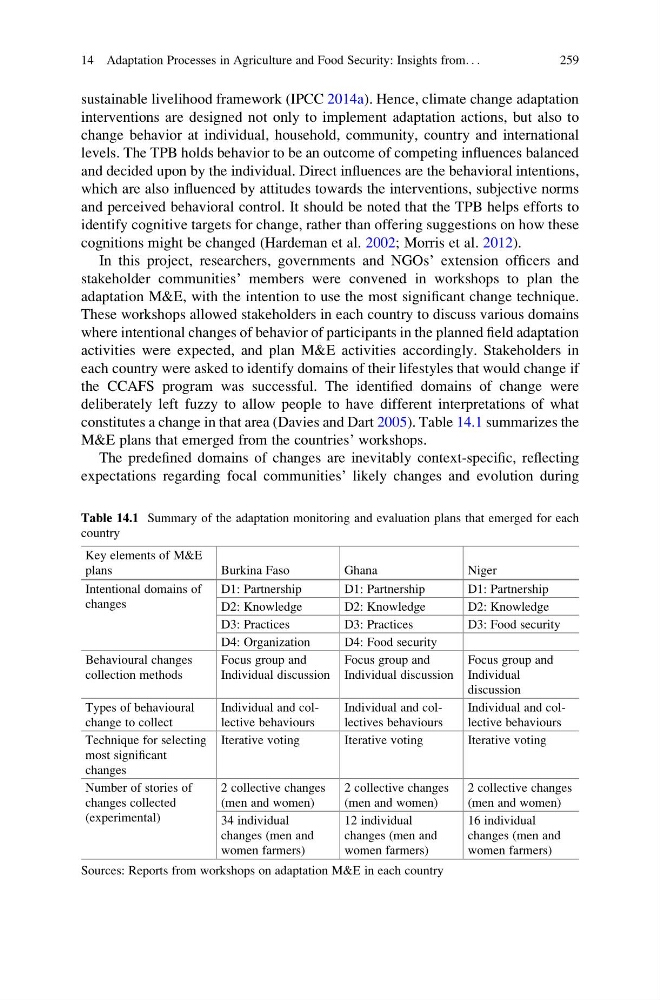
constitutes a change in that area (Davies and Dart 2005). Table 14.1 summarizes the
M&E plans that emerged from the countries’ workshops.
The predefined domains of changes are inevitably context-specific, reflecting
expectations regarding focal communities’ likely changes and evolution during
Table 14.1 Summary of the adaptation monitoring and evaluation plans that emerged for each
country
Key elements of M&E
plans
Burkina Faso
Ghana
Niger
Intentional domains of
changes
D1: Partnership
D1: Partnership
D1: Partnership
D2: Knowledge
D2: Knowledge
D2: Knowledge
D3: Practices
D3: Practices
D3: Food security
D4: Organization
D4: Food security
Behavioural changes
collection methods
Focus group and
Individual discussion
Focus group and
Individual discussion
Focus group and
Individual
discussion
Types of behavioural
change to collect
Individual and collective behaviours
Individual and collectives behaviours
Individual and collective behaviours
Technique for selecting
most significant
changes
Iterative voting
Iterative voting
Iterative voting
Number of stories of
changes collected
(experimental)
2 collective changes
(men and women)
2 collective changes
(men and women)
2 collective changes
(men and women)
34 individual
changes (men and
women farmers)
12 individual
changes (men and
women farmers)
16 individual
changes (men and
women farmers)
Sources: Reports from workshops on adaptation M&E in each country
14 Adaptation Processes in Agriculture and Food Security: Insights from. . .
259
interventions are designed not only to implement adaptation actions, but also to
change behavior at individual, household, community, country and international
levels. The TPB holds behavior to be an outcome of competing influences balanced
and decided upon by the individual. Direct influences are the behavioral intentions,
which are also influenced by attitudes towards the interventions, subjective norms
and perceived behavioral control. It should be noted that the TPB helps efforts to
identify cognitive targets for change, rather than offering suggestions on how these
cognitions might be changed (Hardeman et al. 2002; Morris et al. 2012).
In this project, researchers, governments and NGOs’ extension officers and
stakeholder communities’ members were convened in workshops to plan the
adaptation M&E, with the intention to use the most significant change technique.
These workshops allowed stakeholders in each country to discuss various domains
where intentional changes of behavior of participants in the planned field adaptation
activities were expected, and plan M&E activities accordingly. Stakeholders in
each country were asked to identify domains of their lifestyles that would change if
the CCAFS program was successful. The identified domains of change were
deliberately left fuzzy to allow people to have different interpretations of what
constitutes a change in that area (Davies and Dart 2005). Table 14.1 summarizes the
M&E plans that emerged from the countries’ workshops.
The predefined domains of changes are inevitably context-specific, reflecting
expectations regarding focal communities’ likely changes and evolution during
Table 14.1 Summary of the adaptation monitoring and evaluation plans that emerged for each
country
Key elements of M&E
plans
Burkina Faso
Ghana
Niger
Intentional domains of
changes
D1: Partnership
D1: Partnership
D1: Partnership
D2: Knowledge
D2: Knowledge
D2: Knowledge
D3: Practices
D3: Practices
D3: Food security
D4: Organization
D4: Food security
Behavioural changes
collection methods
Focus group and
Individual discussion
Focus group and
Individual discussion
Focus group and
Individual
discussion
Types of behavioural
change to collect
Individual and collective behaviours
Individual and collectives behaviours
Individual and collective behaviours
Technique for selecting
most significant
changes
Iterative voting
Iterative voting
Iterative voting
Number of stories of
changes collected
(experimental)
2 collective changes
(men and women)
2 collective changes
(men and women)
2 collective changes
(men and women)
34 individual
changes (men and
women farmers)
12 individual
changes (men and
women farmers)
16 individual
changes (men and
women farmers)
Sources: Reports from workshops on adaptation M&E in each country
14 Adaptation Processes in Agriculture and Food Security: Insights from. . .
259