

12.5 Discussion
There is considerable variation in the projects previously described, in terms of
their approach to existing inroads in distribution networks, existing entrypoints to
local markets, the quality of the technology on offer, and the unit cost. All of these
projects offer a carbon-saving technology, an aspect of sustainable development
benefit, and a focus on poor communities. However, by peering into the blackbox of
project design and distribution strategy, it becomes apparent that dissemination
method is an invisible and meaningful factor in determining a carbon project’s
ability to promote livelihood enhancement in the global south.
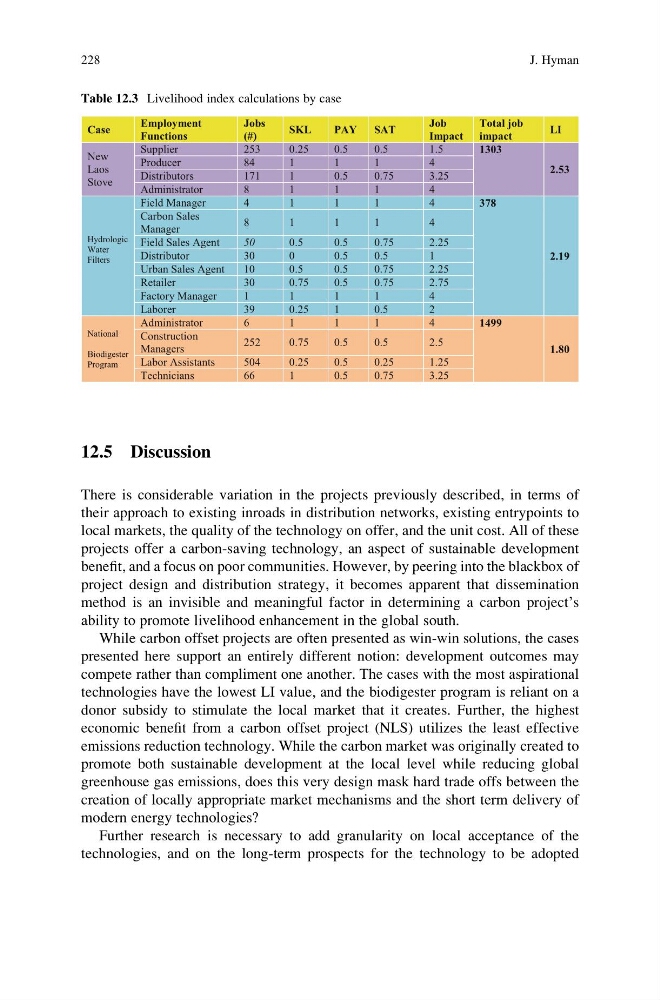
While carbon offset projects are often presented as win-win solutions, the cases
presented here support an entirely different notion: development outcomes may
compete rather than compliment one another. The cases with the most aspirational
technologies have the lowest LI value, and the biodigester program is reliant on a
donor subsidy to stimulate the local market that it creates. Further, the highest
economic benefit from a carbon offset project (NLS) utilizes the least effective
emissions reduction technology. While the carbon market was originally created to
promote both sustainable development at the local level while reducing global
greenhouse gas emissions, does this very design mask hard trade offs between the
creation of locally appropriate market mechanisms and the short term delivery of
modern energy technologies?
Further research is necessary to add granularity on local acceptance of the
technologies, and on the long-term prospects for the technology to be adopted
Table 12.3 Livelihood index calculations by case
Case
Employment
Functions
Jobs
(#)
SKL
PAY
SAT
Job
Impact
Total job
impact
LI
New
Laos
Stove
Supplier
253
0.25
0.5
0.5
1.5
1303
2.53
Producer
84
1
1
1
4
Distributors
171
1
0.5
0.75
3.25
Administrator
8
1
1
1
4
Hydrologic
Water
Filters
Field Manager
4
1
1
1
4
378
2.19
Carbon Sales
Manager
8
1
1
1
4
Field Sales Agent
50
0.5
0.5
0.75
2.25
Distributor
30
0
0.5
0.5
1
Urban Sales Agent
10
0.5
0.5
0.75
2.25
Retailer
30
0.75
0.5
0.75
2.75
Factory Manager
1
1
1
1
4
Laborer
39
0.25
1
0.5
2
National
Biodigester
Program
Administrator
6
1
1
1
4
1499
1.80
Construction
Managers
252
0.75
0.5
0.5
2.5
Labor Assistants
504
0.25
0.5
0.25
1.25
Technicians
66
1
0.5
0.75
3.25
228
J. Hyman
There is considerable variation in the projects previously described, in terms of
their approach to existing inroads in distribution networks, existing entrypoints to
local markets, the quality of the technology on offer, and the unit cost. All of these
projects offer a carbon-saving technology, an aspect of sustainable development
benefit, and a focus on poor communities. However, by peering into the blackbox of
project design and distribution strategy, it becomes apparent that dissemination
method is an invisible and meaningful factor in determining a carbon project’s
ability to promote livelihood enhancement in the global south.
While carbon offset projects are often presented as win-win solutions, the cases
presented here support an entirely different notion: development outcomes may
compete rather than compliment one another. The cases with the most aspirational
technologies have the lowest LI value, and the biodigester program is reliant on a
donor subsidy to stimulate the local market that it creates. Further, the highest
economic benefit from a carbon offset project (NLS) utilizes the least effective
emissions reduction technology. While the carbon market was originally created to
promote both sustainable development at the local level while reducing global
greenhouse gas emissions, does this very design mask hard trade offs between the
creation of locally appropriate market mechanisms and the short term delivery of
modern energy technologies?
Further research is necessary to add granularity on local acceptance of the
technologies, and on the long-term prospects for the technology to be adopted
Table 12.3 Livelihood index calculations by case
Case
Employment
Functions
Jobs
(#)
SKL
PAY
SAT
Job
Impact
Total job
impact
LI
New
Laos
Stove
Supplier
253
0.25
0.5
0.5
1.5
1303
2.53
Producer
84
1
1
1
4
Distributors
171
1
0.5
0.75
3.25
Administrator
8
1
1
1
4
Hydrologic
Water
Filters
Field Manager
4
1
1
1
4
378
2.19
Carbon Sales
Manager
8
1
1
1
4
Field Sales Agent
50
0.5
0.5
0.75
2.25
Distributor
30
0
0.5
0.5
1
Urban Sales Agent
10
0.5
0.5
0.75
2.25
Retailer
30
0.75
0.5
0.75
2.75
Factory Manager
1
1
1
1
4
Laborer
39
0.25
1
0.5
2
National
Biodigester
Program
Administrator
6
1
1
1
4
1499
1.80
Construction
Managers
252
0.75
0.5
0.5
2.5
Labor Assistants
504
0.25
0.5
0.25
1.25
Technicians
66
1
0.5
0.75
3.25
228
J. Hyman