

Different methodologies were applied to each one of the sub-research questions
as explained:
1. How well are projects meeting their goals of sustainable development, climate
change mitigation and climate change adaptation?
Based on development literature, the main variables that are used to measure
sustainable development include economic feasibility, social acceptance and
environmental responsibility (Najam et al. 2003; Olsen 2007; Swart et al. 2003).
The inspection protocol for the photovoltaic systems included the following:
1. System status and history:
(a) Previous technical inspections
(b) Previous and current failures
(c) Equipment replaced
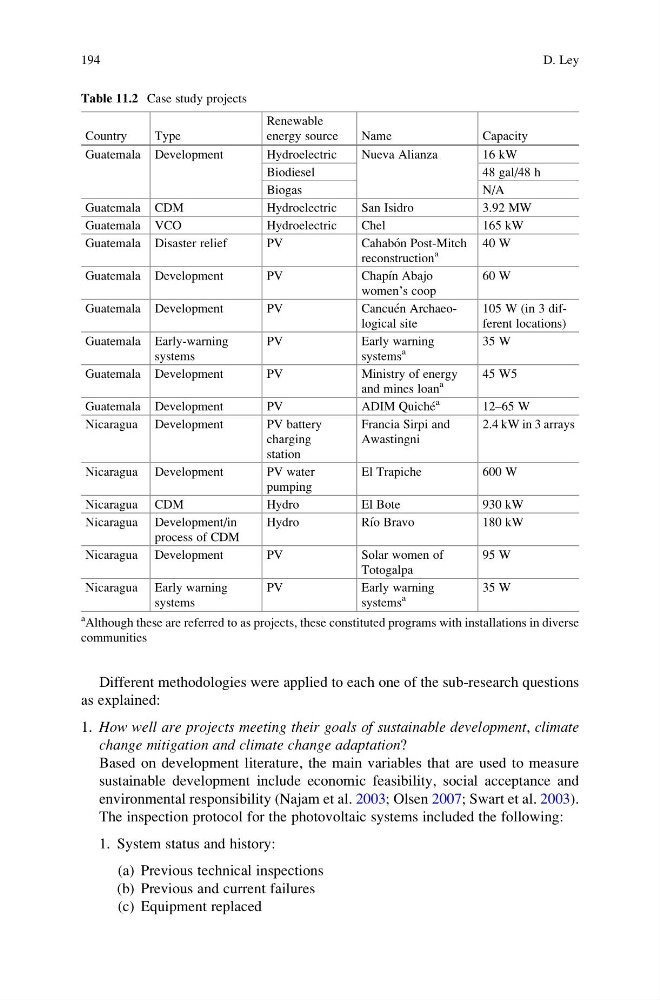
Table 11.2 Case study projects
Country
Type
Renewable
energy source
Name
Capacity
Guatemala Development
Hydroelectric
Nueva Alianza
16 kW
Biodiesel
48 gal/48 h
Biogas
N/A
Guatemala CDM
Hydroelectric
San Isidro
3.92 MW
Guatemala VCO
Hydroelectric
Chel
165 kW
Guatemala Disaster relief
PV
Cahabo ´n Post-Mitch
reconstruction
a
40 W
Guatemala Development
PV
Chapı ´n Abajo
women’s coop
60 W
Guatemala Development
PV
Cancue ´n Archaeological site
105 W (in 3 different locations)
Guatemala Early-warning
systems
PV
Early warning
systems
a
35 W
Guatemala Development
PV
Ministry of energy
and mines loan
a
45 W5
Guatemala Development
PV
ADIM Quiche ´
a
12–65 W
Nicaragua Development
PV battery
charging
station
Francia Sirpi and
Awastingni
2.4 kW in 3 arrays
Nicaragua Development
PV water
pumping
El Trapiche
600 W
Nicaragua CDM
Hydro
El Bote
930 kW
Nicaragua Development/in
process of CDM
Hydro
Rı ´o Bravo
180 kW
Nicaragua Development
PV
Solar women of
Totogalpa
95 W
Nicaragua Early warning
systems
PV
Early warning
systems
a
35 W
a
Although these are referred to as projects, these constituted programs with installations in diverse
communities
194
D. Ley
as explained:
1. How well are projects meeting their goals of sustainable development, climate
change mitigation and climate change adaptation?
Based on development literature, the main variables that are used to measure
sustainable development include economic feasibility, social acceptance and
environmental responsibility (Najam et al. 2003; Olsen 2007; Swart et al. 2003).
The inspection protocol for the photovoltaic systems included the following:
1. System status and history:
(a) Previous technical inspections
(b) Previous and current failures
(c) Equipment replaced
Table 11.2 Case study projects
Country
Type
Renewable
energy source
Name
Capacity
Guatemala Development
Hydroelectric
Nueva Alianza
16 kW
Biodiesel
48 gal/48 h
Biogas
N/A
Guatemala CDM
Hydroelectric
San Isidro
3.92 MW
Guatemala VCO
Hydroelectric
Chel
165 kW
Guatemala Disaster relief
PV
Cahabo ´n Post-Mitch
reconstruction
a
40 W
Guatemala Development
PV
Chapı ´n Abajo
women’s coop
60 W
Guatemala Development
PV
Cancue ´n Archaeological site
105 W (in 3 different locations)
Guatemala Early-warning
systems
PV
Early warning
systems
a
35 W
Guatemala Development
PV
Ministry of energy
and mines loan
a
45 W5
Guatemala Development
PV
ADIM Quiche ´
a
12–65 W
Nicaragua Development
PV battery
charging
station
Francia Sirpi and
Awastingni
2.4 kW in 3 arrays
Nicaragua Development
PV water
pumping
El Trapiche
600 W
Nicaragua CDM
Hydro
El Bote
930 kW
Nicaragua Development/in
process of CDM
Hydro
Rı ´o Bravo
180 kW
Nicaragua Development
PV
Solar women of
Totogalpa
95 W
Nicaragua Early warning
systems
PV
Early warning
systems
a
35 W
a
Although these are referred to as projects, these constituted programs with installations in diverse
communities
194
D. Ley