

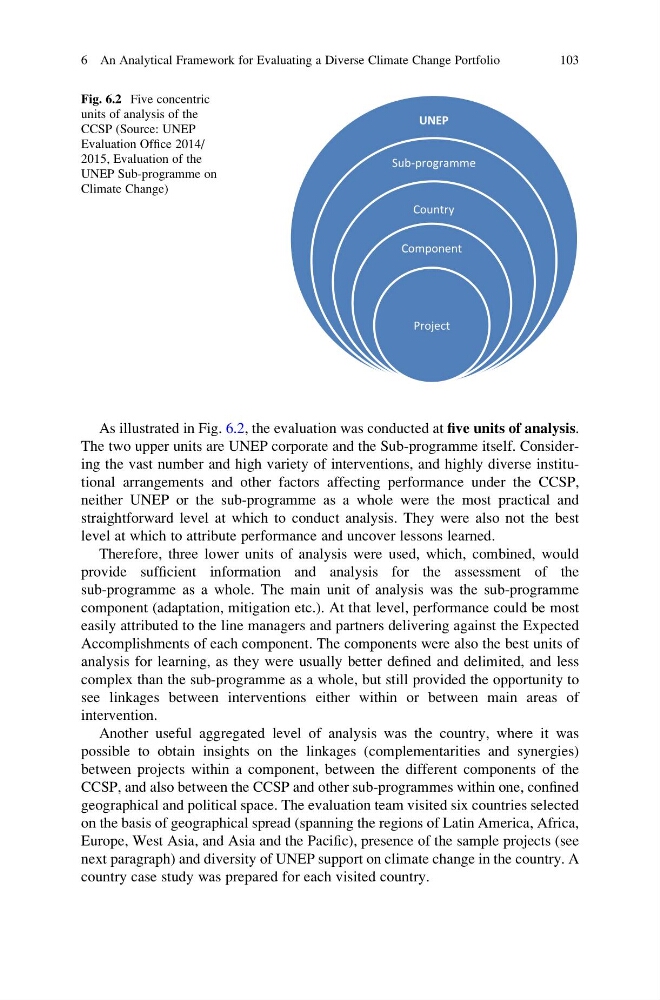
As illustrated in Fig. 6.2, the evaluation was conducted at five units of analysis.
The two upper units are UNEP corporate and the Sub-programme itself. Considering the vast number and high variety of interventions, and highly diverse institutional arrangements and other factors affecting performance under the CCSP,
neither UNEP or the sub-programme as a whole were the most practical and
straightforward level at which to conduct analysis. They were also not the best
level at which to attribute performance and uncover lessons learned.
Therefore, three lower units of analysis were used, which, combined, would
provide sufficient information and analysis for the assessment of the
sub-programme as a whole. The main unit of analysis was the sub-programme
component (adaptation, mitigation etc.). At that level, performance could be most
easily attributed to the line managers and partners delivering against the Expected
Accomplishments of each component. The components were also the best units of
analysis for learning, as they were usually better defined and delimited, and less
complex than the sub-programme as a whole, but still provided the opportunity to
see linkages between interventions either within or between main areas of
intervention.
Another useful aggregated level of analysis was the country, where it was
possible to obtain insights on the linkages (complementarities and synergies)
between projects within a component, between the different components of the
CCSP, and also between the CCSP and other sub-programmes within one, confined
geographical and political space. The evaluation team visited six countries selected
on the basis of geographical spread (spanning the regions of Latin America, Africa,
Europe, West Asia, and Asia and the Pacific), presence of the sample projects (see
next paragraph) and diversity of UNEP support on climate change in the country. A
country case study was prepared for each visited country.
UNEP
Sub-programme
Country
Component
Project
Fig. 6.2 Five concentric
units of analysis of the
CCSP (Source: UNEP
Evaluation Office 2014/
2015, Evaluation of the
UNEP Sub-programme on
Climate Change)
6 An Analytical Framework for Evaluating a Diverse Climate Change Portfolio
103
The two upper units are UNEP corporate and the Sub-programme itself. Considering the vast number and high variety of interventions, and highly diverse institutional arrangements and other factors affecting performance under the CCSP,
neither UNEP or the sub-programme as a whole were the most practical and
straightforward level at which to conduct analysis. They were also not the best
level at which to attribute performance and uncover lessons learned.
Therefore, three lower units of analysis were used, which, combined, would
provide sufficient information and analysis for the assessment of the
sub-programme as a whole. The main unit of analysis was the sub-programme
component (adaptation, mitigation etc.). At that level, performance could be most
easily attributed to the line managers and partners delivering against the Expected
Accomplishments of each component. The components were also the best units of
analysis for learning, as they were usually better defined and delimited, and less
complex than the sub-programme as a whole, but still provided the opportunity to
see linkages between interventions either within or between main areas of
intervention.
Another useful aggregated level of analysis was the country, where it was
possible to obtain insights on the linkages (complementarities and synergies)
between projects within a component, between the different components of the
CCSP, and also between the CCSP and other sub-programmes within one, confined
geographical and political space. The evaluation team visited six countries selected
on the basis of geographical spread (spanning the regions of Latin America, Africa,
Europe, West Asia, and Asia and the Pacific), presence of the sample projects (see
next paragraph) and diversity of UNEP support on climate change in the country. A
country case study was prepared for each visited country.
UNEP
Sub-programme
Country
Component
Project
Fig. 6.2 Five concentric
units of analysis of the
CCSP (Source: UNEP
Evaluation Office 2014/
2015, Evaluation of the
UNEP Sub-programme on
Climate Change)
6 An Analytical Framework for Evaluating a Diverse Climate Change Portfolio
103