

innovative analytical framework and data collection approach for sub-programme
evaluations.
5 These were further refined for the CCSP evaluation and are discussed
in the following sections, followed by a summary of lessons learned which could be
useful for future similar exercises.
6.4 Analytical Framework of the Evaluation
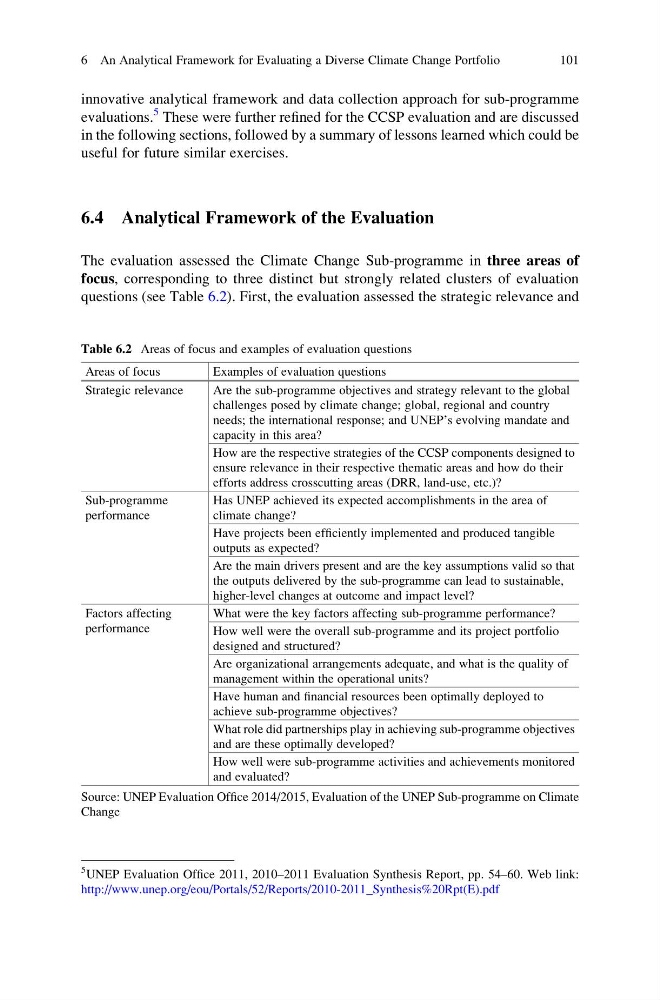
The evaluation assessed the Climate Change Sub-programme in three areas of
focus, corresponding to three distinct but strongly related clusters of evaluation
questions (see Table 6.2). First, the evaluation assessed the strategic relevance and
Table 6.2 Areas of focus and examples of evaluation questions
Areas of focus
Examples of evaluation questions
Strategic relevance
Are the sub-programme objectives and strategy relevant to the global
challenges posed by climate change; global, regional and country
needs; the international response; and UNEP’s evolving mandate and
capacity in this area?
How are the respective strategies of the CCSP components designed to
ensure relevance in their respective thematic areas and how do their
efforts address crosscutting areas (DRR, land-use, etc.)?
Sub-programme
performance
Has UNEP achieved its expected accomplishments in the area of
climate change?
Have projects been efficiently implemented and produced tangible
outputs as expected?
Are the main drivers present and are the key assumptions valid so that
the outputs delivered by the sub-programme can lead to sustainable,
higher-level changes at outcome and impact level?
Factors affecting
performance
What were the key factors affecting sub-programme performance?
How well were the overall sub-programme and its project portfolio
designed and structured?
Are organizational arrangements adequate, and what is the quality of
management within the operational units?
Have human and financial resources been optimally deployed to
achieve sub-programme objectives?
What role did partnerships play in achieving sub-programme objectives
and are these optimally developed?
How well were sub-programme activities and achievements monitored
and evaluated?
Source: UNEP Evaluation Office 2014/2015, Evaluation of the UNEP Sub-programme on Climate
Change
5 UNEP Evaluation Office 2011, 2010–2011 Evaluation Synthesis Report, pp. 54–60. Web link:
http://www.unep.org/eou/Portals/52/Reports/2010-2011_Synthesis%20Rpt(E).pdf
6 An Analytical Framework for Evaluating a Diverse Climate Change Portfolio
101
evaluations.
5 These were further refined for the CCSP evaluation and are discussed
in the following sections, followed by a summary of lessons learned which could be
useful for future similar exercises.
6.4 Analytical Framework of the Evaluation
The evaluation assessed the Climate Change Sub-programme in three areas of
focus, corresponding to three distinct but strongly related clusters of evaluation
questions (see Table 6.2). First, the evaluation assessed the strategic relevance and
Table 6.2 Areas of focus and examples of evaluation questions
Areas of focus
Examples of evaluation questions
Strategic relevance
Are the sub-programme objectives and strategy relevant to the global
challenges posed by climate change; global, regional and country
needs; the international response; and UNEP’s evolving mandate and
capacity in this area?
How are the respective strategies of the CCSP components designed to
ensure relevance in their respective thematic areas and how do their
efforts address crosscutting areas (DRR, land-use, etc.)?
Sub-programme
performance
Has UNEP achieved its expected accomplishments in the area of
climate change?
Have projects been efficiently implemented and produced tangible
outputs as expected?
Are the main drivers present and are the key assumptions valid so that
the outputs delivered by the sub-programme can lead to sustainable,
higher-level changes at outcome and impact level?
Factors affecting
performance
What were the key factors affecting sub-programme performance?
How well were the overall sub-programme and its project portfolio
designed and structured?
Are organizational arrangements adequate, and what is the quality of
management within the operational units?
Have human and financial resources been optimally deployed to
achieve sub-programme objectives?
What role did partnerships play in achieving sub-programme objectives
and are these optimally developed?
How well were sub-programme activities and achievements monitored
and evaluated?
Source: UNEP Evaluation Office 2014/2015, Evaluation of the UNEP Sub-programme on Climate
Change
5 UNEP Evaluation Office 2011, 2010–2011 Evaluation Synthesis Report, pp. 54–60. Web link:
http://www.unep.org/eou/Portals/52/Reports/2010-2011_Synthesis%20Rpt(E).pdf
6 An Analytical Framework for Evaluating a Diverse Climate Change Portfolio
101