

51
documents describing the procedures and methodologies and applied them equally
to the two groups’ talks in order not to generate any managerial differences between
groups. These were the measures being implemented for governing the WS because
of our intent to achieve neutrality and comparability of the contents of both groups’
scenarios. In this manner, we made it possible to analyze the different outcomes
being generated from the same processes.
4.2.2 Methods and Techniques of Dialogue
Among the Workshop Participants
4.2.2.1 Rules and Norms for Free Dialogue
All participants were asked not to reveal any of their attributes such as professions,
positions, and titles throughout the entire period of the WS. We thought this rule
was important because people tend to be intimidated or feel restrained while talking
to someone who they feel holds a superior position or has more expertise. At the
same time, the participants were guided “not to deny, dominate, and conclude” their
dialogue in any way or at any time (Sakano 2011). At the WS, these rules and norms
were applied to the two groups for the sake of creating and maintaining an arena in
where each one of the participants can be spontaneous and independent with others
and thus can think and express opinions and preferences freely.
In addition, by setting the scenarios targeting a relatively longer term (in this case
the year 2064, 48 years from the time of convening the WS in 2016), we meant to
craft visions as ones radically different from, and more creative than those of the
status quo. Also, the year 2064 points to a more distant future if compared to targeted years of the TCG’s policies on urban development and planning. Thus, we
thought that the participants were incentivized to become liberated from and uninfluenced by the current policies being pursued by the TCG.
4.2.2.2 Use of Key Items for Guidance
At the WS, we introduced a list of “key items” in relation to the issues of the city’s
sustainability. Those key items were the ones actually used in the TCG’s general
administrative plan in effect from 2007 to 2016 (Toyama City 2007). The plan had
used the list to provide examples of certain aspects concerning relevant policies and
measures indicating how TCG makes its decisions on urban development and
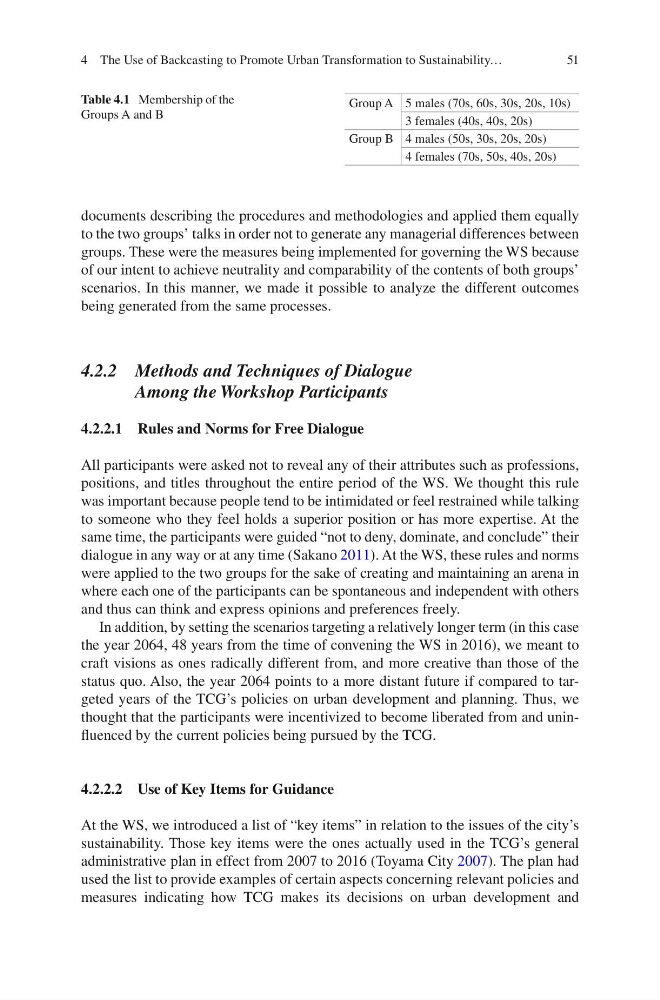
Table 4.1 Membership of the
Groups A and B
Group A 5 males (70s, 60s, 30s, 20s, 10s)
3 females (40s, 40s, 20s)
Group B 4 males (50s, 30s, 20s, 20s)
4 females (70s, 50s, 40s, 20s)
4 The Use of Backcasting to Promote Urban Transformation to Sustainability…
documents describing the procedures and methodologies and applied them equally
to the two groups’ talks in order not to generate any managerial differences between
groups. These were the measures being implemented for governing the WS because
of our intent to achieve neutrality and comparability of the contents of both groups’
scenarios. In this manner, we made it possible to analyze the different outcomes
being generated from the same processes.
4.2.2 Methods and Techniques of Dialogue
Among the Workshop Participants
4.2.2.1 Rules and Norms for Free Dialogue
All participants were asked not to reveal any of their attributes such as professions,
positions, and titles throughout the entire period of the WS. We thought this rule
was important because people tend to be intimidated or feel restrained while talking
to someone who they feel holds a superior position or has more expertise. At the
same time, the participants were guided “not to deny, dominate, and conclude” their
dialogue in any way or at any time (Sakano 2011). At the WS, these rules and norms
were applied to the two groups for the sake of creating and maintaining an arena in
where each one of the participants can be spontaneous and independent with others
and thus can think and express opinions and preferences freely.
In addition, by setting the scenarios targeting a relatively longer term (in this case
the year 2064, 48 years from the time of convening the WS in 2016), we meant to
craft visions as ones radically different from, and more creative than those of the
status quo. Also, the year 2064 points to a more distant future if compared to targeted years of the TCG’s policies on urban development and planning. Thus, we
thought that the participants were incentivized to become liberated from and uninfluenced by the current policies being pursued by the TCG.
4.2.2.2 Use of Key Items for Guidance
At the WS, we introduced a list of “key items” in relation to the issues of the city’s
sustainability. Those key items were the ones actually used in the TCG’s general
administrative plan in effect from 2007 to 2016 (Toyama City 2007). The plan had
used the list to provide examples of certain aspects concerning relevant policies and
measures indicating how TCG makes its decisions on urban development and
Table 4.1 Membership of the
Groups A and B
Group A 5 males (70s, 60s, 30s, 20s, 10s)
3 females (40s, 40s, 20s)
Group B 4 males (50s, 30s, 20s, 20s)
4 females (70s, 50s, 40s, 20s)
4 The Use of Backcasting to Promote Urban Transformation to Sustainability…