

40
3.4 Discussion and Conclusion
Public participation is an essential enhancement to IAS management, since it can
compensate for the shortages of human and financial resources (Jenkins 1999;
Lepczyk 2005; Trumbull et al. 2000); however, few studies have addressed the
potential roles of tourists, although most of them visit wilderness areas such as
national parks. We applied a discrete choice model to invasive carp management on
Amami Oshima Island, Japan, to quantify tourists’ demand for participating in the
carp removal program as a tour option. The results indicate that 64.2% of tourists
who were not provided ecological information, about 100 tourists would avoid participating in carp removal activities as a tour option without any financial discounts
when they have no ecological information (Table 3.2). In other words, on average,
tourists with no information are indifferent to whether they participate in carp
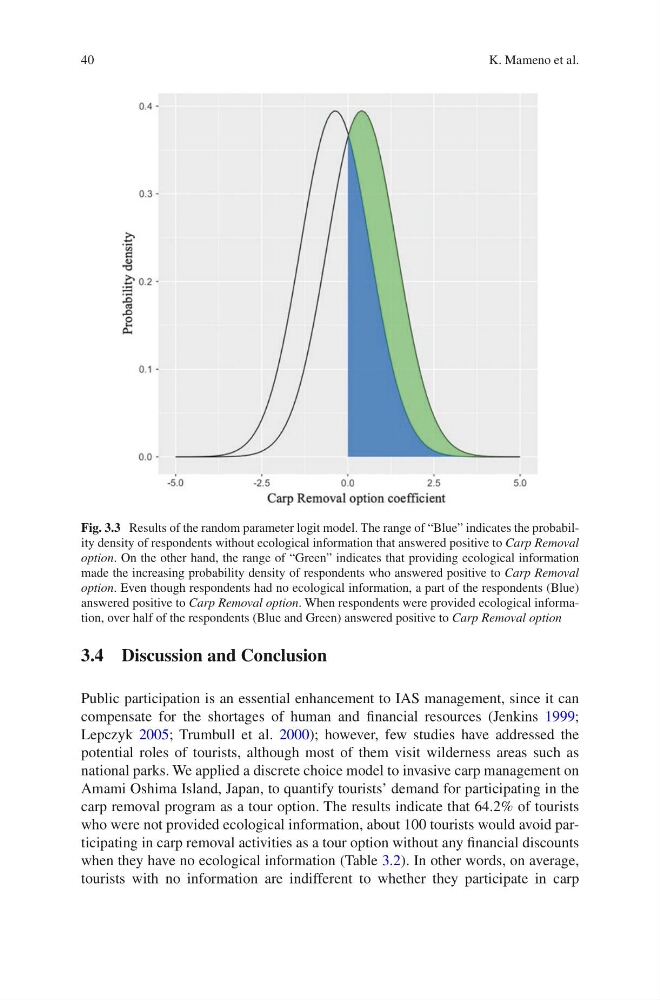
Fig. 3.3 Results of the random parameter logit model. The range of “Blue” indicates the probability density of respondents without ecological information that answered positive to Carp Removal
option. On the other hand, the range of “Green” indicates that providing ecological information
made the increasing probability density of respondents who answered positive to Carp Removal
option. Even though respondents had no ecological information, a part of the respondents (Blue)
answered positive to Carp Removal option. When respondents were provided ecological information, over half of the respondents (Blue and Green) answered positive to Carp Removal option
K. Mameno et al.
3.4 Discussion and Conclusion
Public participation is an essential enhancement to IAS management, since it can
compensate for the shortages of human and financial resources (Jenkins 1999;
Lepczyk 2005; Trumbull et al. 2000); however, few studies have addressed the
potential roles of tourists, although most of them visit wilderness areas such as
national parks. We applied a discrete choice model to invasive carp management on
Amami Oshima Island, Japan, to quantify tourists’ demand for participating in the
carp removal program as a tour option. The results indicate that 64.2% of tourists
who were not provided ecological information, about 100 tourists would avoid participating in carp removal activities as a tour option without any financial discounts
when they have no ecological information (Table 3.2). In other words, on average,
tourists with no information are indifferent to whether they participate in carp
Fig. 3.3 Results of the random parameter logit model. The range of “Blue” indicates the probability density of respondents without ecological information that answered positive to Carp Removal
option. On the other hand, the range of “Green” indicates that providing ecological information
made the increasing probability density of respondents who answered positive to Carp Removal
option. Even though respondents had no ecological information, a part of the respondents (Blue)
answered positive to Carp Removal option. When respondents were provided ecological information, over half of the respondents (Blue and Green) answered positive to Carp Removal option
K. Mameno et al.