

111
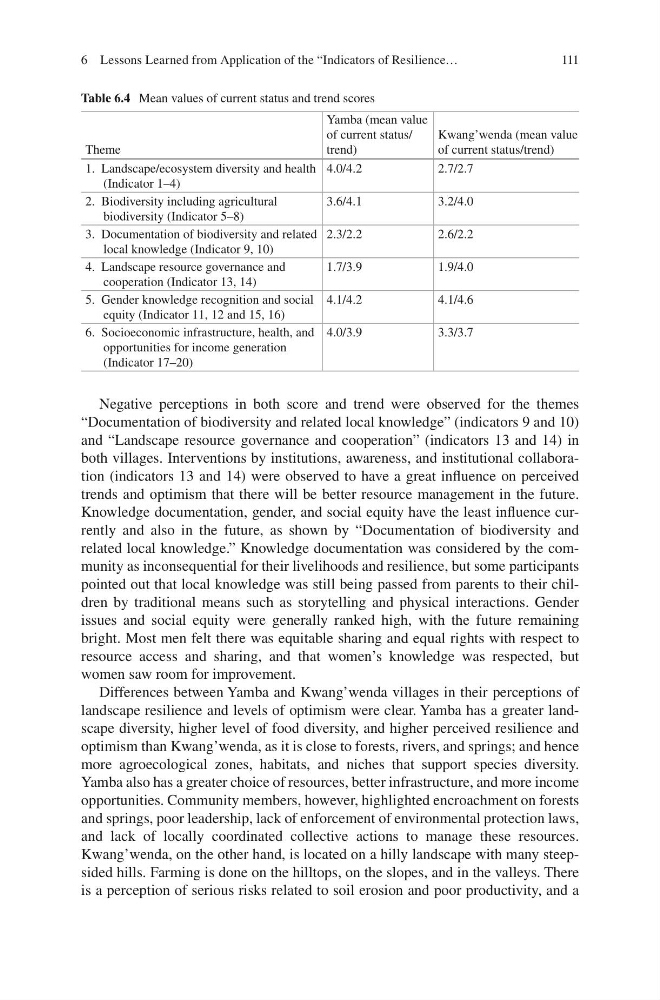
Negative perceptions in both score and trend were observed for the themes
“Documentation of biodiversity and related local knowledge” (indicators 9 and 10)
and “Landscape resource governance and cooperation” (indicators 13 and 14) in
both villages. Interventions by institutions, awareness, and institutional collaboration (indicators 13 and 14) were observed to have a great influence on perceived
trends and optimism that there will be better resource management in the future.
Knowledge documentation, gender, and social equity have the least influence currently and also in the future, as shown by “Documentation of biodiversity and
related local knowledge.” Knowledge documentation was considered by the community as inconsequential for their livelihoods and resilience, but some participants
pointed out that local knowledge was still being passed from parents to their children by traditional means such as storytelling and physical interactions. Gender
issues and social equity were generally ranked high, with the future remaining
bright. Most men felt there was equitable sharing and equal rights with respect to
resource access and sharing, and that women’s knowledge was respected, but
women saw room for improvement.
Differences between Yamba and Kwang’wenda villages in their perceptions of
landscape resilience and levels of optimism were clear. Yamba has a greater landscape diversity, higher level of food diversity, and higher perceived resilience and
optimism than Kwang’wenda, as it is close to forests, rivers, and springs; and hence
more agroecological zones, habitats, and niches that support species diversity.
Yamba also has a greater choice of resources, better infrastructure, and more income
opportunities. Community members, however, highlighted encroachment on forests
and springs, poor leadership, lack of enforcement of environmental protection laws,
and lack of locally coordinated collective actions to manage these resources.
Kwang’wenda, on the other hand, is located on a hilly landscape with many steepsided hills. Farming is done on the hilltops, on the slopes, and in the valleys. There
is a perception of serious risks related to soil erosion and poor productivity, and a
Table 6.4 Mean values of current status and trend scores
Theme
Yamba (mean value
of current status/
trend)
Kwang’wenda (mean value
of current status/trend)
1. Landscape/ecosystem diversity and health
(Indicator 1–4)
4.0/4.2
2.7/2.7
2. Biodiversity including agricultural
biodiversity (Indicator 5–8)
3.6/4.1
3.2/4.0
3. Documentation of biodiversity and related
local knowledge (Indicator 9, 10)
2.3/2.2
2.6/2.2
4. Landscape resource governance and
cooperation (Indicator 13, 14)
1.7/3.9
1.9/4.0
5. Gender knowledge recognition and social
equity (Indicator 11, 12 and 15, 16)
4.1/4.2
4.1/4.6
6. Socioeconomic infrastructure, health, and
opportunities for income generation
(Indicator 17–20)
4.0/3.9
3.3/3.7
6 Lessons Learned from Application of the “Indicators of Resilience…
Negative perceptions in both score and trend were observed for the themes
“Documentation of biodiversity and related local knowledge” (indicators 9 and 10)
and “Landscape resource governance and cooperation” (indicators 13 and 14) in
both villages. Interventions by institutions, awareness, and institutional collaboration (indicators 13 and 14) were observed to have a great influence on perceived
trends and optimism that there will be better resource management in the future.
Knowledge documentation, gender, and social equity have the least influence currently and also in the future, as shown by “Documentation of biodiversity and
related local knowledge.” Knowledge documentation was considered by the community as inconsequential for their livelihoods and resilience, but some participants
pointed out that local knowledge was still being passed from parents to their children by traditional means such as storytelling and physical interactions. Gender
issues and social equity were generally ranked high, with the future remaining
bright. Most men felt there was equitable sharing and equal rights with respect to
resource access and sharing, and that women’s knowledge was respected, but
women saw room for improvement.
Differences between Yamba and Kwang’wenda villages in their perceptions of
landscape resilience and levels of optimism were clear. Yamba has a greater landscape diversity, higher level of food diversity, and higher perceived resilience and
optimism than Kwang’wenda, as it is close to forests, rivers, and springs; and hence
more agroecological zones, habitats, and niches that support species diversity.
Yamba also has a greater choice of resources, better infrastructure, and more income
opportunities. Community members, however, highlighted encroachment on forests
and springs, poor leadership, lack of enforcement of environmental protection laws,
and lack of locally coordinated collective actions to manage these resources.
Kwang’wenda, on the other hand, is located on a hilly landscape with many steepsided hills. Farming is done on the hilltops, on the slopes, and in the valleys. There
is a perception of serious risks related to soil erosion and poor productivity, and a
Table 6.4 Mean values of current status and trend scores
Theme
Yamba (mean value
of current status/
trend)
Kwang’wenda (mean value
of current status/trend)
1. Landscape/ecosystem diversity and health
(Indicator 1–4)
4.0/4.2
2.7/2.7
2. Biodiversity including agricultural
biodiversity (Indicator 5–8)
3.6/4.1
3.2/4.0
3. Documentation of biodiversity and related
local knowledge (Indicator 9, 10)
2.3/2.2
2.6/2.2
4. Landscape resource governance and
cooperation (Indicator 13, 14)
1.7/3.9
1.9/4.0
5. Gender knowledge recognition and social
equity (Indicator 11, 12 and 15, 16)
4.1/4.2
4.1/4.6
6. Socioeconomic infrastructure, health, and
opportunities for income generation
(Indicator 17–20)
4.0/3.9
3.3/3.7
6 Lessons Learned from Application of the “Indicators of Resilience…