

4.2 Resilience Engineering for Integrated Risk-Informed
Decision-Making Process
It has been discussed that resilience is not restricted to a systems’ response to crisis,
but also includes adapting to slow and long-term changes. In other words, resilience
can be defined also as the adaptive capacity of systems to maintain, through
proactive maintenance, functions that deteriorate over time, the capacity of systems
to evolve by remaking itself in order to adapt to existing and future environmental
challenges, and the capacity of a system to become more robust by learning from
past failures or from recent findings. In other words, maintenance science
and technology should be effectively integrated into the decision-making process
associated with continuous improvement of nuclear safety. This type of resilience is
related to the first level of “defense in depth.”
Hollnagel [13] suggests that the conventional safety perspective that defines
safety as the condition where the number of adverse outcomes is as low as possible
(i.e. safety-I) has some limitations, and a new safety perspective should also be
emphasized, which defines safety as the condition where the number of intended
outcomes is as high as possible (i.e. safety-II). This framework is considered to be
important when the decision-making process with continuous improvement is
discussed. Resilience engineering needs to include resilience for both safety-I and
safety-II.
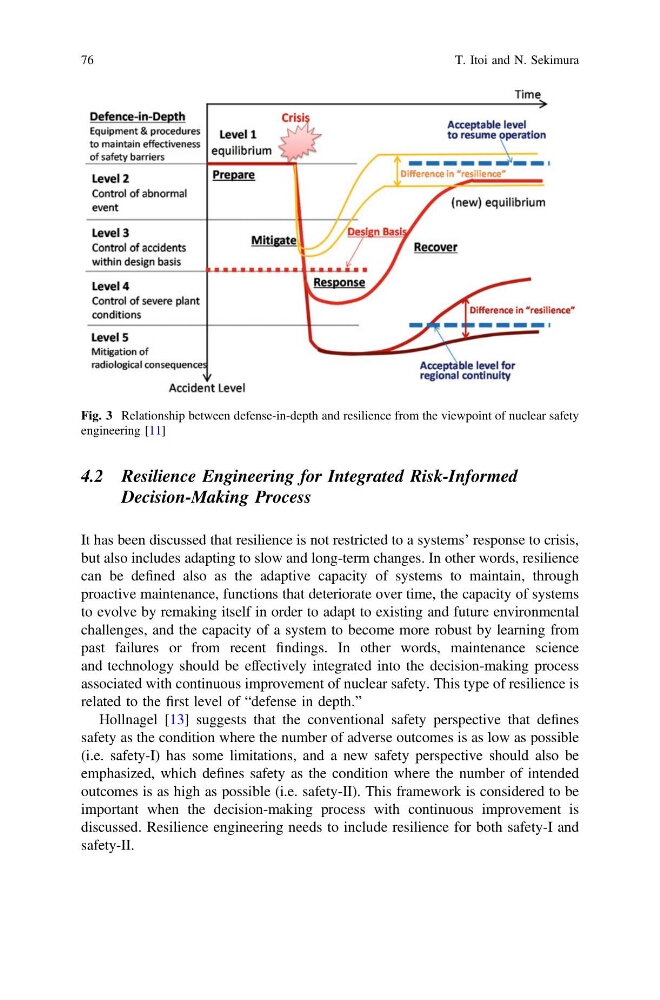
Fig. 3 Relationship between defense-in-depth and resilience from the viewpoint of nuclear safety
engineering [11]
76
T. Itoi and N. Sekimura
Decision-Making Process
It has been discussed that resilience is not restricted to a systems’ response to crisis,
but also includes adapting to slow and long-term changes. In other words, resilience
can be defined also as the adaptive capacity of systems to maintain, through
proactive maintenance, functions that deteriorate over time, the capacity of systems
to evolve by remaking itself in order to adapt to existing and future environmental
challenges, and the capacity of a system to become more robust by learning from
past failures or from recent findings. In other words, maintenance science
and technology should be effectively integrated into the decision-making process
associated with continuous improvement of nuclear safety. This type of resilience is
related to the first level of “defense in depth.”
Hollnagel [13] suggests that the conventional safety perspective that defines
safety as the condition where the number of adverse outcomes is as low as possible
(i.e. safety-I) has some limitations, and a new safety perspective should also be
emphasized, which defines safety as the condition where the number of intended
outcomes is as high as possible (i.e. safety-II). This framework is considered to be
important when the decision-making process with continuous improvement is
discussed. Resilience engineering needs to include resilience for both safety-I and
safety-II.
Fig. 3 Relationship between defense-in-depth and resilience from the viewpoint of nuclear safety
engineering [11]
76
T. Itoi and N. Sekimura