

2 The Great East Japan Earthquake Disaster
and the Fukushima Daiichi NPP Accident
The 2011 Tohoku earthquake and tsunami caused 19,335 deaths and 2,600 people
are still missing [1]. Spatially distributed damage is also the characteristic of the
earthquake and tsunami. Almost a hundred thousand people were forced to evacuate
as a result of the Fukushima Daiichi NPP accident, whereas almost 300,000 people
in total were evacuated in the aftermath of the earthquake and tsunami. In terms of
fatalities, a number of people died related to the Fukushima Daiichi NPP accident,
e.g., two plant workers due to tsunami, and more than 20 hospital patients during and
after evacuation, though no people died because of radiation effects due to the release
of radioactive material. Large negative impacts to society have also been caused by
the nuclear accident as well as by the earthquake and tsunami. Some have pointed
out that the evacuation orders following the nuclear accident prevented rescue
activities for people under collapsed houses in the areas surrounding the Fukushima
Daiichi and Daini NPPs, which may have caused more fatalities.
3 Challenges Identified in Light of the Fukushima
Daiichi NPP Accident
Risk management is a process that consists of identification, analysis, evaluation,
treatment, and monitoring of risk. If risk is evaluated to be high, it has to be reduced
by introducing a countermeasure to be retained. A contingency plan is also needed
to prepare for the retained risk, if it should be realized. Risk analysis can be
effectively used only if it is organically integrated into a risk management process.
In our society, however, risk analysis of nuclear power plants, i.e., estimation of the
probability that an accident will occur, tends to be used only to judge whether the
risk is acceptable or not. Afterwards, simply speaking, nuclear plant operators
together with regulators may fail to prepare a contingency plan in the case when the
risk becomes obvious, and may also fail to implement an effective mechanism to
continuously manage risk.
3.1 Risks of Nuclear Power Plant Accidents
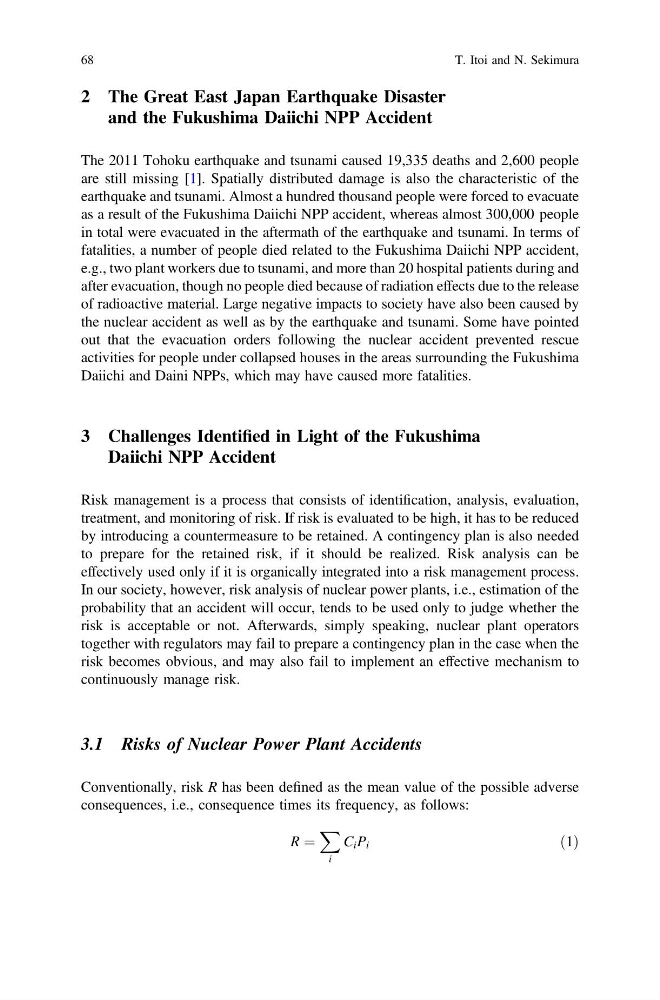
Conventionally, risk R has been defined as the mean value of the possible adverse
consequences, i.e., consequence times its frequency, as follows:
R ¼
X
i
C i P i
ð1Þ
68
T. Itoi and N. Sekimura
and the Fukushima Daiichi NPP Accident
The 2011 Tohoku earthquake and tsunami caused 19,335 deaths and 2,600 people
are still missing [1]. Spatially distributed damage is also the characteristic of the
earthquake and tsunami. Almost a hundred thousand people were forced to evacuate
as a result of the Fukushima Daiichi NPP accident, whereas almost 300,000 people
in total were evacuated in the aftermath of the earthquake and tsunami. In terms of
fatalities, a number of people died related to the Fukushima Daiichi NPP accident,
e.g., two plant workers due to tsunami, and more than 20 hospital patients during and
after evacuation, though no people died because of radiation effects due to the release
of radioactive material. Large negative impacts to society have also been caused by
the nuclear accident as well as by the earthquake and tsunami. Some have pointed
out that the evacuation orders following the nuclear accident prevented rescue
activities for people under collapsed houses in the areas surrounding the Fukushima
Daiichi and Daini NPPs, which may have caused more fatalities.
3 Challenges Identified in Light of the Fukushima
Daiichi NPP Accident
Risk management is a process that consists of identification, analysis, evaluation,
treatment, and monitoring of risk. If risk is evaluated to be high, it has to be reduced
by introducing a countermeasure to be retained. A contingency plan is also needed
to prepare for the retained risk, if it should be realized. Risk analysis can be
effectively used only if it is organically integrated into a risk management process.
In our society, however, risk analysis of nuclear power plants, i.e., estimation of the
probability that an accident will occur, tends to be used only to judge whether the
risk is acceptable or not. Afterwards, simply speaking, nuclear plant operators
together with regulators may fail to prepare a contingency plan in the case when the
risk becomes obvious, and may also fail to implement an effective mechanism to
continuously manage risk.
3.1 Risks of Nuclear Power Plant Accidents
Conventionally, risk R has been defined as the mean value of the possible adverse
consequences, i.e., consequence times its frequency, as follows:
R ¼
X
i
C i P i
ð1Þ
68
T. Itoi and N. Sekimura