

Margin
how closely or how precarious the system is currently
operating relative to one or another kind of performance
boundary;
Tolerance
how a system behaves near a boundary, whether the system
gracefully degrades as stress/pressure increase, or collapses
quickly when pressure exceeds adaptive capacity.
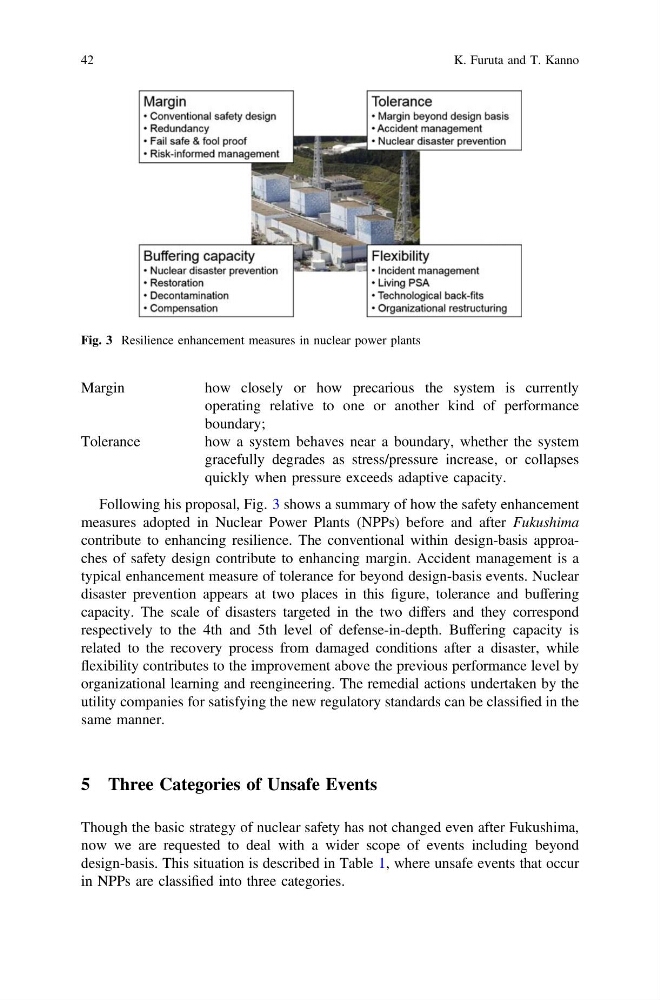
Following his proposal, Fig. 3 shows a summary of how the safety enhancement
measures adopted in Nuclear Power Plants (NPPs) before and after Fukushima
contribute to enhancing resilience. The conventional within design-basis approaches of safety design contribute to enhancing margin. Accident management is a
typical enhancement measure of tolerance for beyond design-basis events. Nuclear
disaster prevention appears at two places in this figure, tolerance and buffering
capacity. The scale of disasters targeted in the two differs and they correspond
respectively to the 4th and 5th level of defense-in-depth. Buffering capacity is
related to the recovery process from damaged conditions after a disaster, while
flexibility contributes to the improvement above the previous performance level by
organizational learning and reengineering. The remedial actions undertaken by the
utility companies for satisfying the new regulatory standards can be classified in the
same manner.
5 Three Categories of Unsafe Events
Though the basic strategy of nuclear safety has not changed even after Fukushima,
now we are requested to deal with a wider scope of events including beyond
design-basis. This situation is described in Table 1, where unsafe events that occur
in NPPs are classified into three categories.
Fig. 3 Resilience enhancement measures in nuclear power plants
42
K. Furuta and T. Kanno
how closely or how precarious the system is currently
operating relative to one or another kind of performance
boundary;
Tolerance
how a system behaves near a boundary, whether the system
gracefully degrades as stress/pressure increase, or collapses
quickly when pressure exceeds adaptive capacity.
Following his proposal, Fig. 3 shows a summary of how the safety enhancement
measures adopted in Nuclear Power Plants (NPPs) before and after Fukushima
contribute to enhancing resilience. The conventional within design-basis approaches of safety design contribute to enhancing margin. Accident management is a
typical enhancement measure of tolerance for beyond design-basis events. Nuclear
disaster prevention appears at two places in this figure, tolerance and buffering
capacity. The scale of disasters targeted in the two differs and they correspond
respectively to the 4th and 5th level of defense-in-depth. Buffering capacity is
related to the recovery process from damaged conditions after a disaster, while
flexibility contributes to the improvement above the previous performance level by
organizational learning and reengineering. The remedial actions undertaken by the
utility companies for satisfying the new regulatory standards can be classified in the
same manner.
5 Three Categories of Unsafe Events
Though the basic strategy of nuclear safety has not changed even after Fukushima,
now we are requested to deal with a wider scope of events including beyond
design-basis. This situation is described in Table 1, where unsafe events that occur
in NPPs are classified into three categories.
Fig. 3 Resilience enhancement measures in nuclear power plants
42
K. Furuta and T. Kanno