

presentation). To have achieved this, the value-laden issue needs to be defined, then
the context of the technological problem conveyed, then the problem consulted.
The results of the consultation can then be analyzed by the researchers and translated back into its implications for discussions of technology use. This process
needs to sufficiently convey the context of the discussion, and be appropriately
defined (if the issue is too abstract in terms of value, for example if people were
asked to discuss political values each endorses, this would likely not work any
better than asking them to talk about the appropriate thickness of waste containers).
The method of consultation devised here takes the form of a group interview.
During August 2014 to February 2015, 18 people were interviewed in various
groups, each session lasting around 90 min. Participants were asked to relax and to
discuss freely “what you think is a desirable means of ‘disposal’ of high level
radioactive waste” without worrying about present technical limitations. A less than
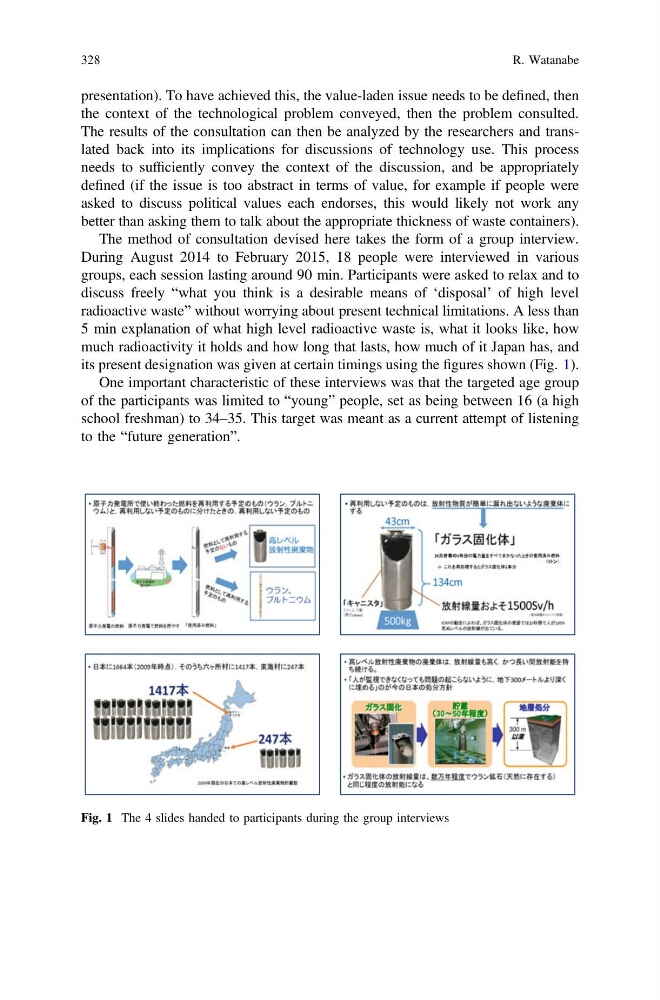
5 min explanation of what high level radioactive waste is, what it looks like, how
much radioactivity it holds and how long that lasts, how much of it Japan has, and
its present designation was given at certain timings using the figures shown (Fig. 1).
One important characteristic of these interviews was that the targeted age group
of the participants was limited to “young” people, set as being between 16 (a high
school freshman) to 34–35. This target was meant as a current attempt of listening
to the “future generation”.
Fig. 1 The 4 slides handed to participants during the group interviews
328
R. Watanabe
the context of the technological problem conveyed, then the problem consulted.
The results of the consultation can then be analyzed by the researchers and translated back into its implications for discussions of technology use. This process
needs to sufficiently convey the context of the discussion, and be appropriately
defined (if the issue is too abstract in terms of value, for example if people were
asked to discuss political values each endorses, this would likely not work any
better than asking them to talk about the appropriate thickness of waste containers).
The method of consultation devised here takes the form of a group interview.
During August 2014 to February 2015, 18 people were interviewed in various
groups, each session lasting around 90 min. Participants were asked to relax and to
discuss freely “what you think is a desirable means of ‘disposal’ of high level
radioactive waste” without worrying about present technical limitations. A less than
5 min explanation of what high level radioactive waste is, what it looks like, how
much radioactivity it holds and how long that lasts, how much of it Japan has, and
its present designation was given at certain timings using the figures shown (Fig. 1).
One important characteristic of these interviews was that the targeted age group
of the participants was limited to “young” people, set as being between 16 (a high
school freshman) to 34–35. This target was meant as a current attempt of listening
to the “future generation”.
Fig. 1 The 4 slides handed to participants during the group interviews
328
R. Watanabe