

constrain the maximum possible bio-accumulation for these organisms to well
beyond the bounds of those seen practically all other marine biota. Assuming a
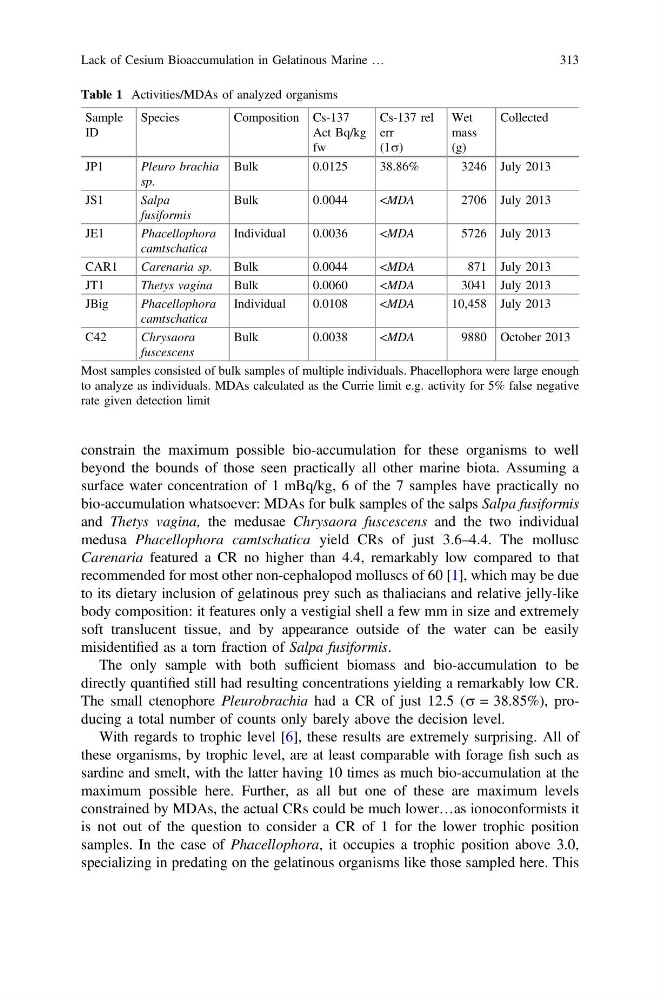
surface water concentration of 1 mBq/kg, 6 of the 7 samples have practically no
bio-accumulation whatsoever: MDAs for bulk samples of the salps Salpa fusiformis
and Thetys vagina, the medusae Chrysaora fuscescens and the two individual
medusa Phacellophora camtschatica yield CRs of just 3.6–4.4. The mollusc
Carenaria featured a CR no higher than 4.4, remarkably low compared to that
recommended for most other non-cephalopod molluscs of 60 [1], which may be due
to its dietary inclusion of gelatinous prey such as thaliacians and relative jelly-like
body composition: it features only a vestigial shell a few mm in size and extremely
soft translucent tissue, and by appearance outside of the water can be easily
misidentified as a torn fraction of Salpa fusiformis.
The only sample with both sufficient biomass and bio-accumulation to be
directly quantified still had resulting concentrations yielding a remarkably low CR.
The small ctenophore Pleurobrachia had a CR of just 12.5 (r = 38.85%), producing a total number of counts only barely above the decision level.
With regards to trophic level [6], these results are extremely surprising. All of
these organisms, by trophic level, are at least comparable with forage fish such as
sardine and smelt, with the latter having 10 times as much bio-accumulation at the
maximum possible here. Further, as all but one of these are maximum levels
constrained by MDAs, the actual CRs could be much lower…as ionoconformists it
is not out of the question to consider a CR of 1 for the lower trophic position
samples. In the case of Phacellophora, it occupies a trophic position above 3.0,
specializing in predating on the gelatinous organisms like those sampled here. This
Table 1 Activities/MDAs of analyzed organisms
Sample
ID
Species
Composition Cs-137
Act Bq/kg
fw
Cs-137 rel
err
(1r)
Wet
mass
(g)
Collected
JP1
Pleuro brachia
sp.
Bulk
0.0125
38.86%
3246 July 2013
JS1
Salpa
fusiformis
Bulk
0.0044
JE1
Phacellophora
camtschatica
Individual
0.0036
CAR1
Carenaria sp.
Bulk
0.0044
JT1
Thetys vagina
Bulk
0.0060
JBig
Phacellophora
camtschatica
Individual
0.0108
C42
Chrysaora
fuscescens
Bulk
0.0038
Most samples consisted of bulk samples of multiple individuals. Phacellophora were large enough
to analyze as individuals. MDAs calculated as the Currie limit e.g. activity for 5% false negative
rate given detection limit
Lack of Cesium Bioaccumulation in Gelatinous Marine …
313
beyond the bounds of those seen practically all other marine biota. Assuming a
surface water concentration of 1 mBq/kg, 6 of the 7 samples have practically no
bio-accumulation whatsoever: MDAs for bulk samples of the salps Salpa fusiformis
and Thetys vagina, the medusae Chrysaora fuscescens and the two individual
medusa Phacellophora camtschatica yield CRs of just 3.6–4.4. The mollusc
Carenaria featured a CR no higher than 4.4, remarkably low compared to that
recommended for most other non-cephalopod molluscs of 60 [1], which may be due
to its dietary inclusion of gelatinous prey such as thaliacians and relative jelly-like
body composition: it features only a vestigial shell a few mm in size and extremely
soft translucent tissue, and by appearance outside of the water can be easily
misidentified as a torn fraction of Salpa fusiformis.
The only sample with both sufficient biomass and bio-accumulation to be
directly quantified still had resulting concentrations yielding a remarkably low CR.
The small ctenophore Pleurobrachia had a CR of just 12.5 (r = 38.85%), producing a total number of counts only barely above the decision level.
With regards to trophic level [6], these results are extremely surprising. All of
these organisms, by trophic level, are at least comparable with forage fish such as
sardine and smelt, with the latter having 10 times as much bio-accumulation at the
maximum possible here. Further, as all but one of these are maximum levels
constrained by MDAs, the actual CRs could be much lower…as ionoconformists it
is not out of the question to consider a CR of 1 for the lower trophic position
samples. In the case of Phacellophora, it occupies a trophic position above 3.0,
specializing in predating on the gelatinous organisms like those sampled here. This
Table 1 Activities/MDAs of analyzed organisms
Sample
ID
Species
Composition Cs-137
Act Bq/kg
fw
Cs-137 rel
err
(1r)
Wet
mass
(g)
Collected
JP1
Pleuro brachia
sp.
Bulk
0.0125
38.86%
3246 July 2013
JS1
Salpa
fusiformis
Bulk
0.0044
JE1
Phacellophora
camtschatica
Individual
0.0036
CAR1
Carenaria sp.
Bulk
0.0044
JT1
Thetys vagina
Bulk
0.0060
JBig
Phacellophora
camtschatica
Individual
0.0108
C42
Chrysaora
fuscescens
Bulk
0.0038
Most samples consisted of bulk samples of multiple individuals. Phacellophora were large enough
to analyze as individuals. MDAs calculated as the Currie limit e.g. activity for 5% false negative
rate given detection limit
Lack of Cesium Bioaccumulation in Gelatinous Marine …
313