

2.1 Conceptual Model
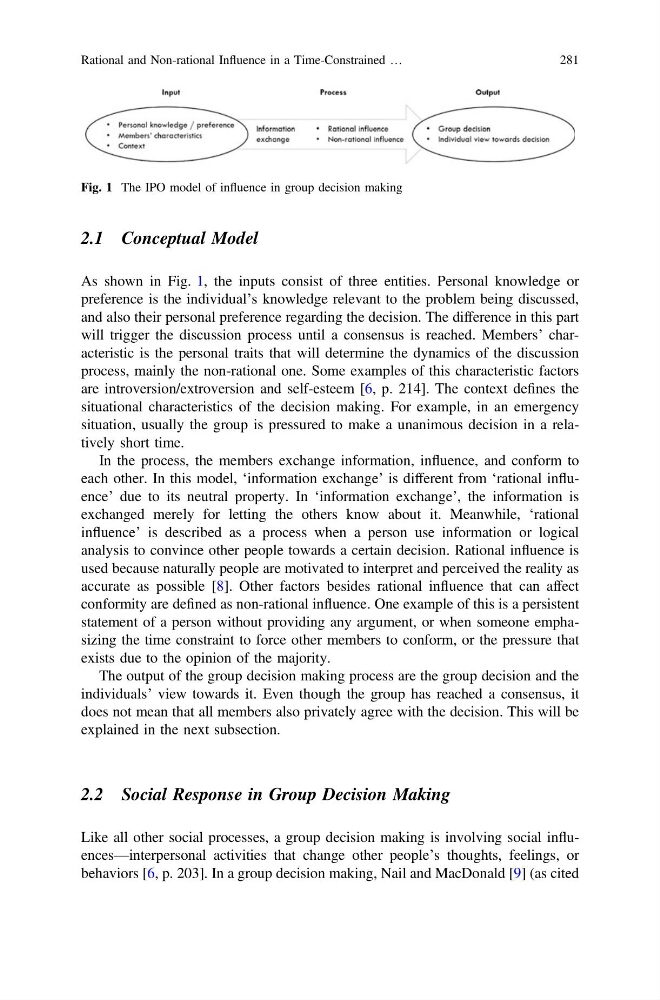
As shown in Fig. 1, the inputs consist of three entities. Personal knowledge or
preference is the individual’s knowledge relevant to the problem being discussed,
and also their personal preference regarding the decision. The difference in this part
will trigger the discussion process until a consensus is reached. Members’ characteristic is the personal traits that will determine the dynamics of the discussion
process, mainly the non-rational one. Some examples of this characteristic factors
are introversion/extroversion and self-esteem [6, p. 214]. The context defines the
situational characteristics of the decision making. For example, in an emergency
situation, usually the group is pressured to make a unanimous decision in a relatively short time.
In the process, the members exchange information, influence, and conform to
each other. In this model, ‘information exchange’ is different from ‘rational influence’ due to its neutral property. In ‘information exchange’, the information is
exchanged merely for letting the others know about it. Meanwhile, ‘rational
influence’ is described as a process when a person use information or logical
analysis to convince other people towards a certain decision. Rational influence is
used because naturally people are motivated to interpret and perceived the reality as
accurate as possible [8]. Other factors besides rational influence that can affect
conformity are defined as non-rational influence. One example of this is a persistent
statement of a person without providing any argument, or when someone emphasizing the time constraint to force other members to conform, or the pressure that
exists due to the opinion of the majority.
The output of the group decision making process are the group decision and the
individuals’ view towards it. Even though the group has reached a consensus, it
does not mean that all members also privately agree with the decision. This will be
explained in the next subsection.
2.2 Social Response in Group Decision Making
Like all other social processes, a group decision making is involving social influences—interpersonal activities that change other people’s thoughts, feelings, or
behaviors [6, p. 203]. In a group decision making, Nail and MacDonald [9] (as cited
Fig. 1 The IPO model of influence in group decision making
Rational and Non-rational Influence in a Time-Constrained …
281
As shown in Fig. 1, the inputs consist of three entities. Personal knowledge or
preference is the individual’s knowledge relevant to the problem being discussed,
and also their personal preference regarding the decision. The difference in this part
will trigger the discussion process until a consensus is reached. Members’ characteristic is the personal traits that will determine the dynamics of the discussion
process, mainly the non-rational one. Some examples of this characteristic factors
are introversion/extroversion and self-esteem [6, p. 214]. The context defines the
situational characteristics of the decision making. For example, in an emergency
situation, usually the group is pressured to make a unanimous decision in a relatively short time.
In the process, the members exchange information, influence, and conform to
each other. In this model, ‘information exchange’ is different from ‘rational influence’ due to its neutral property. In ‘information exchange’, the information is
exchanged merely for letting the others know about it. Meanwhile, ‘rational
influence’ is described as a process when a person use information or logical
analysis to convince other people towards a certain decision. Rational influence is
used because naturally people are motivated to interpret and perceived the reality as
accurate as possible [8]. Other factors besides rational influence that can affect
conformity are defined as non-rational influence. One example of this is a persistent
statement of a person without providing any argument, or when someone emphasizing the time constraint to force other members to conform, or the pressure that
exists due to the opinion of the majority.
The output of the group decision making process are the group decision and the
individuals’ view towards it. Even though the group has reached a consensus, it
does not mean that all members also privately agree with the decision. This will be
explained in the next subsection.
2.2 Social Response in Group Decision Making
Like all other social processes, a group decision making is involving social influences—interpersonal activities that change other people’s thoughts, feelings, or
behaviors [6, p. 203]. In a group decision making, Nail and MacDonald [9] (as cited
Fig. 1 The IPO model of influence in group decision making
Rational and Non-rational Influence in a Time-Constrained …
281