

Cobalt-60 is used by national and international organizations as a standard
candle for gamma rejection. In our detector, cobalt-60 is a proxy for unwanted low
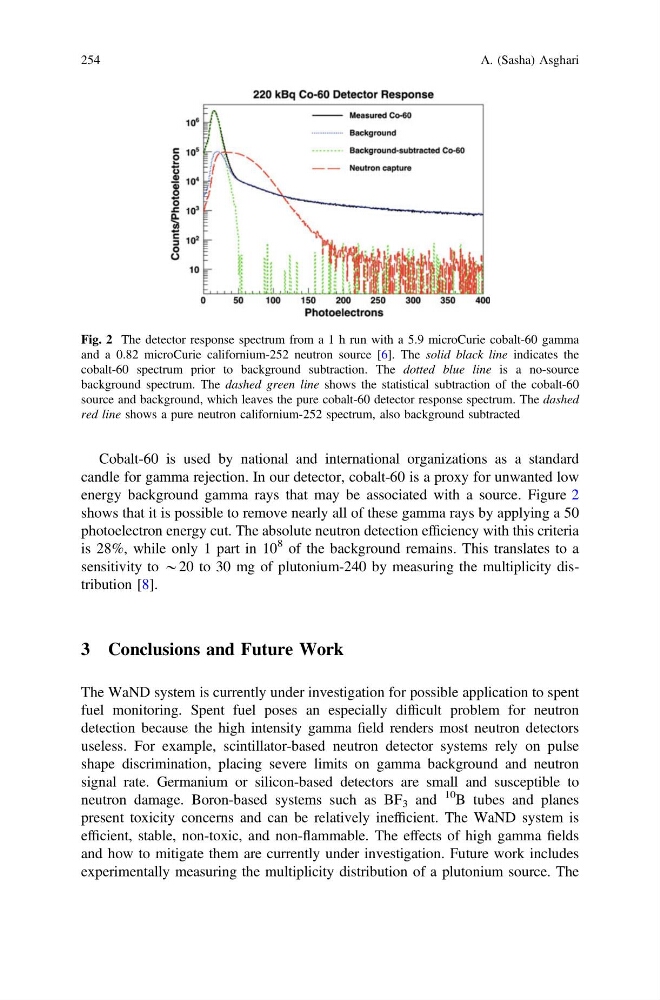
energy background gamma rays that may be associated with a source. Figure 2
shows that it is possible to remove nearly all of these gamma rays by applying a 50
photoelectron energy cut. The absolute neutron detection efficiency with this criteria
is 28%, while only 1 part in 10
8 of the background remains. This translates to a
sensitivity to *20 to 30 mg of plutonium-240 by measuring the multiplicity distribution [8].
3 Conclusions and Future Work
The WaND system is currently under investigation for possible application to spent
fuel monitoring. Spent fuel poses an especially difficult problem for neutron
detection because the high intensity gamma field renders most neutron detectors
useless. For example, scintillator-based neutron detector systems rely on pulse
shape discrimination, placing severe limits on gamma background and neutron
signal rate. Germanium or silicon-based detectors are small and susceptible to
neutron damage. Boron-based systems such as BF 3 and
10 B tubes and planes
present toxicity concerns and can be relatively inefficient. The WaND system is
efficient, stable, non-toxic, and non-flammable. The effects of high gamma fields
and how to mitigate them are currently under investigation. Future work includes
experimentally measuring the multiplicity distribution of a plutonium source. The
Fig. 2 The detector response spectrum from a 1 h run with a 5.9 microCurie cobalt-60 gamma
and a 0.82 microCurie californium-252 neutron source [6]. The solid black line indicates the
cobalt-60 spectrum prior to background subtraction. The dotted blue line is a no-source
background spectrum. The dashed green line shows the statistical subtraction of the cobalt-60
source and background, which leaves the pure cobalt-60 detector response spectrum. The dashed
red line shows a pure neutron californium-252 spectrum, also background subtracted
254
A. (Sasha) Asghari
candle for gamma rejection. In our detector, cobalt-60 is a proxy for unwanted low
energy background gamma rays that may be associated with a source. Figure 2
shows that it is possible to remove nearly all of these gamma rays by applying a 50
photoelectron energy cut. The absolute neutron detection efficiency with this criteria
is 28%, while only 1 part in 10
8 of the background remains. This translates to a
sensitivity to *20 to 30 mg of plutonium-240 by measuring the multiplicity distribution [8].
3 Conclusions and Future Work
The WaND system is currently under investigation for possible application to spent
fuel monitoring. Spent fuel poses an especially difficult problem for neutron
detection because the high intensity gamma field renders most neutron detectors
useless. For example, scintillator-based neutron detector systems rely on pulse
shape discrimination, placing severe limits on gamma background and neutron
signal rate. Germanium or silicon-based detectors are small and susceptible to
neutron damage. Boron-based systems such as BF 3 and
10 B tubes and planes
present toxicity concerns and can be relatively inefficient. The WaND system is
efficient, stable, non-toxic, and non-flammable. The effects of high gamma fields
and how to mitigate them are currently under investigation. Future work includes
experimentally measuring the multiplicity distribution of a plutonium source. The
Fig. 2 The detector response spectrum from a 1 h run with a 5.9 microCurie cobalt-60 gamma
and a 0.82 microCurie californium-252 neutron source [6]. The solid black line indicates the
cobalt-60 spectrum prior to background subtraction. The dotted blue line is a no-source
background spectrum. The dashed green line shows the statistical subtraction of the cobalt-60
source and background, which leaves the pure cobalt-60 detector response spectrum. The dashed
red line shows a pure neutron californium-252 spectrum, also background subtracted
254
A. (Sasha) Asghari