

people are still evacuated and many, particularly older people want to move back to
their homes and communities [22]. The research areas we are currently pursuing in
collaboration with scientists from JAEA aim at more effective means to map the
contamination, at a better understanding and improved predictive power of environmental transport models, enhanced understanding and measurements of internal
human radiation dose, and the removal of contamination from soil. While the focus
initially is on the most abundant contaminant left (cesium) in the environment of
Fukushima, the knowledge gained and technologies developed will provide significantly improved means in the aftermath of any radiological event in the future
that is associated with the release of radioactive materials. The environment in
Fukushima Prefecture represents a very different environment than, for example,
the region of Chernobyl, as Fukushima Prefecture consists of large portions of
forests and mountains with significant precipitation year-round, causing continuous
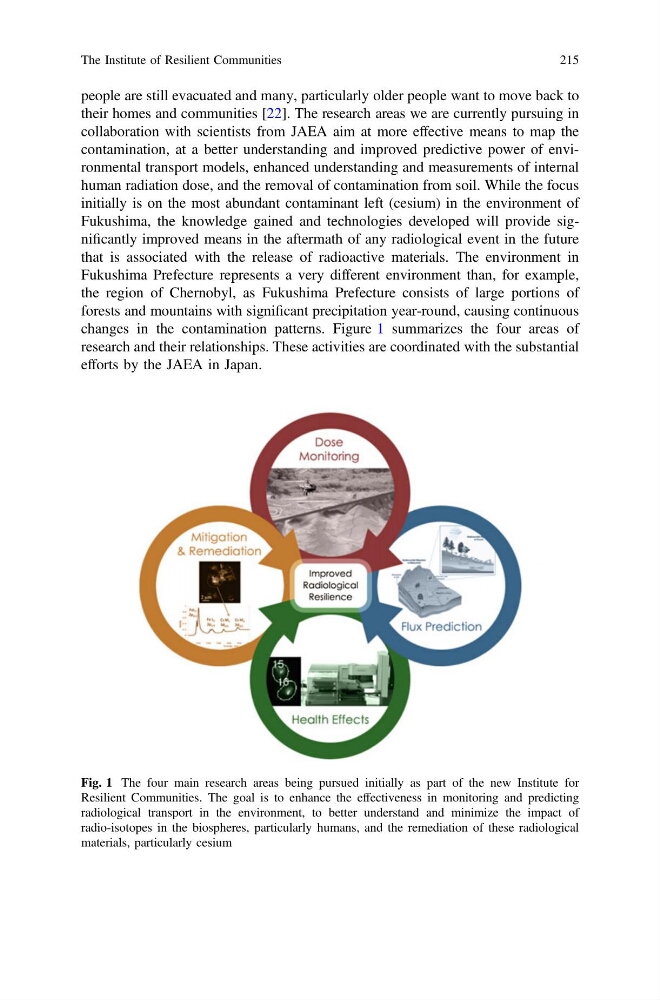
changes in the contamination patterns. Figure 1 summarizes the four areas of
research and their relationships. These activities are coordinated with the substantial
efforts by the JAEA in Japan.
Fig. 1 The four main research areas being pursued initially as part of the new Institute for
Resilient Communities. The goal is to enhance the effectiveness in monitoring and predicting
radiological transport in the environment, to better understand and minimize the impact of
radio-isotopes in the biospheres, particularly humans, and the remediation of these radiological
materials, particularly cesium
The Institute of Resilient Communities
215
their homes and communities [22]. The research areas we are currently pursuing in
collaboration with scientists from JAEA aim at more effective means to map the
contamination, at a better understanding and improved predictive power of environmental transport models, enhanced understanding and measurements of internal
human radiation dose, and the removal of contamination from soil. While the focus
initially is on the most abundant contaminant left (cesium) in the environment of
Fukushima, the knowledge gained and technologies developed will provide significantly improved means in the aftermath of any radiological event in the future
that is associated with the release of radioactive materials. The environment in
Fukushima Prefecture represents a very different environment than, for example,
the region of Chernobyl, as Fukushima Prefecture consists of large portions of
forests and mountains with significant precipitation year-round, causing continuous
changes in the contamination patterns. Figure 1 summarizes the four areas of
research and their relationships. These activities are coordinated with the substantial
efforts by the JAEA in Japan.
Fig. 1 The four main research areas being pursued initially as part of the new Institute for
Resilient Communities. The goal is to enhance the effectiveness in monitoring and predicting
radiological transport in the environment, to better understand and minimize the impact of
radio-isotopes in the biospheres, particularly humans, and the remediation of these radiological
materials, particularly cesium
The Institute of Resilient Communities
215