

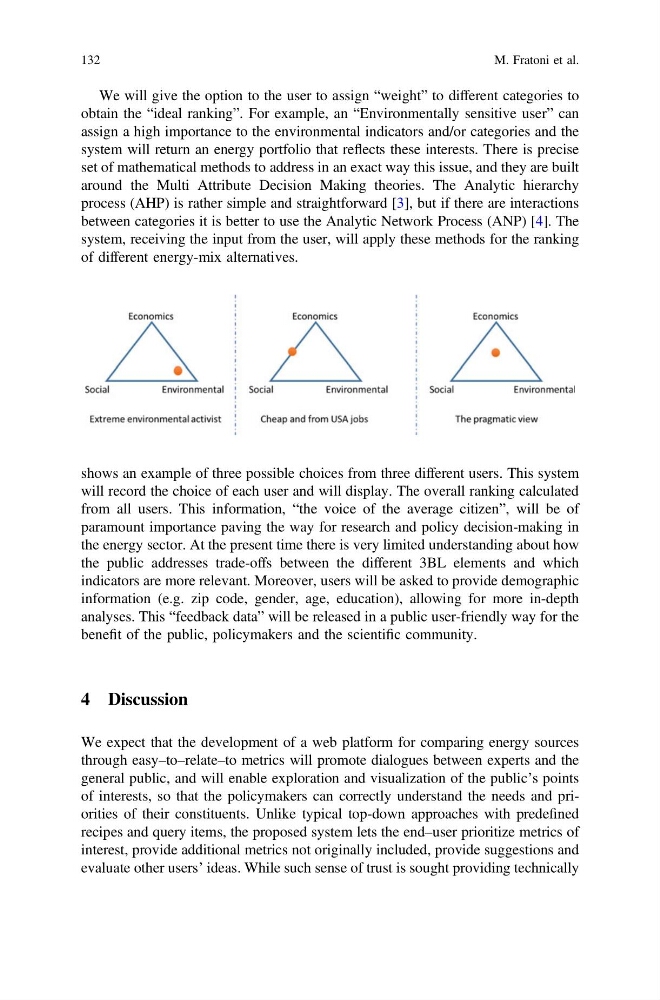
We will give the option to the user to assign “weight” to different categories to
obtain the “ideal ranking”. For example, an “Environmentally sensitive user” can
assign a high importance to the environmental indicators and/or categories and the
system will return an energy portfolio that reflects these interests. There is precise
set of mathematical methods to address in an exact way this issue, and they are built
around the Multi Attribute Decision Making theories. The Analytic hierarchy
process (AHP) is rather simple and straightforward [3], but if there are interactions
between categories it is better to use the Analytic Network Process (ANP) [4]. The
system, receiving the input from the user, will apply these methods for the ranking
of different energy-mix alternatives.
shows an example of three possible choices from three different users. This system
will record the choice of each user and will display. The overall ranking calculated
from all users. This information, “the voice of the average citizen”, will be of
paramount importance paving the way for research and policy decision-making in
the energy sector. At the present time there is very limited understanding about how
the public addresses trade-offs between the different 3BL elements and which
indicators are more relevant. Moreover, users will be asked to provide demographic
information (e.g. zip code, gender, age, education), allowing for more in-depth
analyses. This “feedback data” will be released in a public user-friendly way for the
benefit of the public, policymakers and the scientific community.
4 Discussion
We expect that the development of a web platform for comparing energy sources
through easy–to–relate–to metrics will promote dialogues between experts and the
general public, and will enable exploration and visualization of the public’s points
of interests, so that the policymakers can correctly understand the needs and priorities of their constituents. Unlike typical top-down approaches with predefined
recipes and query items, the proposed system lets the end–user prioritize metrics of
interest, provide additional metrics not originally included, provide suggestions and
evaluate other users’ ideas. While such sense of trust is sought providing technically
132
M. Fratoni et al.
obtain the “ideal ranking”. For example, an “Environmentally sensitive user” can
assign a high importance to the environmental indicators and/or categories and the
system will return an energy portfolio that reflects these interests. There is precise
set of mathematical methods to address in an exact way this issue, and they are built
around the Multi Attribute Decision Making theories. The Analytic hierarchy
process (AHP) is rather simple and straightforward [3], but if there are interactions
between categories it is better to use the Analytic Network Process (ANP) [4]. The
system, receiving the input from the user, will apply these methods for the ranking
of different energy-mix alternatives.
shows an example of three possible choices from three different users. This system
will record the choice of each user and will display. The overall ranking calculated
from all users. This information, “the voice of the average citizen”, will be of
paramount importance paving the way for research and policy decision-making in
the energy sector. At the present time there is very limited understanding about how
the public addresses trade-offs between the different 3BL elements and which
indicators are more relevant. Moreover, users will be asked to provide demographic
information (e.g. zip code, gender, age, education), allowing for more in-depth
analyses. This “feedback data” will be released in a public user-friendly way for the
benefit of the public, policymakers and the scientific community.
4 Discussion
We expect that the development of a web platform for comparing energy sources
through easy–to–relate–to metrics will promote dialogues between experts and the
general public, and will enable exploration and visualization of the public’s points
of interests, so that the policymakers can correctly understand the needs and priorities of their constituents. Unlike typical top-down approaches with predefined
recipes and query items, the proposed system lets the end–user prioritize metrics of
interest, provide additional metrics not originally included, provide suggestions and
evaluate other users’ ideas. While such sense of trust is sought providing technically
132
M. Fratoni et al.