

310
14 Summary: What’s Wrong with AI?
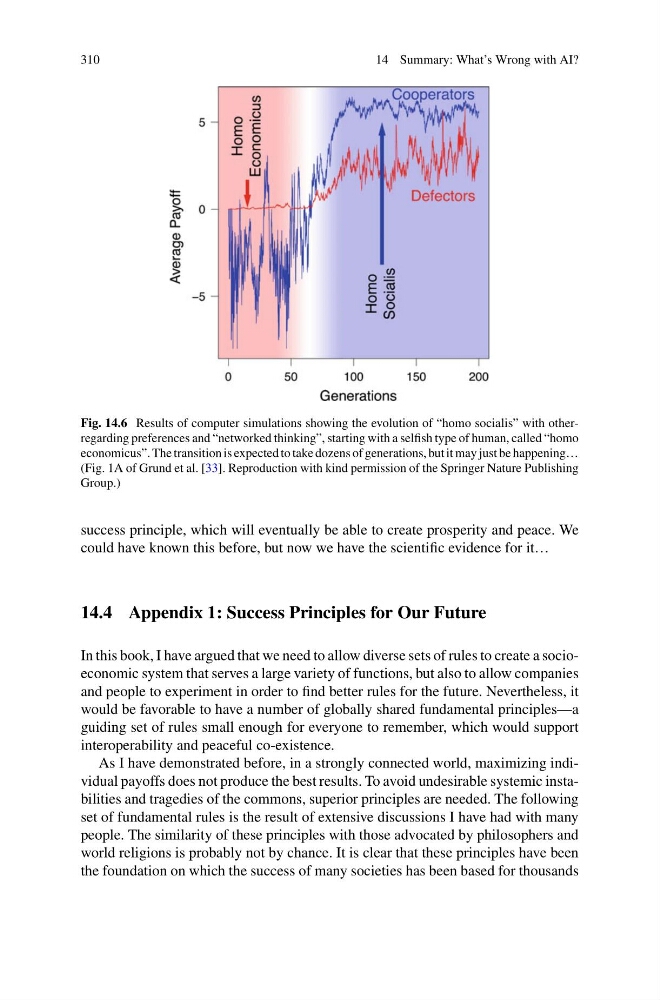
Fig. 14.6 Results of computer simulations showing the evolution of “homo socialis” with otherregarding preferences and “networked thinking”, starting with a selfish type of human, called “homo
economicus”. The transition is expected to take dozens of generations, but it may just be happening…
(Fig. 1A of Grund et al. [33]. Reproduction with kind permission of the Springer Nature Publishing
Group.)
success principle, which will eventually be able to create prosperity and peace. We
could have known this before, but now we have the scientific evidence for it…
14.4 Appendix 1: Success Principles for Our Future
In this book, I have argued that we need to allow diverse sets of rules to create a socioeconomic system that serves a large variety of functions, but also to allow companies
and people to experiment in order to find better rules for the future. Nevertheless, it
would be favorable to have a number of globally shared fundamental principles—a
guiding set of rules small enough for everyone to remember, which would support
interoperability and peaceful co-existence.
As I have demonstrated before, in a strongly connected world, maximizing individual payoffs does not produce the best results. To avoid undesirable systemic instabilities and tragedies of the commons, superior principles are needed. The following
set of fundamental rules is the result of extensive discussions I have had with many
people. The similarity of these principles with those advocated by philosophers and
world religions is probably not by chance. It is clear that these principles have been
the foundation on which the success of many societies has been based for thousands
14 Summary: What’s Wrong with AI?
Fig. 14.6 Results of computer simulations showing the evolution of “homo socialis” with otherregarding preferences and “networked thinking”, starting with a selfish type of human, called “homo
economicus”. The transition is expected to take dozens of generations, but it may just be happening…
(Fig. 1A of Grund et al. [33]. Reproduction with kind permission of the Springer Nature Publishing
Group.)
success principle, which will eventually be able to create prosperity and peace. We
could have known this before, but now we have the scientific evidence for it…
14.4 Appendix 1: Success Principles for Our Future
In this book, I have argued that we need to allow diverse sets of rules to create a socioeconomic system that serves a large variety of functions, but also to allow companies
and people to experiment in order to find better rules for the future. Nevertheless, it
would be favorable to have a number of globally shared fundamental principles—a
guiding set of rules small enough for everyone to remember, which would support
interoperability and peaceful co-existence.
As I have demonstrated before, in a strongly connected world, maximizing individual payoffs does not produce the best results. To avoid undesirable systemic instabilities and tragedies of the commons, superior principles are needed. The following
set of fundamental rules is the result of extensive discussions I have had with many
people. The similarity of these principles with those advocated by philosophers and
world religions is probably not by chance. It is clear that these principles have been
the foundation on which the success of many societies has been based for thousands