

234
11 The Self-Organizing Society
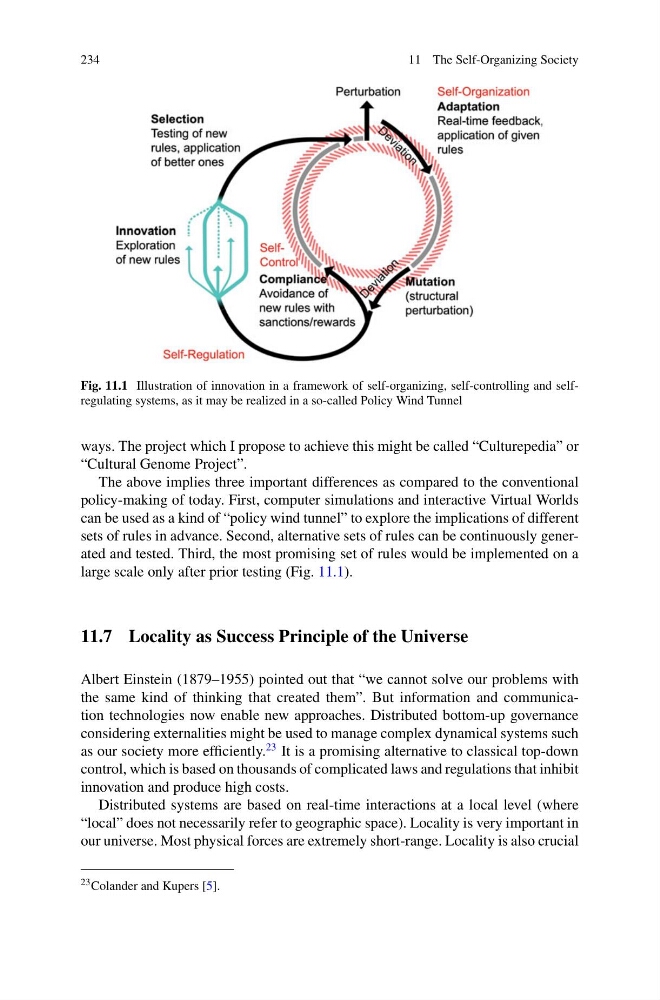
Fig. 11.1 Illustration of innovation in a framework of self-organizing, self-controlling and selfregulating systems, as it may be realized in a so-called Policy Wind Tunnel
ways. The project which I propose to achieve this might be called “Culturepedia” or
“Cultural Genome Project”.
The above implies three important differences as compared to the conventional
policy-making of today. First, computer simulations and interactive Virtual Worlds
can be used as a kind of “policy wind tunnel” to explore the implications of different
sets of rules in advance. Second, alternative sets of rules can be continuously generated and tested. Third, the most promising set of rules would be implemented on a
large scale only after prior testing (Fig. 11.1).
11.7 Locality as Success Principle of the Universe
Albert Einstein (1879–1955) pointed out that “we cannot solve our problems with
the same kind of thinking that created them”. But information and communication technologies now enable new approaches. Distributed bottom-up governance
considering externalities might be used to manage complex dynamical systems such
as our society more efficiently.
23 It is a promising alternative to classical top-down
control, which is based on thousands of complicated laws and regulations that inhibit
innovation and produce high costs.
Distributed systems are based on real-time interactions at a local level (where
“local” does not necessarily refer to geographic space). Locality is very important in
our universe. Most physical forces are extremely short-range. Locality is also crucial
23 Colander and Kupers [5].
11 The Self-Organizing Society
Fig. 11.1 Illustration of innovation in a framework of self-organizing, self-controlling and selfregulating systems, as it may be realized in a so-called Policy Wind Tunnel
ways. The project which I propose to achieve this might be called “Culturepedia” or
“Cultural Genome Project”.
The above implies three important differences as compared to the conventional
policy-making of today. First, computer simulations and interactive Virtual Worlds
can be used as a kind of “policy wind tunnel” to explore the implications of different
sets of rules in advance. Second, alternative sets of rules can be continuously generated and tested. Third, the most promising set of rules would be implemented on a
large scale only after prior testing (Fig. 11.1).
11.7 Locality as Success Principle of the Universe
Albert Einstein (1879–1955) pointed out that “we cannot solve our problems with
the same kind of thinking that created them”. But information and communication technologies now enable new approaches. Distributed bottom-up governance
considering externalities might be used to manage complex dynamical systems such
as our society more efficiently.
23 It is a promising alternative to classical top-down
control, which is based on thousands of complicated laws and regulations that inhibit
innovation and produce high costs.
Distributed systems are based on real-time interactions at a local level (where
“local” does not necessarily refer to geographic space). Locality is very important in
our universe. Most physical forces are extremely short-range. Locality is also crucial
23 Colander and Kupers [5].