

10.14 A New Kind of Economy Is Born
215
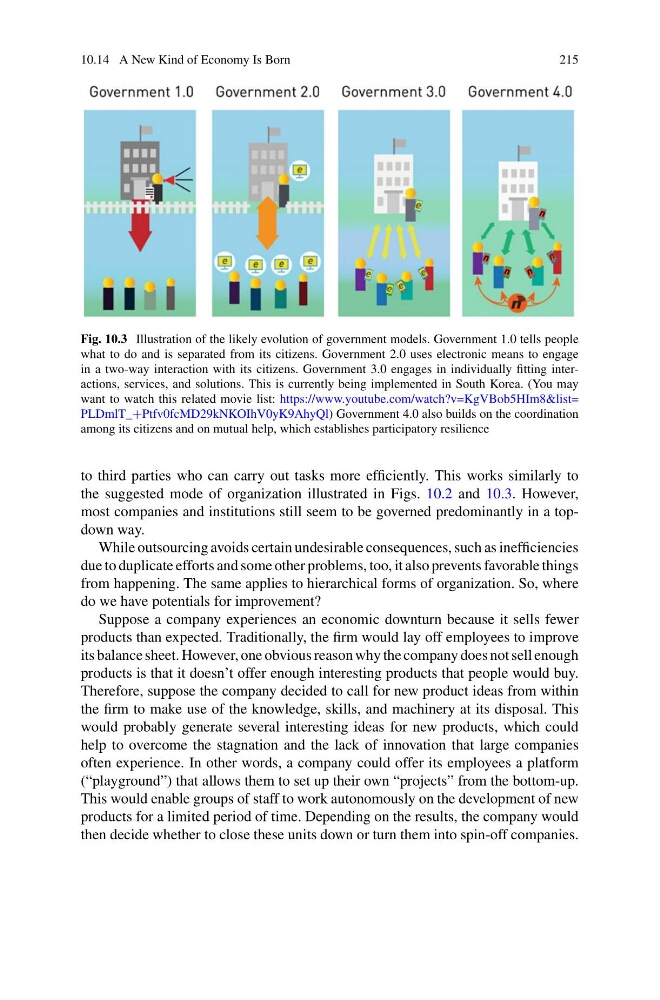
Fig. 10.3 Illustration of the likely evolution of government models. Government 1.0 tells people
what to do and is separated from its citizens. Government 2.0 uses electronic means to engage
in a two-way interaction with its citizens. Government 3.0 engages in individually fitting interactions, services, and solutions. This is currently being implemented in South Korea. (You may
want to watch this related movie list: https://www.youtube.com/watch?v=KgVBob5HIm8&list=
PLDmlT_+Ptfv0fcMD29kNKOIhV0yK9AhyQl) Government 4.0 also builds on the coordination
among its citizens and on mutual help, which establishes participatory resilience
to third parties who can carry out tasks more efficiently. This works similarly to
the suggested mode of organization illustrated in Figs. 10.2 and 10.3. However,
most companies and institutions still seem to be governed predominantly in a topdown way.
While outsourcing avoids certain undesirable consequences, such as inefficiencies
due to duplicate efforts and some other problems, too, it also prevents favorable things
from happening. The same applies to hierarchical forms of organization. So, where
do we have potentials for improvement?
Suppose a company experiences an economic downturn because it sells fewer
products than expected. Traditionally, the firm would lay off employees to improve
its balance sheet. However, one obvious reason why the company does not sell enough
products is that it doesn’t offer enough interesting products that people would buy.
Therefore, suppose the company decided to call for new product ideas from within
the firm to make use of the knowledge, skills, and machinery at its disposal. This
would probably generate several interesting ideas for new products, which could
help to overcome the stagnation and the lack of innovation that large companies
often experience. In other words, a company could offer its employees a platform
(“playground”) that allows them to set up their own “projects” from the bottom-up.
This would enable groups of staff to work autonomously on the development of new
products for a limited period of time. Depending on the results, the company would
then decide whether to close these units down or turn them into spin-off companies.
215
Fig. 10.3 Illustration of the likely evolution of government models. Government 1.0 tells people
what to do and is separated from its citizens. Government 2.0 uses electronic means to engage
in a two-way interaction with its citizens. Government 3.0 engages in individually fitting interactions, services, and solutions. This is currently being implemented in South Korea. (You may
want to watch this related movie list: https://www.youtube.com/watch?v=KgVBob5HIm8&list=
PLDmlT_+Ptfv0fcMD29kNKOIhV0yK9AhyQl) Government 4.0 also builds on the coordination
among its citizens and on mutual help, which establishes participatory resilience
to third parties who can carry out tasks more efficiently. This works similarly to
the suggested mode of organization illustrated in Figs. 10.2 and 10.3. However,
most companies and institutions still seem to be governed predominantly in a topdown way.
While outsourcing avoids certain undesirable consequences, such as inefficiencies
due to duplicate efforts and some other problems, too, it also prevents favorable things
from happening. The same applies to hierarchical forms of organization. So, where
do we have potentials for improvement?
Suppose a company experiences an economic downturn because it sells fewer
products than expected. Traditionally, the firm would lay off employees to improve
its balance sheet. However, one obvious reason why the company does not sell enough
products is that it doesn’t offer enough interesting products that people would buy.
Therefore, suppose the company decided to call for new product ideas from within
the firm to make use of the knowledge, skills, and machinery at its disposal. This
would probably generate several interesting ideas for new products, which could
help to overcome the stagnation and the lack of innovation that large companies
often experience. In other words, a company could offer its employees a platform
(“playground”) that allows them to set up their own “projects” from the bottom-up.
This would enable groups of staff to work autonomously on the development of new
products for a limited period of time. Depending on the results, the company would
then decide whether to close these units down or turn them into spin-off companies.