

10.12 Allowing Diverse Resources to Come Together Quickly
213
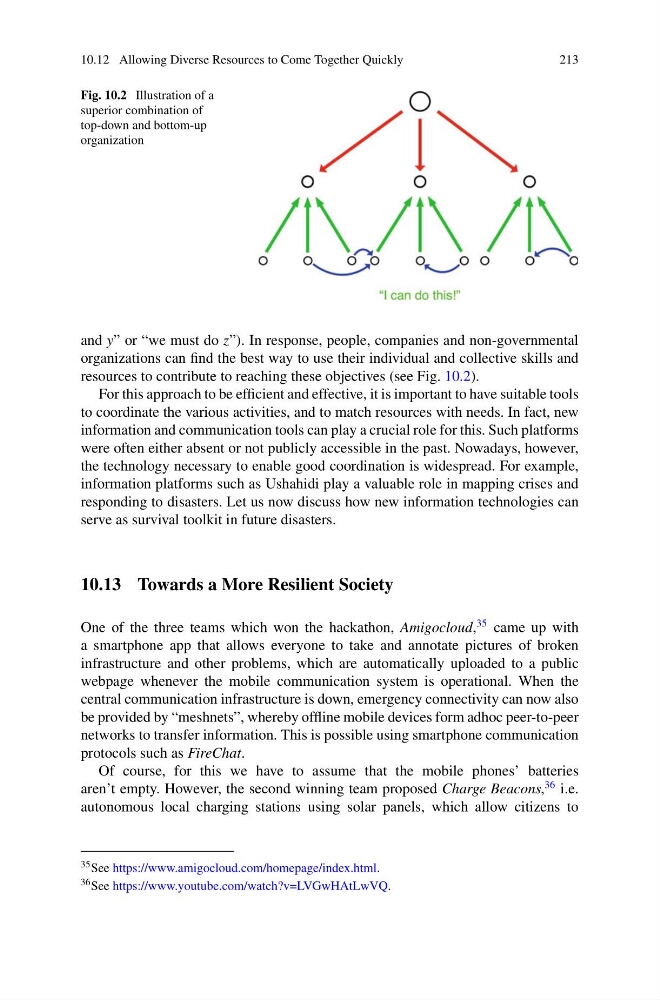
Fig. 10.2 Illustration of a
superior combination of
top-down and bottom-up
organization
and y” or “we must do z”). In response, people, companies and non-governmental
organizations can find the best way to use their individual and collective skills and
resources to contribute to reaching these objectives (see Fig. 10.2).
For this approach to be efficient and effective, it is important to have suitable tools
to coordinate the various activities, and to match resources with needs. In fact, new
information and communication tools can play a crucial role for this. Such platforms
were often either absent or not publicly accessible in the past. Nowadays, however,
the technology necessary to enable good coordination is widespread. For example,
information platforms such as Ushahidi play a valuable role in mapping crises and
responding to disasters. Let us now discuss how new information technologies can
serve as survival toolkit in future disasters.
10.13 Towards a More Resilient Society
One of the three teams which won the hackathon, Amigocloud,
35 came up with
a smartphone app that allows everyone to take and annotate pictures of broken
infrastructure and other problems, which are automatically uploaded to a public
webpage whenever the mobile communication system is operational. When the
central communication infrastructure is down, emergency connectivity can now also
be provided by “meshnets”, whereby offline mobile devices form adhoc peer-to-peer
networks to transfer information. This is possible using smartphone communication
protocols such as FireChat.
Of course, for this we have to assume that the mobile phones’ batteries
aren’t empty. However, the second winning team proposed Charge Beacons,
36 i.e.
autonomous local charging stations using solar panels, which allow citizens to
35 See https://www.amigocloud.com/homepage/index.html.
36 See https://www.youtube.com/watch?v=LVGwHAtLwVQ.
213
Fig. 10.2 Illustration of a
superior combination of
top-down and bottom-up
organization
and y” or “we must do z”). In response, people, companies and non-governmental
organizations can find the best way to use their individual and collective skills and
resources to contribute to reaching these objectives (see Fig. 10.2).
For this approach to be efficient and effective, it is important to have suitable tools
to coordinate the various activities, and to match resources with needs. In fact, new
information and communication tools can play a crucial role for this. Such platforms
were often either absent or not publicly accessible in the past. Nowadays, however,
the technology necessary to enable good coordination is widespread. For example,
information platforms such as Ushahidi play a valuable role in mapping crises and
responding to disasters. Let us now discuss how new information technologies can
serve as survival toolkit in future disasters.
10.13 Towards a More Resilient Society
One of the three teams which won the hackathon, Amigocloud,
35 came up with
a smartphone app that allows everyone to take and annotate pictures of broken
infrastructure and other problems, which are automatically uploaded to a public
webpage whenever the mobile communication system is operational. When the
central communication infrastructure is down, emergency connectivity can now also
be provided by “meshnets”, whereby offline mobile devices form adhoc peer-to-peer
networks to transfer information. This is possible using smartphone communication
protocols such as FireChat.
Of course, for this we have to assume that the mobile phones’ batteries
aren’t empty. However, the second winning team proposed Charge Beacons,
36 i.e.
autonomous local charging stations using solar panels, which allow citizens to
35 See https://www.amigocloud.com/homepage/index.html.
36 See https://www.youtube.com/watch?v=LVGwHAtLwVQ.