

9.9 Making Mistakes Is Important!
185
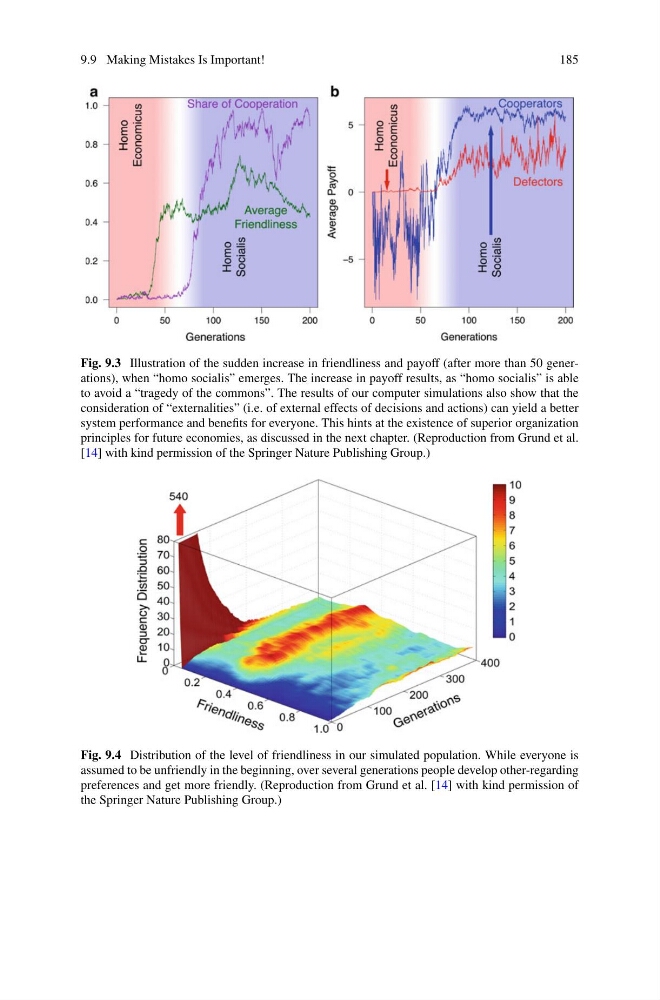
Fig. 9.3 Illustration of the sudden increase in friendliness and payoff (after more than 50 generations), when “homo socialis” emerges. The increase in payoff results, as “homo socialis” is able
to avoid a “tragedy of the commons”. The results of our computer simulations also show that the
consideration of “externalities” (i.e. of external effects of decisions and actions) can yield a better
system performance and benefits for everyone. This hints at the existence of superior organization
principles for future economies, as discussed in the next chapter. (Reproduction from Grund et al.
[14] with kind permission of the Springer Nature Publishing Group.)
Fig. 9.4 Distribution of the level of friendliness in our simulated population. While everyone is
assumed to be unfriendly in the beginning, over several generations people develop other-regarding
preferences and get more friendly. (Reproduction from Grund et al. [14] with kind permission of
the Springer Nature Publishing Group.)
185
Fig. 9.3 Illustration of the sudden increase in friendliness and payoff (after more than 50 generations), when “homo socialis” emerges. The increase in payoff results, as “homo socialis” is able
to avoid a “tragedy of the commons”. The results of our computer simulations also show that the
consideration of “externalities” (i.e. of external effects of decisions and actions) can yield a better
system performance and benefits for everyone. This hints at the existence of superior organization
principles for future economies, as discussed in the next chapter. (Reproduction from Grund et al.
[14] with kind permission of the Springer Nature Publishing Group.)
Fig. 9.4 Distribution of the level of friendliness in our simulated population. While everyone is
assumed to be unfriendly in the beginning, over several generations people develop other-regarding
preferences and get more friendly. (Reproduction from Grund et al. [14] with kind permission of
the Springer Nature Publishing Group.)