

8.16 Merit-Based Matching: Who Pays More Earns More
167
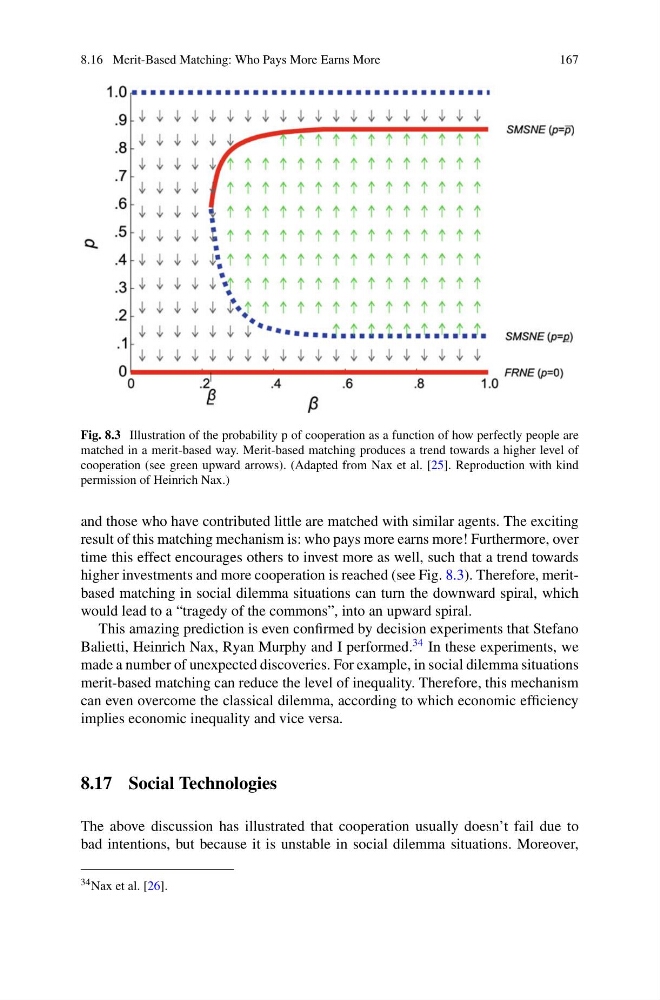
Fig. 8.3 Illustration of the probability p of cooperation as a function of how perfectly people are
matched in a merit-based way. Merit-based matching produces a trend towards a higher level of
cooperation (see green upward arrows). (Adapted from Nax et al. [25]. Reproduction with kind
permission of Heinrich Nax.)
and those who have contributed little are matched with similar agents. The exciting
result of this matching mechanism is: who pays more earns more! Furthermore, over
time this effect encourages others to invest more as well, such that a trend towards
higher investments and more cooperation is reached (see Fig. 8.3). Therefore, meritbased matching in social dilemma situations can turn the downward spiral, which
would lead to a “tragedy of the commons”, into an upward spiral.
This amazing prediction is even confirmed by decision experiments that Stefano
Balietti, Heinrich Nax, Ryan Murphy and I performed.
34 In these experiments, we
made a number of unexpected discoveries. For example, in social dilemma situations
merit-based matching can reduce the level of inequality. Therefore, this mechanism
can even overcome the classical dilemma, according to which economic efficiency
implies economic inequality and vice versa.
8.17 Social Technologies
The above discussion has illustrated that cooperation usually doesn’t fail due to
bad intentions, but because it is unstable in social dilemma situations. Moreover,
34 Nax et al. [26].
167
Fig. 8.3 Illustration of the probability p of cooperation as a function of how perfectly people are
matched in a merit-based way. Merit-based matching produces a trend towards a higher level of
cooperation (see green upward arrows). (Adapted from Nax et al. [25]. Reproduction with kind
permission of Heinrich Nax.)
and those who have contributed little are matched with similar agents. The exciting
result of this matching mechanism is: who pays more earns more! Furthermore, over
time this effect encourages others to invest more as well, such that a trend towards
higher investments and more cooperation is reached (see Fig. 8.3). Therefore, meritbased matching in social dilemma situations can turn the downward spiral, which
would lead to a “tragedy of the commons”, into an upward spiral.
This amazing prediction is even confirmed by decision experiments that Stefano
Balietti, Heinrich Nax, Ryan Murphy and I performed.
34 In these experiments, we
made a number of unexpected discoveries. For example, in social dilemma situations
merit-based matching can reduce the level of inequality. Therefore, this mechanism
can even overcome the classical dilemma, according to which economic efficiency
implies economic inequality and vice versa.
8.17 Social Technologies
The above discussion has illustrated that cooperation usually doesn’t fail due to
bad intentions, but because it is unstable in social dilemma situations. Moreover,
34 Nax et al. [26].