

164
8 How Society Works
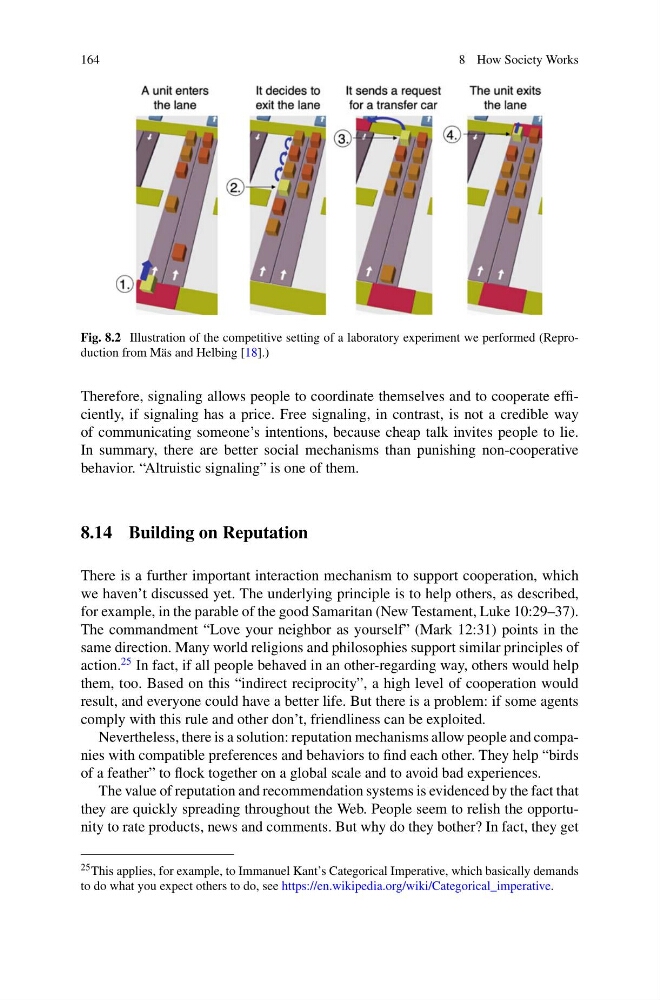
Fig. 8.2 Illustration of the competitive setting of a laboratory experiment we performed (Reproduction from Mäs and Helbing [18].)
Therefore, signaling allows people to coordinate themselves and to cooperate efficiently, if signaling has a price. Free signaling, in contrast, is not a credible way
of communicating someone’s intentions, because cheap talk invites people to lie.
In summary, there are better social mechanisms than punishing non-cooperative
behavior. “Altruistic signaling” is one of them.
8.14 Building on Reputation
There is a further important interaction mechanism to support cooperation, which
we haven’t discussed yet. The underlying principle is to help others, as described,
for example, in the parable of the good Samaritan (New Testament, Luke 10:29–37).
The commandment “Love your neighbor as yourself” (Mark 12:31) points in the
same direction. Many world religions and philosophies support similar principles of
action.
25 In fact, if all people behaved in an other-regarding way, others would help
them, too. Based on this “indirect reciprocity”, a high level of cooperation would
result, and everyone could have a better life. But there is a problem: if some agents
comply with this rule and other don’t, friendliness can be exploited.
Nevertheless, there is a solution: reputation mechanisms allow people and companies with compatible preferences and behaviors to find each other. They help “birds
of a feather” to flock together on a global scale and to avoid bad experiences.
The value of reputation and recommendation systems is evidenced by the fact that
they are quickly spreading throughout the Web. People seem to relish the opportunity to rate products, news and comments. But why do they bother? In fact, they get
25 This applies, for example, to Immanuel Kant’s Categorical Imperative, which basically demands
to do what you expect others to do, see https://en.wikipedia.org/wiki/Categorical_imperative.
8 How Society Works
Fig. 8.2 Illustration of the competitive setting of a laboratory experiment we performed (Reproduction from Mäs and Helbing [18].)
Therefore, signaling allows people to coordinate themselves and to cooperate efficiently, if signaling has a price. Free signaling, in contrast, is not a credible way
of communicating someone’s intentions, because cheap talk invites people to lie.
In summary, there are better social mechanisms than punishing non-cooperative
behavior. “Altruistic signaling” is one of them.
8.14 Building on Reputation
There is a further important interaction mechanism to support cooperation, which
we haven’t discussed yet. The underlying principle is to help others, as described,
for example, in the parable of the good Samaritan (New Testament, Luke 10:29–37).
The commandment “Love your neighbor as yourself” (Mark 12:31) points in the
same direction. Many world religions and philosophies support similar principles of
action.
25 In fact, if all people behaved in an other-regarding way, others would help
them, too. Based on this “indirect reciprocity”, a high level of cooperation would
result, and everyone could have a better life. But there is a problem: if some agents
comply with this rule and other don’t, friendliness can be exploited.
Nevertheless, there is a solution: reputation mechanisms allow people and companies with compatible preferences and behaviors to find each other. They help “birds
of a feather” to flock together on a global scale and to avoid bad experiences.
The value of reputation and recommendation systems is evidenced by the fact that
they are quickly spreading throughout the Web. People seem to relish the opportunity to rate products, news and comments. But why do they bother? In fact, they get
25 This applies, for example, to Immanuel Kant’s Categorical Imperative, which basically demands
to do what you expect others to do, see https://en.wikipedia.org/wiki/Categorical_imperative.