

8.6 The Birth of Moral Behavior
157
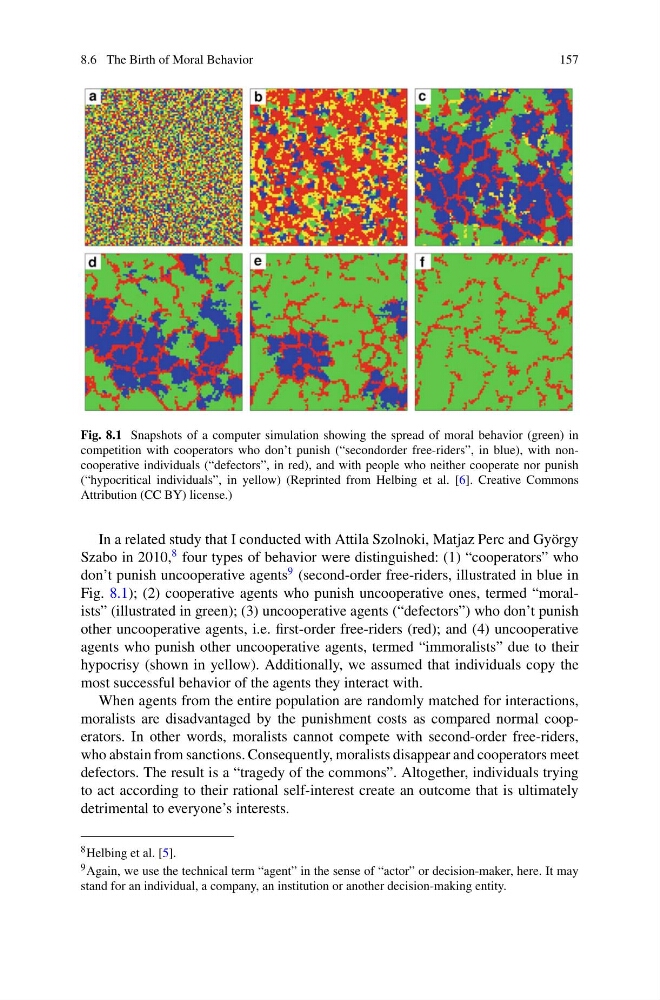
Fig. 8.1 Snapshots of a computer simulation showing the spread of moral behavior (green) in
competition with cooperators who don’t punish (“secondorder free-riders”, in blue), with noncooperative individuals (“defectors”, in red), and with people who neither cooperate nor punish
(“hypocritical individuals”, in yellow) (Reprinted from Helbing et al. [6]. Creative Commons
Attribution (CC BY) license.)
In a related study that I conducted with Attila Szolnoki, Matjaz Perc and György
Szabo in 2010,
8 four types of behavior were distinguished: (1) “cooperators” who
don’t punish uncooperative agents
9 (second-order free-riders, illustrated in blue in
Fig. 8.1); (2) cooperative agents who punish uncooperative ones, termed “moralists” (illustrated in green); (3) uncooperative agents (“defectors”) who don’t punish
other uncooperative agents, i.e. first-order free-riders (red); and (4) uncooperative
agents who punish other uncooperative agents, termed “immoralists” due to their
hypocrisy (shown in yellow). Additionally, we assumed that individuals copy the
most successful behavior of the agents they interact with.
When agents from the entire population are randomly matched for interactions,
moralists are disadvantaged by the punishment costs as compared normal cooperators. In other words, moralists cannot compete with second-order free-riders,
who abstain from sanctions. Consequently, moralists disappear and cooperators meet
defectors. The result is a “tragedy of the commons”. Altogether, individuals trying
to act according to their rational self-interest create an outcome that is ultimately
detrimental to everyone’s interests.
8 Helbing et al. [5].
9 Again, we use the technical term “agent” in the sense of “actor” or decision-maker, here. It may
stand for an individual, a company, an institution or another decision-making entity.
157
Fig. 8.1 Snapshots of a computer simulation showing the spread of moral behavior (green) in
competition with cooperators who don’t punish (“secondorder free-riders”, in blue), with noncooperative individuals (“defectors”, in red), and with people who neither cooperate nor punish
(“hypocritical individuals”, in yellow) (Reprinted from Helbing et al. [6]. Creative Commons
Attribution (CC BY) license.)
In a related study that I conducted with Attila Szolnoki, Matjaz Perc and György
Szabo in 2010,
8 four types of behavior were distinguished: (1) “cooperators” who
don’t punish uncooperative agents
9 (second-order free-riders, illustrated in blue in
Fig. 8.1); (2) cooperative agents who punish uncooperative ones, termed “moralists” (illustrated in green); (3) uncooperative agents (“defectors”) who don’t punish
other uncooperative agents, i.e. first-order free-riders (red); and (4) uncooperative
agents who punish other uncooperative agents, termed “immoralists” due to their
hypocrisy (shown in yellow). Additionally, we assumed that individuals copy the
most successful behavior of the agents they interact with.
When agents from the entire population are randomly matched for interactions,
moralists are disadvantaged by the punishment costs as compared normal cooperators. In other words, moralists cannot compete with second-order free-riders,
who abstain from sanctions. Consequently, moralists disappear and cooperators meet
defectors. The result is a “tragedy of the commons”. Altogether, individuals trying
to act according to their rational self-interest create an outcome that is ultimately
detrimental to everyone’s interests.
8 Helbing et al. [5].
9 Again, we use the technical term “agent” in the sense of “actor” or decision-maker, here. It may
stand for an individual, a company, an institution or another decision-making entity.