

150
7 Digitally Assisted Self-Organization
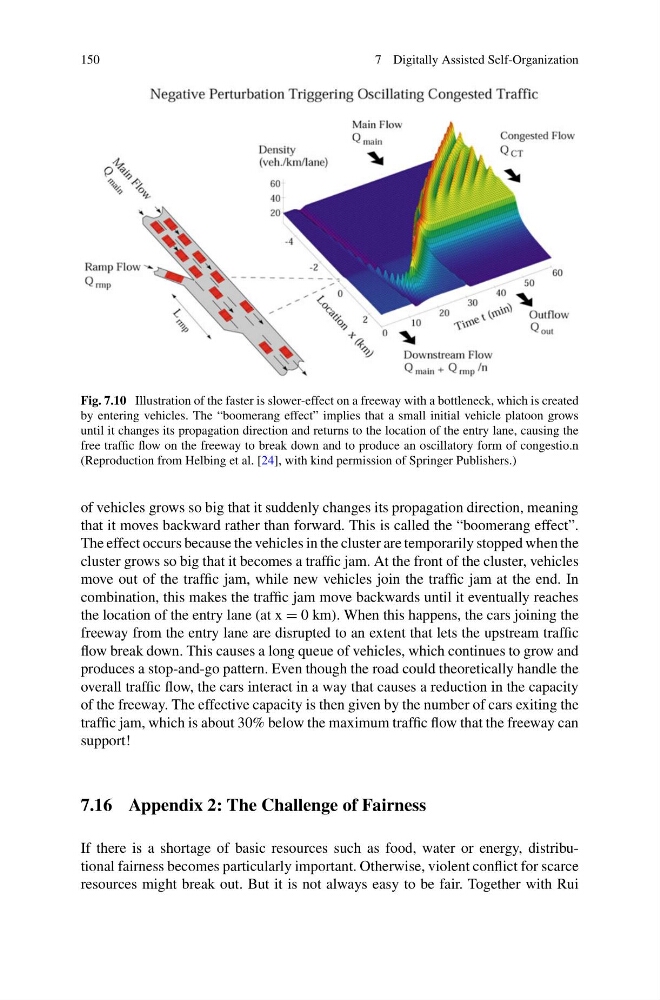
Fig. 7.10 Illustration of the faster is slower-effect on a freeway with a bottleneck, which is created
by entering vehicles. The “boomerang effect” implies that a small initial vehicle platoon grows
until it changes its propagation direction and returns to the location of the entry lane, causing the
free traffic flow on the freeway to break down and to produce an oscillatory form of congestio.n
(Reproduction from Helbing et al. [24], with kind permission of Springer Publishers.)
of vehicles grows so big that it suddenly changes its propagation direction, meaning
that it moves backward rather than forward. This is called the “boomerang effect”.
The effect occurs because the vehicles in the cluster are temporarily stopped when the
cluster grows so big that it becomes a traffic jam. At the front of the cluster, vehicles
move out of the traffic jam, while new vehicles join the traffic jam at the end. In
combination, this makes the traffic jam move backwards until it eventually reaches
the location of the entry lane (at x = 0 km). When this happens, the cars joining the
freeway from the entry lane are disrupted to an extent that lets the upstream traffic
flow break down. This causes a long queue of vehicles, which continues to grow and
produces a stop-and-go pattern. Even though the road could theoretically handle the
overall traffic flow, the cars interact in a way that causes a reduction in the capacity
of the freeway. The effective capacity is then given by the number of cars exiting the
traffic jam, which is about 30% below the maximum traffic flow that the freeway can
support!
7.16 Appendix 2: The Challenge of Fairness
If there is a shortage of basic resources such as food, water or energy, distributional fairness becomes particularly important. Otherwise, violent conflict for scarce
resources might break out. But it is not always easy to be fair. Together with Rui
7 Digitally Assisted Self-Organization
Fig. 7.10 Illustration of the faster is slower-effect on a freeway with a bottleneck, which is created
by entering vehicles. The “boomerang effect” implies that a small initial vehicle platoon grows
until it changes its propagation direction and returns to the location of the entry lane, causing the
free traffic flow on the freeway to break down and to produce an oscillatory form of congestio.n
(Reproduction from Helbing et al. [24], with kind permission of Springer Publishers.)
of vehicles grows so big that it suddenly changes its propagation direction, meaning
that it moves backward rather than forward. This is called the “boomerang effect”.
The effect occurs because the vehicles in the cluster are temporarily stopped when the
cluster grows so big that it becomes a traffic jam. At the front of the cluster, vehicles
move out of the traffic jam, while new vehicles join the traffic jam at the end. In
combination, this makes the traffic jam move backwards until it eventually reaches
the location of the entry lane (at x = 0 km). When this happens, the cars joining the
freeway from the entry lane are disrupted to an extent that lets the upstream traffic
flow break down. This causes a long queue of vehicles, which continues to grow and
produces a stop-and-go pattern. Even though the road could theoretically handle the
overall traffic flow, the cars interact in a way that causes a reduction in the capacity
of the freeway. The effective capacity is then given by the number of cars exiting the
traffic jam, which is about 30% below the maximum traffic flow that the freeway can
support!
7.16 Appendix 2: The Challenge of Fairness
If there is a shortage of basic resources such as food, water or energy, distributional fairness becomes particularly important. Otherwise, violent conflict for scarce
resources might break out. But it is not always easy to be fair. Together with Rui