

144
7 Digitally Assisted Self-Organization
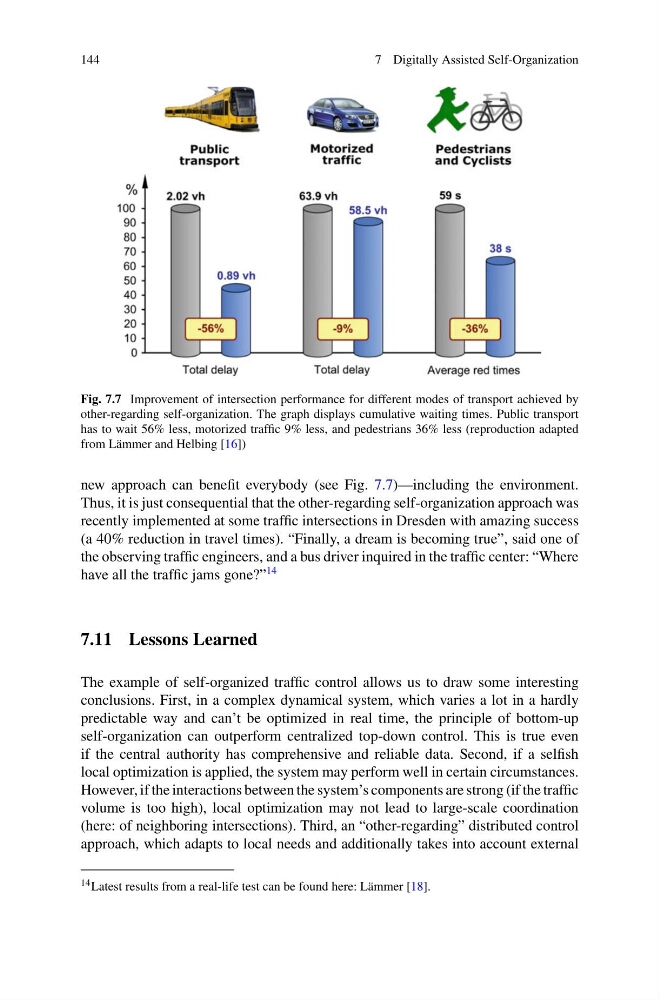
Fig. 7.7 Improvement of intersection performance for different modes of transport achieved by
other-regarding self-organization. The graph displays cumulative waiting times. Public transport
has to wait 56% less, motorized traffic 9% less, and pedestrians 36% less (reproduction adapted
from Lämmer and Helbing [16])
new approach can benefit everybody (see Fig. 7.7)—including the environment.
Thus, it is just consequential that the other-regarding self-organization approach was
recently implemented at some traffic intersections in Dresden with amazing success
(a 40% reduction in travel times). “Finally, a dream is becoming true”, said one of
the observing traffic engineers, and a bus driver inquired in the traffic center: “Where
have all the traffic jams gone?”
14
7.11 Lessons Learned
The example of self-organized traffic control allows us to draw some interesting
conclusions. First, in a complex dynamical system, which varies a lot in a hardly
predictable way and can’t be optimized in real time, the principle of bottom-up
self-organization can outperform centralized top-down control. This is true even
if the central authority has comprehensive and reliable data. Second, if a selfish
local optimization is applied, the system may perform well in certain circumstances.
However, if the interactions between the system’s components are strong (if the traffic
volume is too high), local optimization may not lead to large-scale coordination
(here: of neighboring intersections). Third, an “other-regarding” distributed control
approach, which adapts to local needs and additionally takes into account external
14 Latest results from a real-life test can be found here: Lämmer [18].
7 Digitally Assisted Self-Organization
Fig. 7.7 Improvement of intersection performance for different modes of transport achieved by
other-regarding self-organization. The graph displays cumulative waiting times. Public transport
has to wait 56% less, motorized traffic 9% less, and pedestrians 36% less (reproduction adapted
from Lämmer and Helbing [16])
new approach can benefit everybody (see Fig. 7.7)—including the environment.
Thus, it is just consequential that the other-regarding self-organization approach was
recently implemented at some traffic intersections in Dresden with amazing success
(a 40% reduction in travel times). “Finally, a dream is becoming true”, said one of
the observing traffic engineers, and a bus driver inquired in the traffic center: “Where
have all the traffic jams gone?”
14
7.11 Lessons Learned
The example of self-organized traffic control allows us to draw some interesting
conclusions. First, in a complex dynamical system, which varies a lot in a hardly
predictable way and can’t be optimized in real time, the principle of bottom-up
self-organization can outperform centralized top-down control. This is true even
if the central authority has comprehensive and reliable data. Second, if a selfish
local optimization is applied, the system may perform well in certain circumstances.
However, if the interactions between the system’s components are strong (if the traffic
volume is too high), local optimization may not lead to large-scale coordination
(here: of neighboring intersections). Third, an “other-regarding” distributed control
approach, which adapts to local needs and additionally takes into account external
14 Latest results from a real-life test can be found here: Lämmer [18].