

138
7 Digitally Assisted Self-Organization
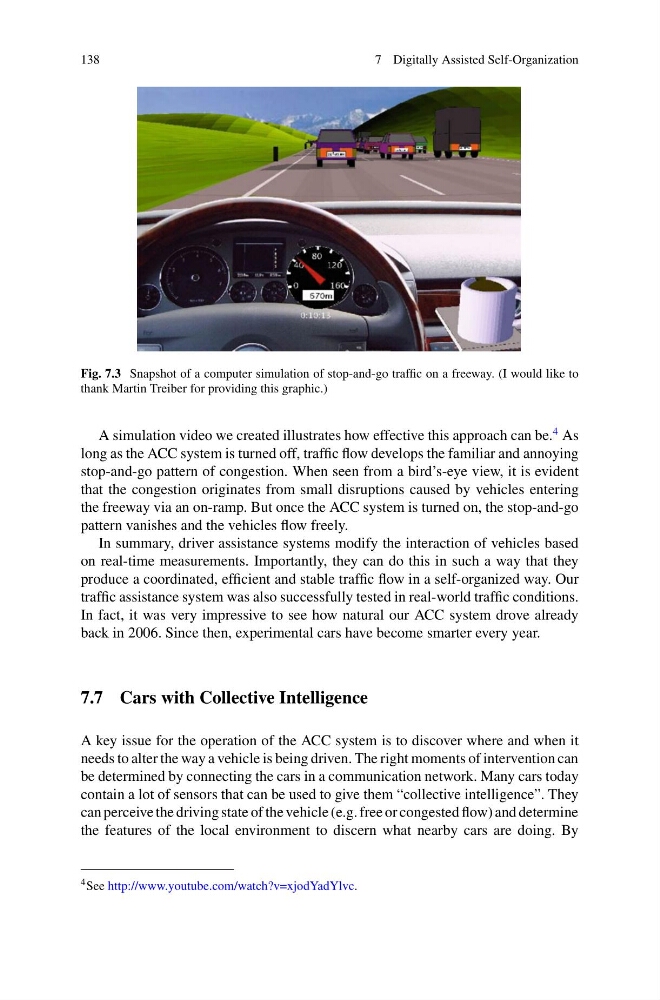
Fig. 7.3 Snapshot of a computer simulation of stop-and-go traffic on a freeway. (I would like to
thank Martin Treiber for providing this graphic.)
A simulation video we created illustrates how effective this approach can be.
4 As
long as the ACC system is turned off, traffic flow develops the familiar and annoying
stop-and-go pattern of congestion. When seen from a bird’s-eye view, it is evident
that the congestion originates from small disruptions caused by vehicles entering
the freeway via an on-ramp. But once the ACC system is turned on, the stop-and-go
pattern vanishes and the vehicles flow freely.
In summary, driver assistance systems modify the interaction of vehicles based
on real-time measurements. Importantly, they can do this in such a way that they
produce a coordinated, efficient and stable traffic flow in a self-organized way. Our
traffic assistance system was also successfully tested in real-world traffic conditions.
In fact, it was very impressive to see how natural our ACC system drove already
back in 2006. Since then, experimental cars have become smarter every year.
7.7 Cars with Collective Intelligence
A key issue for the operation of the ACC system is to discover where and when it
needs to alter the way a vehicle is being driven. The right moments of intervention can
be determined by connecting the cars in a communication network. Many cars today
contain a lot of sensors that can be used to give them “collective intelligence”. They
can perceive the driving state of the vehicle (e.g. free or congested flow) and determine
the features of the local environment to discern what nearby cars are doing. By
4 See http://www.youtube.com/watch?v=xjodYadYlvc.
7 Digitally Assisted Self-Organization
Fig. 7.3 Snapshot of a computer simulation of stop-and-go traffic on a freeway. (I would like to
thank Martin Treiber for providing this graphic.)
A simulation video we created illustrates how effective this approach can be.
4 As
long as the ACC system is turned off, traffic flow develops the familiar and annoying
stop-and-go pattern of congestion. When seen from a bird’s-eye view, it is evident
that the congestion originates from small disruptions caused by vehicles entering
the freeway via an on-ramp. But once the ACC system is turned on, the stop-and-go
pattern vanishes and the vehicles flow freely.
In summary, driver assistance systems modify the interaction of vehicles based
on real-time measurements. Importantly, they can do this in such a way that they
produce a coordinated, efficient and stable traffic flow in a self-organized way. Our
traffic assistance system was also successfully tested in real-world traffic conditions.
In fact, it was very impressive to see how natural our ACC system drove already
back in 2006. Since then, experimental cars have become smarter every year.
7.7 Cars with Collective Intelligence
A key issue for the operation of the ACC system is to discover where and when it
needs to alter the way a vehicle is being driven. The right moments of intervention can
be determined by connecting the cars in a communication network. Many cars today
contain a lot of sensors that can be used to give them “collective intelligence”. They
can perceive the driving state of the vehicle (e.g. free or congested flow) and determine
the features of the local environment to discern what nearby cars are doing. By
4 See http://www.youtube.com/watch?v=xjodYadYlvc.