

3 Reduced Phase Models of Oscillatory Neural Networks
33
The phase dynamics Eqs. (3.2 and 3.3) can subsequently be analyzed with respect
to the synchronization behavior of the network. A useful macroscopic observable to
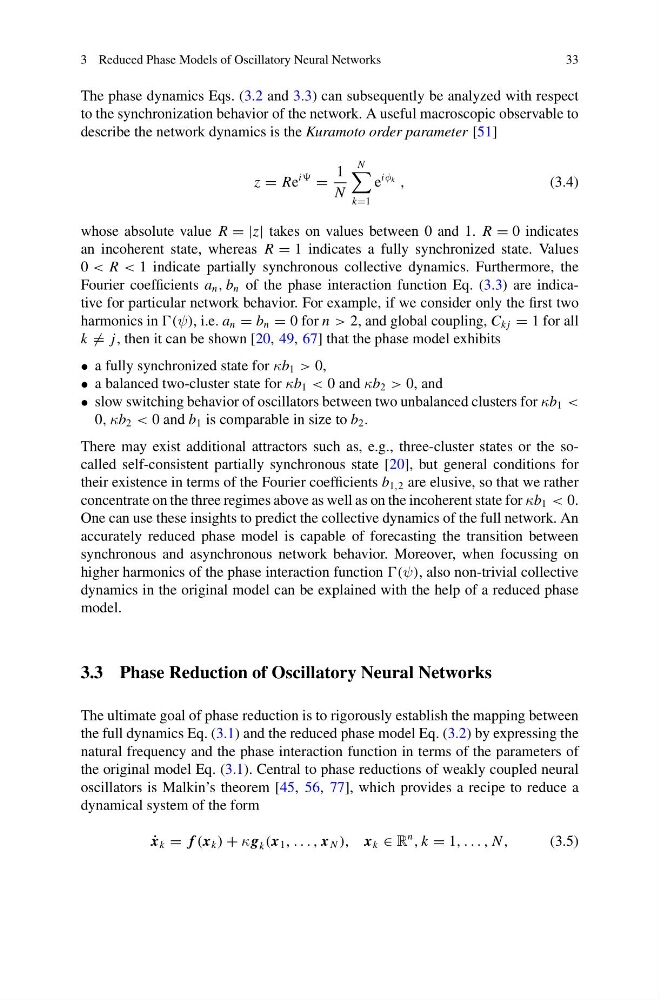
describe the network dynamics is the Kuramoto order parameter [51]
z = Re
i
=
1
N
N
k=1
e
iφ k ,
(3.4)
whose absolute value R = |z| takes on values between 0 and 1. R = 0 indicates
an incoherent state, whereas R = 1 indicates a fully synchronized state. Values
0 < R < 1 indicate partially synchronous collective dynamics. Furthermore, the
Fourier coefficients a n , b n of the phase interaction function Eq. (3.3) are indicative for particular network behavior. For example, if we consider only the first two
harmonics in (ψ), i.e. a n = b n = 0 for n > 2, and global coupling, C k j = 1 for all
k = j, then it can be shown [20, 49, 67] that the phase model exhibits
• a fully synchronized state for κb 1 > 0,
• a balanced two-cluster state for κb 1 < 0 and κb 2 > 0, and
• slow switching behavior of oscillators between two unbalanced clusters for κb 1 <
0, κb 2 < 0 and b 1 is comparable in size to b 2 .
There may exist additional attractors such as, e.g., three-cluster states or the socalled self-consistent partially synchronous state [20], but general conditions for
their existence in terms of the Fourier coefficients b 1,2 are elusive, so that we rather
concentrate on the three regimes above as well as on the incoherent state for κb 1 < 0.
One can use these insights to predict the collective dynamics of the full network. An
accurately reduced phase model is capable of forecasting the transition between
synchronous and asynchronous network behavior. Moreover, when focussing on
higher harmonics of the phase interaction function (ψ), also non-trivial collective
dynamics in the original model can be explained with the help of a reduced phase
model.
3.3 Phase Reduction of Oscillatory Neural Networks
The ultimate goal of phase reduction is to rigorously establish the mapping between
the full dynamics Eq. (3.1) and the reduced phase model Eq. (3.2) by expressing the
natural frequency and the phase interaction function in terms of the parameters of
the original model Eq. (3.1). Central to phase reductions of weakly coupled neural
oscillators is Malkin’s theorem [45, 56, 77], which provides a recipe to reduce a
dynamical system of the form
˙
x k = f (x k ) + κg k (x 1 , . . . , x N ), x k ∈ R
n
, k = 1, . . . , N ,
(3.5)
33
The phase dynamics Eqs. (3.2 and 3.3) can subsequently be analyzed with respect
to the synchronization behavior of the network. A useful macroscopic observable to
describe the network dynamics is the Kuramoto order parameter [51]
z = Re
i
=
1
N
N
k=1
e
iφ k ,
(3.4)
whose absolute value R = |z| takes on values between 0 and 1. R = 0 indicates
an incoherent state, whereas R = 1 indicates a fully synchronized state. Values
0 < R < 1 indicate partially synchronous collective dynamics. Furthermore, the
Fourier coefficients a n , b n of the phase interaction function Eq. (3.3) are indicative for particular network behavior. For example, if we consider only the first two
harmonics in (ψ), i.e. a n = b n = 0 for n > 2, and global coupling, C k j = 1 for all
k = j, then it can be shown [20, 49, 67] that the phase model exhibits
• a fully synchronized state for κb 1 > 0,
• a balanced two-cluster state for κb 1 < 0 and κb 2 > 0, and
• slow switching behavior of oscillators between two unbalanced clusters for κb 1 <
0, κb 2 < 0 and b 1 is comparable in size to b 2 .
There may exist additional attractors such as, e.g., three-cluster states or the socalled self-consistent partially synchronous state [20], but general conditions for
their existence in terms of the Fourier coefficients b 1,2 are elusive, so that we rather
concentrate on the three regimes above as well as on the incoherent state for κb 1 < 0.
One can use these insights to predict the collective dynamics of the full network. An
accurately reduced phase model is capable of forecasting the transition between
synchronous and asynchronous network behavior. Moreover, when focussing on
higher harmonics of the phase interaction function (ψ), also non-trivial collective
dynamics in the original model can be explained with the help of a reduced phase
model.
3.3 Phase Reduction of Oscillatory Neural Networks
The ultimate goal of phase reduction is to rigorously establish the mapping between
the full dynamics Eq. (3.1) and the reduced phase model Eq. (3.2) by expressing the
natural frequency and the phase interaction function in terms of the parameters of
the original model Eq. (3.1). Central to phase reductions of weakly coupled neural
oscillators is Malkin’s theorem [45, 56, 77], which provides a recipe to reduce a
dynamical system of the form
˙
x k = f (x k ) + κg k (x 1 , . . . , x N ), x k ∈ R
n
, k = 1, . . . , N ,
(3.5)