

390
C. Thorn and A. Shore
healing rates [9, 43]. There is good evidence that compression bandages and hosiery
heal more ulcers compared with no compression [44, 51] and evidence from one trial
that compression hosiery reduces rates of re-ulceration of venous ulcers compared
with no compression [45]. The first pneumatic devices appeared around the end of the
19th century automating the uniform, sequential or graded sequential compression
to the limbs provided by compression bandaging. Intermittent pneumatic compression has found clinical application in the management of advanced chronic venous
disease, specifically venous ulceration [46], lymphedema [63], and the prevention
of deep vein thrombosis [62]. IPC devices consist of an electrical pneumatic pump
that inflates a cuff around the foot/hand or calf/thigh, compressing the deep veins
and improving venous return to the heart. Upon cuff deflation the veins refill with
arterial blood assuming that the venous valves are competent. External compression
to the peripheral circulation displaces blood proximally increasing arteriovenous
pressure gradient [22], however intermittent pneumatic compression also augments
vascular homeostasis [7] through the perturbation of blood flow, which stimulates
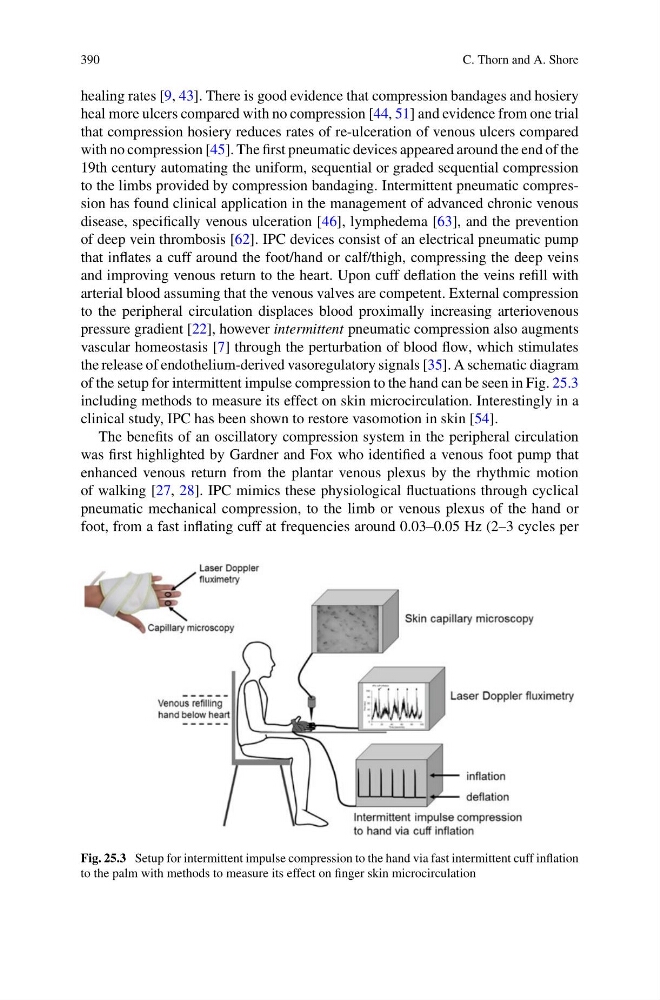
the release of endothelium-derived vasoregulatory signals [35]. A schematic diagram
of the setup for intermittent impulse compression to the hand can be seen in Fig. 25.3
including methods to measure its effect on skin microcirculation. Interestingly in a
clinical study, IPC has been shown to restore vasomotion in skin [54].
The benefits of an oscillatory compression system in the peripheral circulation
was first highlighted by Gardner and Fox who identified a venous foot pump that
enhanced venous return from the plantar venous plexus by the rhythmic motion
of walking [27, 28]. IPC mimics these physiological fluctuations through cyclical
pneumatic mechanical compression, to the limb or venous plexus of the hand or
foot, from a fast inflating cuff at frequencies around 0.03–0.05 Hz (2–3 cycles per
Fig. 25.3 Setup for intermittent impulse compression to the hand via fast intermittent cuff inflation
to the palm with methods to measure its effect on finger skin microcirculation
C. Thorn and A. Shore
healing rates [9, 43]. There is good evidence that compression bandages and hosiery
heal more ulcers compared with no compression [44, 51] and evidence from one trial
that compression hosiery reduces rates of re-ulceration of venous ulcers compared
with no compression [45]. The first pneumatic devices appeared around the end of the
19th century automating the uniform, sequential or graded sequential compression
to the limbs provided by compression bandaging. Intermittent pneumatic compression has found clinical application in the management of advanced chronic venous
disease, specifically venous ulceration [46], lymphedema [63], and the prevention
of deep vein thrombosis [62]. IPC devices consist of an electrical pneumatic pump
that inflates a cuff around the foot/hand or calf/thigh, compressing the deep veins
and improving venous return to the heart. Upon cuff deflation the veins refill with
arterial blood assuming that the venous valves are competent. External compression
to the peripheral circulation displaces blood proximally increasing arteriovenous
pressure gradient [22], however intermittent pneumatic compression also augments
vascular homeostasis [7] through the perturbation of blood flow, which stimulates
the release of endothelium-derived vasoregulatory signals [35]. A schematic diagram
of the setup for intermittent impulse compression to the hand can be seen in Fig. 25.3
including methods to measure its effect on skin microcirculation. Interestingly in a
clinical study, IPC has been shown to restore vasomotion in skin [54].
The benefits of an oscillatory compression system in the peripheral circulation
was first highlighted by Gardner and Fox who identified a venous foot pump that
enhanced venous return from the plantar venous plexus by the rhythmic motion
of walking [27, 28]. IPC mimics these physiological fluctuations through cyclical
pneumatic mechanical compression, to the limb or venous plexus of the hand or
foot, from a fast inflating cuff at frequencies around 0.03–0.05 Hz (2–3 cycles per
Fig. 25.3 Setup for intermittent impulse compression to the hand via fast intermittent cuff inflation
to the palm with methods to measure its effect on finger skin microcirculation