

386
C. Thorn and A. Shore
temporarily suppressed such as under anaesthesia then a ventilator can be implemented. These medical products are systems that can substitute or support these
innate fluctuations of life. Here we look at the effects of a particular medical product,
intermittent pneumatic compression and its effect on microcirculation.
The viability of all biological tissue is dependent upon dynamic changes in the
delivery of nutrients and removal of metabolic waste products through the microcirculation, both to maintain homeostasis and meet fluctuating needs. Albert SzentGyörgyi (Nobel Prize, Physiology or Medicine, 1937) succinctly states “Life is
nothing but an electron looking for a place to rest”. To sustain life in any aerobic
systems undergoing respiration such as in man, electrons pass through an electron
transport chain and the final electron acceptor is oxygen. Therefore to sustain life at
a cellular level, the transport of oxygenated blood from the heart to trillions of cells
in the body is achieved through an exquisite complex system of microscopic blood
vessels known as the microcirculation.
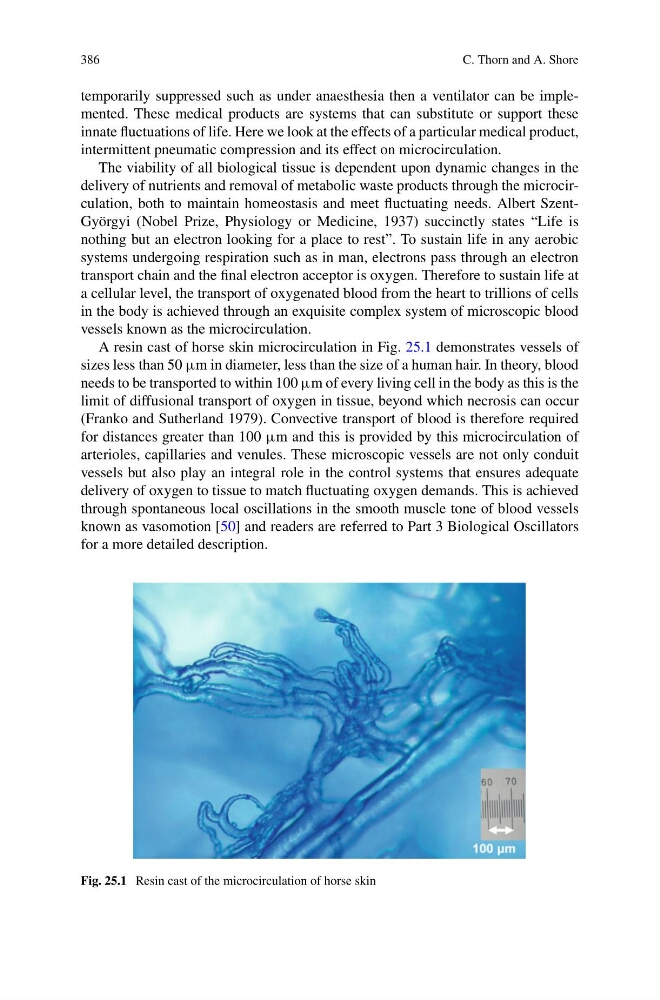
A resin cast of horse skin microcirculation in Fig. 25.1 demonstrates vessels of
sizes less than 50 µm in diameter, less than the size of a human hair. In theory, blood
needs to be transported to within 100 µm of every living cell in the body as this is the
limit of diffusional transport of oxygen in tissue, beyond which necrosis can occur
(Franko and Sutherland 1979). Convective transport of blood is therefore required
for distances greater than 100 µm and this is provided by this microcirculation of
arterioles, capillaries and venules. These microscopic vessels are not only conduit
vessels but also play an integral role in the control systems that ensures adequate
delivery of oxygen to tissue to match fluctuating oxygen demands. This is achieved
through spontaneous local oscillations in the smooth muscle tone of blood vessels
known as vasomotion [50] and readers are referred to Part 3 Biological Oscillators
for a more detailed description.
Fig. 25.1 Resin cast of the microcirculation of horse skin
C. Thorn and A. Shore
temporarily suppressed such as under anaesthesia then a ventilator can be implemented. These medical products are systems that can substitute or support these
innate fluctuations of life. Here we look at the effects of a particular medical product,
intermittent pneumatic compression and its effect on microcirculation.
The viability of all biological tissue is dependent upon dynamic changes in the
delivery of nutrients and removal of metabolic waste products through the microcirculation, both to maintain homeostasis and meet fluctuating needs. Albert SzentGyörgyi (Nobel Prize, Physiology or Medicine, 1937) succinctly states “Life is
nothing but an electron looking for a place to rest”. To sustain life in any aerobic
systems undergoing respiration such as in man, electrons pass through an electron
transport chain and the final electron acceptor is oxygen. Therefore to sustain life at
a cellular level, the transport of oxygenated blood from the heart to trillions of cells
in the body is achieved through an exquisite complex system of microscopic blood
vessels known as the microcirculation.
A resin cast of horse skin microcirculation in Fig. 25.1 demonstrates vessels of
sizes less than 50 µm in diameter, less than the size of a human hair. In theory, blood
needs to be transported to within 100 µm of every living cell in the body as this is the
limit of diffusional transport of oxygen in tissue, beyond which necrosis can occur
(Franko and Sutherland 1979). Convective transport of blood is therefore required
for distances greater than 100 µm and this is provided by this microcirculation of
arterioles, capillaries and venules. These microscopic vessels are not only conduit
vessels but also play an integral role in the control systems that ensures adequate
delivery of oxygen to tissue to match fluctuating oxygen demands. This is achieved
through spontaneous local oscillations in the smooth muscle tone of blood vessels
known as vasomotion [50] and readers are referred to Part 3 Biological Oscillators
for a more detailed description.
Fig. 25.1 Resin cast of the microcirculation of horse skin