

20 Sleep-Related Modulations of Heart Rate Variability…
321
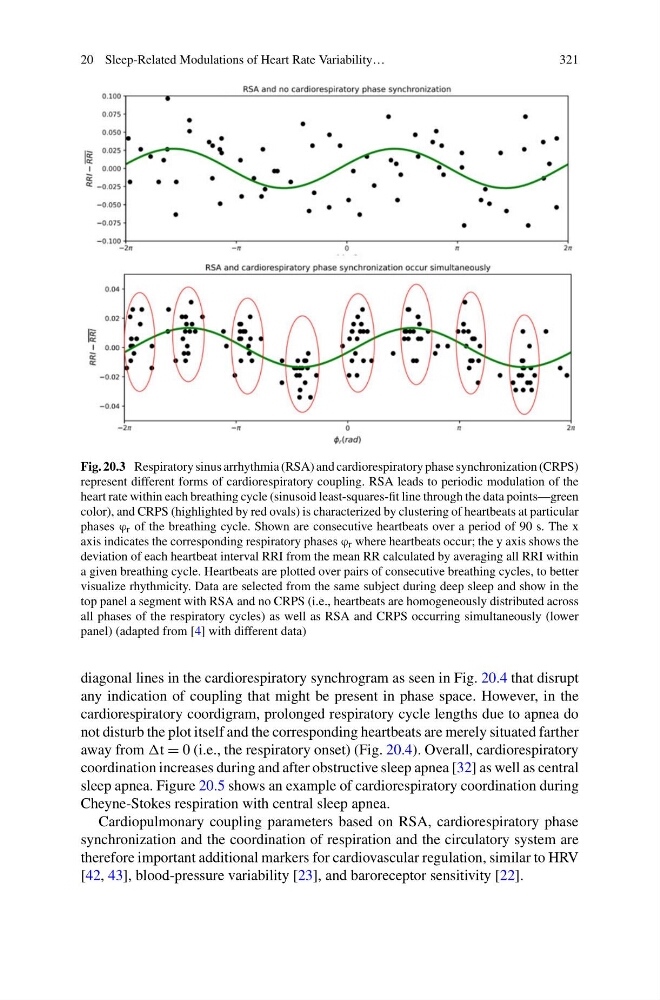
Fig. 20.3 Respiratory sinus arrhythmia (RSA) and cardiorespiratory phase synchronization (CRPS)
represent different forms of cardiorespiratory coupling. RSA leads to periodic modulation of the
heart rate within each breathing cycle (sinusoid least-squares-fit line through the data points—green
color), and CRPS (highlighted by red ovals) is characterized by clustering of heartbeats at particular
phases ϕ r of the breathing cycle. Shown are consecutive heartbeats over a period of 90 s. The x
axis indicates the corresponding respiratory phases ϕ r where heartbeats occur; the y axis shows the
deviation of each heartbeat interval RRI from the mean RR calculated by averaging all RRI within
a given breathing cycle. Heartbeats are plotted over pairs of consecutive breathing cycles, to better
visualize rhythmicity. Data are selected from the same subject during deep sleep and show in the
top panel a segment with RSA and no CRPS (i.e., heartbeats are homogeneously distributed across
all phases of the respiratory cycles) as well as RSA and CRPS occurring simultaneously (lower
panel) (adapted from [4] with different data)
diagonal lines in the cardiorespiratory synchrogram as seen in Fig. 20.4 that disrupt
any indication of coupling that might be present in phase space. However, in the
cardiorespiratory coordigram, prolonged respiratory cycle lengths due to apnea do
not disturb the plot itself and the corresponding heartbeats are merely situated farther
away from t = 0 (i.e., the respiratory onset) (Fig. 20.4). Overall, cardiorespiratory
coordination increases during and after obstructive sleep apnea [32] as well as central
sleep apnea. Figure 20.5 shows an example of cardiorespiratory coordination during
Cheyne-Stokes respiration with central sleep apnea.
Cardiopulmonary coupling parameters based on RSA, cardiorespiratory phase
synchronization and the coordination of respiration and the circulatory system are
therefore important additional markers for cardiovascular regulation, similar to HRV
[42, 43], blood-pressure variability [23], and baroreceptor sensitivity [22].
321
Fig. 20.3 Respiratory sinus arrhythmia (RSA) and cardiorespiratory phase synchronization (CRPS)
represent different forms of cardiorespiratory coupling. RSA leads to periodic modulation of the
heart rate within each breathing cycle (sinusoid least-squares-fit line through the data points—green
color), and CRPS (highlighted by red ovals) is characterized by clustering of heartbeats at particular
phases ϕ r of the breathing cycle. Shown are consecutive heartbeats over a period of 90 s. The x
axis indicates the corresponding respiratory phases ϕ r where heartbeats occur; the y axis shows the
deviation of each heartbeat interval RRI from the mean RR calculated by averaging all RRI within
a given breathing cycle. Heartbeats are plotted over pairs of consecutive breathing cycles, to better
visualize rhythmicity. Data are selected from the same subject during deep sleep and show in the
top panel a segment with RSA and no CRPS (i.e., heartbeats are homogeneously distributed across
all phases of the respiratory cycles) as well as RSA and CRPS occurring simultaneously (lower
panel) (adapted from [4] with different data)
diagonal lines in the cardiorespiratory synchrogram as seen in Fig. 20.4 that disrupt
any indication of coupling that might be present in phase space. However, in the
cardiorespiratory coordigram, prolonged respiratory cycle lengths due to apnea do
not disturb the plot itself and the corresponding heartbeats are merely situated farther
away from t = 0 (i.e., the respiratory onset) (Fig. 20.4). Overall, cardiorespiratory
coordination increases during and after obstructive sleep apnea [32] as well as central
sleep apnea. Figure 20.5 shows an example of cardiorespiratory coordination during
Cheyne-Stokes respiration with central sleep apnea.
Cardiopulmonary coupling parameters based on RSA, cardiorespiratory phase
synchronization and the coordination of respiration and the circulatory system are
therefore important additional markers for cardiovascular regulation, similar to HRV
[42, 43], blood-pressure variability [23], and baroreceptor sensitivity [22].