

11 Coupling Functions in Neuroscience
179
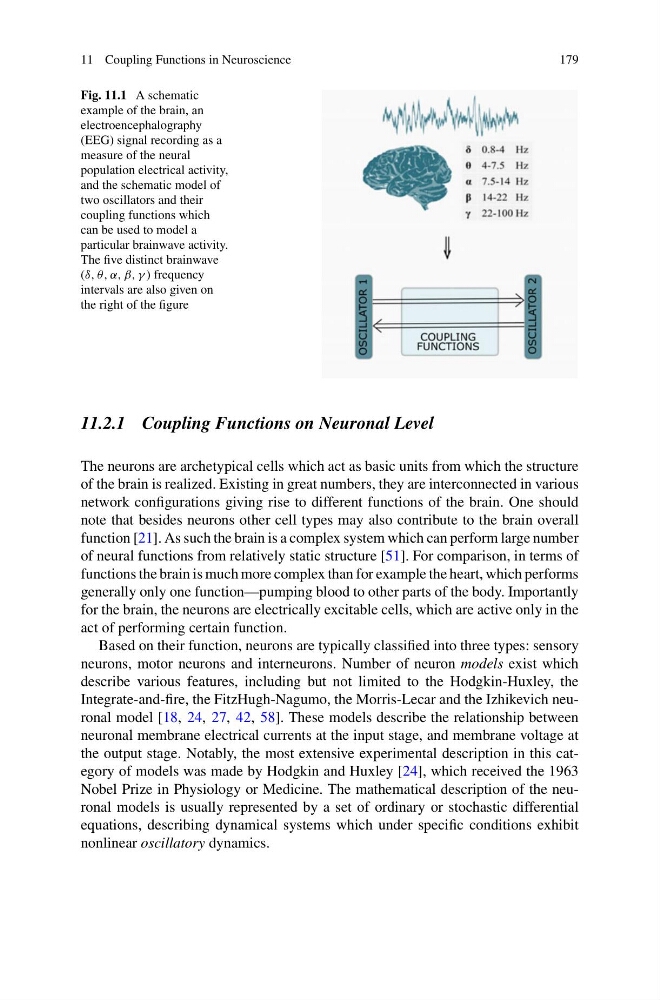
Fig. 11.1 A schematic
example of the brain, an
electroencephalography
(EEG) signal recording as a
measure of the neural
population electrical activity,
and the schematic model of
two oscillators and their
coupling functions which
can be used to model a
particular brainwave activity.
The five distinct brainwave
(δ, θ, α, β, γ ) frequency
intervals are also given on
the right of the figure
11.2.1 Coupling Functions on Neuronal Level
The neurons are archetypical cells which act as basic units from which the structure
of the brain is realized. Existing in great numbers, they are interconnected in various
network configurations giving rise to different functions of the brain. One should
note that besides neurons other cell types may also contribute to the brain overall
function [21]. As such the brain is a complex system which can perform large number
of neural functions from relatively static structure [51]. For comparison, in terms of
functions the brain is much more complex than for example the heart, which performs
generally only one function—pumping blood to other parts of the body. Importantly
for the brain, the neurons are electrically excitable cells, which are active only in the
act of performing certain function.
Based on their function, neurons are typically classified into three types: sensory
neurons, motor neurons and interneurons. Number of neuron models exist which
describe various features, including but not limited to the Hodgkin-Huxley, the
Integrate-and-fire, the FitzHugh-Nagumo, the Morris-Lecar and the Izhikevich neuronal model [18, 24, 27, 42, 58]. These models describe the relationship between
neuronal membrane electrical currents at the input stage, and membrane voltage at
the output stage. Notably, the most extensive experimental description in this category of models was made by Hodgkin and Huxley [24], which received the 1963
Nobel Prize in Physiology or Medicine. The mathematical description of the neuronal models is usually represented by a set of ordinary or stochastic differential
equations, describing dynamical systems which under specific conditions exhibit
nonlinear oscillatory dynamics.
179
Fig. 11.1 A schematic
example of the brain, an
electroencephalography
(EEG) signal recording as a
measure of the neural
population electrical activity,
and the schematic model of
two oscillators and their
coupling functions which
can be used to model a
particular brainwave activity.
The five distinct brainwave
(δ, θ, α, β, γ ) frequency
intervals are also given on
the right of the figure
11.2.1 Coupling Functions on Neuronal Level
The neurons are archetypical cells which act as basic units from which the structure
of the brain is realized. Existing in great numbers, they are interconnected in various
network configurations giving rise to different functions of the brain. One should
note that besides neurons other cell types may also contribute to the brain overall
function [21]. As such the brain is a complex system which can perform large number
of neural functions from relatively static structure [51]. For comparison, in terms of
functions the brain is much more complex than for example the heart, which performs
generally only one function—pumping blood to other parts of the body. Importantly
for the brain, the neurons are electrically excitable cells, which are active only in the
act of performing certain function.
Based on their function, neurons are typically classified into three types: sensory
neurons, motor neurons and interneurons. Number of neuron models exist which
describe various features, including but not limited to the Hodgkin-Huxley, the
Integrate-and-fire, the FitzHugh-Nagumo, the Morris-Lecar and the Izhikevich neuronal model [18, 24, 27, 42, 58]. These models describe the relationship between
neuronal membrane electrical currents at the input stage, and membrane voltage at
the output stage. Notably, the most extensive experimental description in this category of models was made by Hodgkin and Huxley [24], which received the 1963
Nobel Prize in Physiology or Medicine. The mathematical description of the neuronal models is usually represented by a set of ordinary or stochastic differential
equations, describing dynamical systems which under specific conditions exhibit
nonlinear oscillatory dynamics.