

142
S. Yuvan and M. Bier
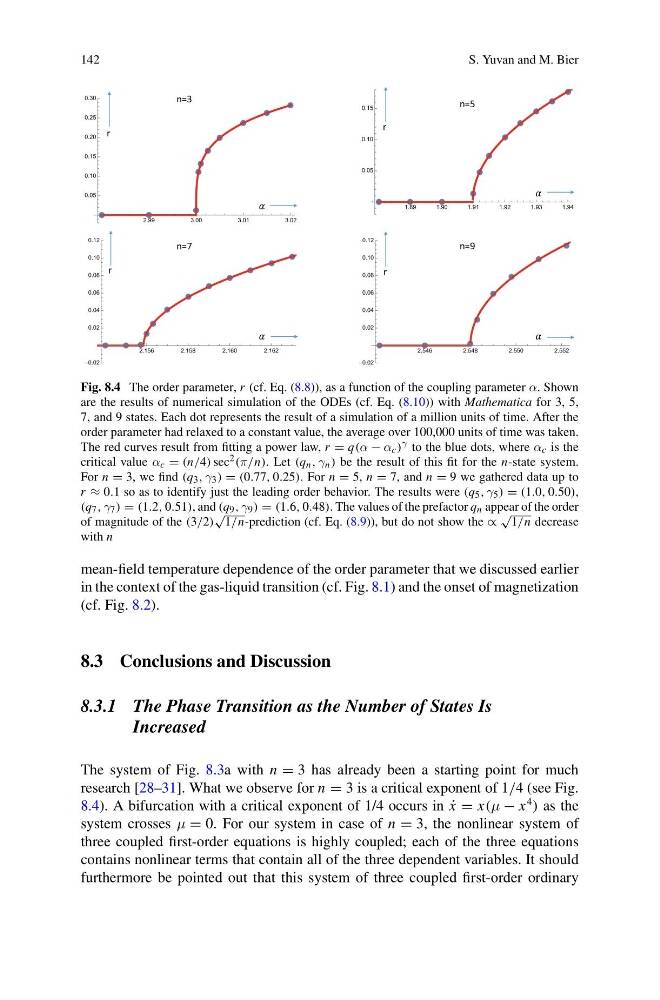
Fig. 8.4 The order parameter, r (cf. Eq. (8.8)), as a function of the coupling parameter α. Shown
are the results of numerical simulation of the ODEs (cf. Eq. (8.10)) with Mathematica for 3, 5,
7, and 9 states. Each dot represents the result of a simulation of a million units of time. After the
order parameter had relaxed to a constant value, the average over 100,000 units of time was taken.
The red curves result from fitting a power law, r = q(α − α c ) γ to the blue dots, where α c is the
critical value α c = (n/4) sec 2 (π/n). Let (q n , γ n ) be the result of this fit for the n-state system.
For n = 3, we find (q 3 , γ 3 ) = (0.77, 0.25). For n = 5, n = 7, and n = 9 we gathered data up to
r ≈ 0.1 so as to identify just the leading order behavior. The results were (q 5 , γ 5 ) = (1.0, 0.50),
(q 7 , γ 7 ) = (1.2, 0.51), and (q 9 , γ 9 ) = (1.6, 0.48). The values of the prefactor q n appear of the order
of magnitude of the (3/2)
√
1/n-prediction (cf. Eq. (8.9)), but do not show the ∝
√
1/n decrease
with n
mean-field temperature dependence of the order parameter that we discussed earlier
in the context of the gas-liquid transition (cf. Fig. 8.1) and the onset of magnetization
(cf. Fig. 8.2).
8.3 Conclusions and Discussion
8.3.1 The Phase Transition as the Number of States Is
Increased
The system of Fig. 8.3a with n = 3 has already been a starting point for much
research [28–31]. What we observe for n = 3 is a critical exponent of 1/4 (see Fig.
8.4). A bifurcation with a critical exponent of 1/4 occurs in ˙
x = x(μ − x
4
) as the
system crosses μ = 0. For our system in case of n = 3, the nonlinear system of
three coupled first-order equations is highly coupled; each of the three equations
contains nonlinear terms that contain all of the three dependent variables. It should
furthermore be pointed out that this system of three coupled first-order ordinary
S. Yuvan and M. Bier
Fig. 8.4 The order parameter, r (cf. Eq. (8.8)), as a function of the coupling parameter α. Shown
are the results of numerical simulation of the ODEs (cf. Eq. (8.10)) with Mathematica for 3, 5,
7, and 9 states. Each dot represents the result of a simulation of a million units of time. After the
order parameter had relaxed to a constant value, the average over 100,000 units of time was taken.
The red curves result from fitting a power law, r = q(α − α c ) γ to the blue dots, where α c is the
critical value α c = (n/4) sec 2 (π/n). Let (q n , γ n ) be the result of this fit for the n-state system.
For n = 3, we find (q 3 , γ 3 ) = (0.77, 0.25). For n = 5, n = 7, and n = 9 we gathered data up to
r ≈ 0.1 so as to identify just the leading order behavior. The results were (q 5 , γ 5 ) = (1.0, 0.50),
(q 7 , γ 7 ) = (1.2, 0.51), and (q 9 , γ 9 ) = (1.6, 0.48). The values of the prefactor q n appear of the order
of magnitude of the (3/2)
√
1/n-prediction (cf. Eq. (8.9)), but do not show the ∝
√
1/n decrease
with n
mean-field temperature dependence of the order parameter that we discussed earlier
in the context of the gas-liquid transition (cf. Fig. 8.1) and the onset of magnetization
(cf. Fig. 8.2).
8.3 Conclusions and Discussion
8.3.1 The Phase Transition as the Number of States Is
Increased
The system of Fig. 8.3a with n = 3 has already been a starting point for much
research [28–31]. What we observe for n = 3 is a critical exponent of 1/4 (see Fig.
8.4). A bifurcation with a critical exponent of 1/4 occurs in ˙
x = x(μ − x
4
) as the
system crosses μ = 0. For our system in case of n = 3, the nonlinear system of
three coupled first-order equations is highly coupled; each of the three equations
contains nonlinear terms that contain all of the three dependent variables. It should
furthermore be pointed out that this system of three coupled first-order ordinary