

140
S. Yuvan and M. Bier
˙
p 1 = k n p n − k 1 p 1 ,
˙
p 2 = k 1 p 1 − k 2 p 2 ,
...
˙
p n = k n−1 p n−1 − k n p n .
(8.10)
Here the k’s represent the transition rates (cf. Eq. (8.5)) and a dot above a symbol
denotes differentiation with respect to time, i.e.
•
≡ d/dt. The periodic boundary
conditions imply k n = exp
α ( p 1 − p n−1 )
and k 1 = exp [α ( p 2 − p n )]. The point
p j = 1/n ∀ j is the obvious fixed point. As in an ordinary Taylor series, the behavior
of the system in the close vicinity of a point is determined by the lowest order terms,
generally the linear terms, in an expansion. This leads to an n × n matrix; the so-called
Jacobian matrix [8]. The j-th row of this matrix lists the values of the derivatives of
(k j−1 p j−1 − k j p j ) at the fixed point. The expression (k j−1 p j−1 − k j p j ) is the righthand-side of the j-th equation in Eq. (8.10). Along a row of the matrix, derivatives are
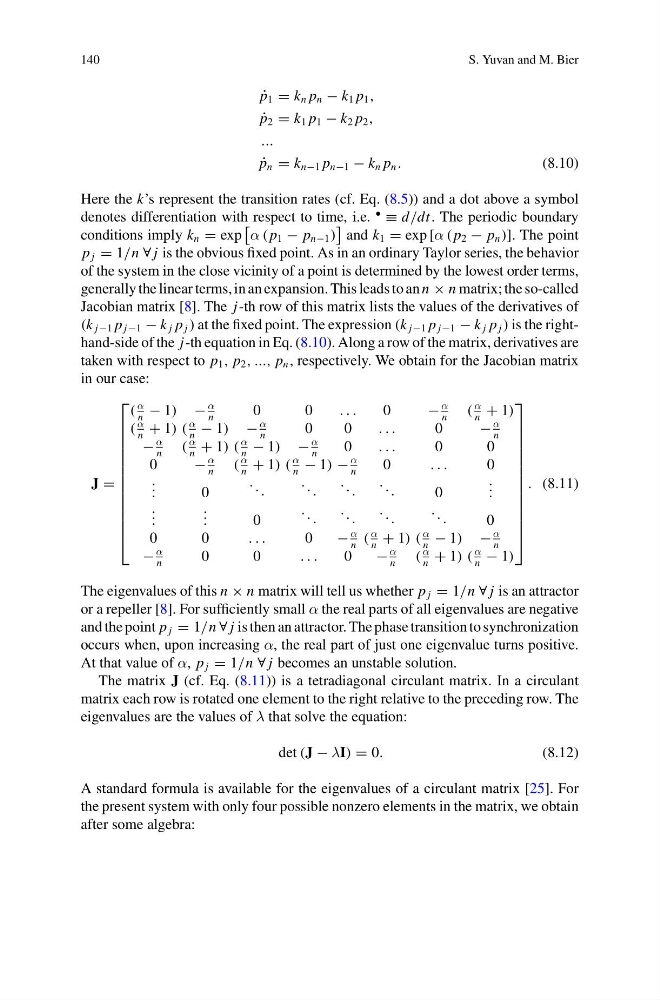
taken with respect to p 1 , p 2 , ..., p n , respectively. We obtain for the Jacobian matrix
in our case:
J =
⎡
⎢
⎢
⎢
⎢
⎢
⎢
⎢
⎢
⎢
⎢
⎢
⎢
⎣
(
α
n
− 1) −
α
n
0
0
. . .
0
−
α
n
(
α
n
+ 1)
(
α
n
+ 1) (
α
n
− 1) −
α
n
0
0
. . .
0
−
α
n
−
α
n
(
α
n
+ 1) (
α
n
− 1) −
α
n
0
. . .
0
0
0
−
α
n
(
α
n
+ 1) (
α
n
− 1) −
α
n
0
. . .
0
. . .
0
. . .
. . .
. . .
. . .
0
. . .
. . .
. . .
0
. . .
. . .
. . .
. . .
0
0
0
. . .
0
−
α
n
(
α
n
+ 1) (
α
n
− 1) −
α
n
−
α
n
0
0
. . .
0
−
α
n
(
α
n
+ 1) (
α
n
− 1)
⎤
⎥
⎥
⎥
⎥
⎥
⎥
⎥
⎥
⎥
⎥
⎥
⎥
⎦
. (8.11)
The eigenvalues of this n × n matrix will tell us whether p j = 1/n ∀ j is an attractor
or a repeller [8]. For sufficiently small α the real parts of all eigenvalues are negative
and the point p j = 1/n ∀ j is then an attractor. The phase transition to synchronization
occurs when, upon increasing α, the real part of just one eigenvalue turns positive.
At that value of α, p j = 1/n ∀ j becomes an unstable solution.
The matrix J (cf. Eq. (8.11)) is a tetradiagonal circulant matrix. In a circulant
matrix each row is rotated one element to the right relative to the preceding row. The
eigenvalues are the values of λ that solve the equation:
det (J − λI) = 0.
(8.12)
A standard formula is available for the eigenvalues of a circulant matrix [25]. For
the present system with only four possible nonzero elements in the matrix, we obtain
after some algebra:
S. Yuvan and M. Bier
˙
p 1 = k n p n − k 1 p 1 ,
˙
p 2 = k 1 p 1 − k 2 p 2 ,
...
˙
p n = k n−1 p n−1 − k n p n .
(8.10)
Here the k’s represent the transition rates (cf. Eq. (8.5)) and a dot above a symbol
denotes differentiation with respect to time, i.e.
•
≡ d/dt. The periodic boundary
conditions imply k n = exp
α ( p 1 − p n−1 )
and k 1 = exp [α ( p 2 − p n )]. The point
p j = 1/n ∀ j is the obvious fixed point. As in an ordinary Taylor series, the behavior
of the system in the close vicinity of a point is determined by the lowest order terms,
generally the linear terms, in an expansion. This leads to an n × n matrix; the so-called
Jacobian matrix [8]. The j-th row of this matrix lists the values of the derivatives of
(k j−1 p j−1 − k j p j ) at the fixed point. The expression (k j−1 p j−1 − k j p j ) is the righthand-side of the j-th equation in Eq. (8.10). Along a row of the matrix, derivatives are
taken with respect to p 1 , p 2 , ..., p n , respectively. We obtain for the Jacobian matrix
in our case:
J =
⎡
⎢
⎢
⎢
⎢
⎢
⎢
⎢
⎢
⎢
⎢
⎢
⎢
⎣
(
α
n
− 1) −
α
n
0
0
. . .
0
−
α
n
(
α
n
+ 1)
(
α
n
+ 1) (
α
n
− 1) −
α
n
0
0
. . .
0
−
α
n
−
α
n
(
α
n
+ 1) (
α
n
− 1) −
α
n
0
. . .
0
0
0
−
α
n
(
α
n
+ 1) (
α
n
− 1) −
α
n
0
. . .
0
. . .
0
. . .
. . .
. . .
. . .
0
. . .
. . .
. . .
0
. . .
. . .
. . .
. . .
0
0
0
. . .
0
−
α
n
(
α
n
+ 1) (
α
n
− 1) −
α
n
−
α
n
0
0
. . .
0
−
α
n
(
α
n
+ 1) (
α
n
− 1)
⎤
⎥
⎥
⎥
⎥
⎥
⎥
⎥
⎥
⎥
⎥
⎥
⎥
⎦
. (8.11)
The eigenvalues of this n × n matrix will tell us whether p j = 1/n ∀ j is an attractor
or a repeller [8]. For sufficiently small α the real parts of all eigenvalues are negative
and the point p j = 1/n ∀ j is then an attractor. The phase transition to synchronization
occurs when, upon increasing α, the real part of just one eigenvalue turns positive.
At that value of α, p j = 1/n ∀ j becomes an unstable solution.
The matrix J (cf. Eq. (8.11)) is a tetradiagonal circulant matrix. In a circulant
matrix each row is rotated one element to the right relative to the preceding row. The
eigenvalues are the values of λ that solve the equation:
det (J − λI) = 0.
(8.12)
A standard formula is available for the eigenvalues of a circulant matrix [25]. For
the present system with only four possible nonzero elements in the matrix, we obtain
after some algebra: