

134
S. Yuvan and M. Bier
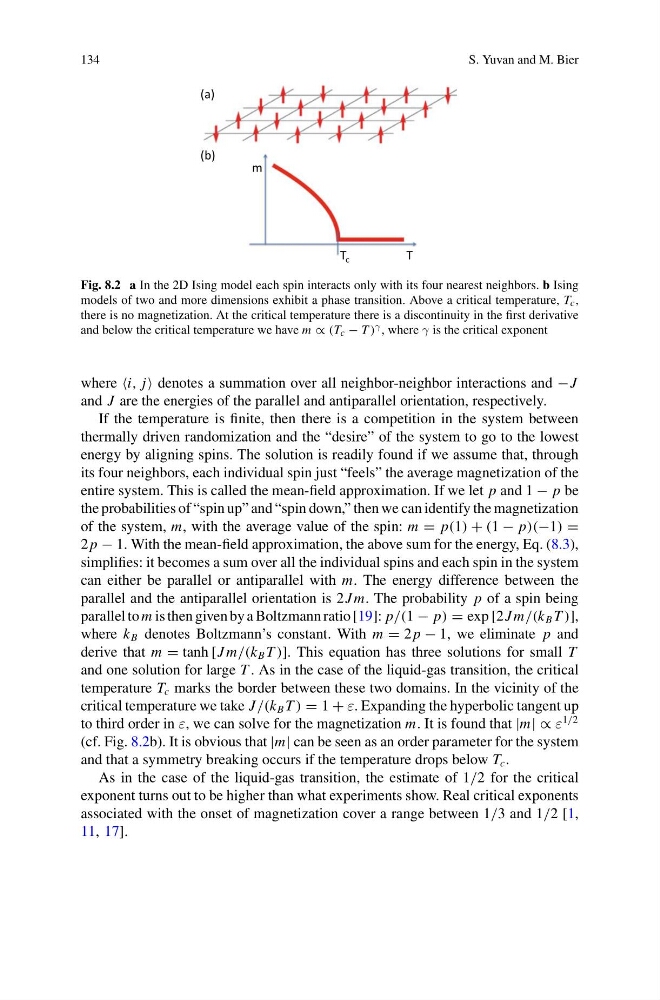
Fig. 8.2 a In the 2D Ising model each spin interacts only with its four nearest neighbors. b Ising
models of two and more dimensions exhibit a phase transition. Above a critical temperature, T c ,
there is no magnetization. At the critical temperature there is a discontinuity in the first derivative
and below the critical temperature we have m ∝ (T c − T ) γ , where γ is the critical exponent
where j denotes a summation over all neighbor-neighbor interactions and −J
and J are the energies of the parallel and antiparallel orientation, respectively.
If the temperature is finite, then there is a competition in the system between
thermally driven randomization and the “desire” of the system to go to the lowest
energy by aligning spins. The solution is readily found if we assume that, through
its four neighbors, each individual spin just “feels” the average magnetization of the
entire system. This is called the mean-field approximation. If we let p and 1 − p be
the probabilities of “spin up” and “spin down,” then we can identify the magnetization
of the system, m, with the average value of the spin: m = p(1) + (1 − p)(−1) =
2 p − 1. With the mean-field approximation, the above sum for the energy, Eq. (8.3),
simplifies: it becomes a sum over all the individual spins and each spin in the system
can either be parallel or antiparallel with m. The energy difference between the
parallel and the antiparallel orientation is 2J m. The probability p of a spin being
parallel to m is then given by a Boltzmann ratio [19]: p/(1 − p) = exp [2J m/(k B T )],
where k B denotes Boltzmann’s constant. With m = 2 p − 1, we eliminate p and
derive that m = tanh [J m/(k B T )]. This equation has three solutions for small T
and one solution for large T . As in the case of the liquid-gas transition, the critical
temperature T c marks the border between these two domains. In the vicinity of the
critical temperature we take J/(k B T ) = 1 + ε. Expanding the hyperbolic tangent up
to third order in ε, we can solve for the magnetization m. It is found that |m| ∝ ε
1/2
(cf. Fig. 8.2b). It is obvious that |m| can be seen as an order parameter for the system
and that a symmetry breaking occurs if the temperature drops below T c .
As in the case of the liquid-gas transition, the estimate of 1/2 for the critical
exponent turns out to be higher than what experiments show. Real critical exponents
associated with the onset of magnetization cover a range between 1/3 and 1/2 [1,
11, 17].
S. Yuvan and M. Bier
Fig. 8.2 a In the 2D Ising model each spin interacts only with its four nearest neighbors. b Ising
models of two and more dimensions exhibit a phase transition. Above a critical temperature, T c ,
there is no magnetization. At the critical temperature there is a discontinuity in the first derivative
and below the critical temperature we have m ∝ (T c − T ) γ , where γ is the critical exponent
where j denotes a summation over all neighbor-neighbor interactions and −J
and J are the energies of the parallel and antiparallel orientation, respectively.
If the temperature is finite, then there is a competition in the system between
thermally driven randomization and the “desire” of the system to go to the lowest
energy by aligning spins. The solution is readily found if we assume that, through
its four neighbors, each individual spin just “feels” the average magnetization of the
entire system. This is called the mean-field approximation. If we let p and 1 − p be
the probabilities of “spin up” and “spin down,” then we can identify the magnetization
of the system, m, with the average value of the spin: m = p(1) + (1 − p)(−1) =
2 p − 1. With the mean-field approximation, the above sum for the energy, Eq. (8.3),
simplifies: it becomes a sum over all the individual spins and each spin in the system
can either be parallel or antiparallel with m. The energy difference between the
parallel and the antiparallel orientation is 2J m. The probability p of a spin being
parallel to m is then given by a Boltzmann ratio [19]: p/(1 − p) = exp [2J m/(k B T )],
where k B denotes Boltzmann’s constant. With m = 2 p − 1, we eliminate p and
derive that m = tanh [J m/(k B T )]. This equation has three solutions for small T
and one solution for large T . As in the case of the liquid-gas transition, the critical
temperature T c marks the border between these two domains. In the vicinity of the
critical temperature we take J/(k B T ) = 1 + ε. Expanding the hyperbolic tangent up
to third order in ε, we can solve for the magnetization m. It is found that |m| ∝ ε
1/2
(cf. Fig. 8.2b). It is obvious that |m| can be seen as an order parameter for the system
and that a symmetry breaking occurs if the temperature drops below T c .
As in the case of the liquid-gas transition, the estimate of 1/2 for the critical
exponent turns out to be higher than what experiments show. Real critical exponents
associated with the onset of magnetization cover a range between 1/3 and 1/2 [1,
11, 17].