

132
S. Yuvan and M. Bier
8.1 Introduction
8.1.1 The Liquid-Gas Phase Transition
A small correction to the Ideal Gas Law suffices to capture most of the phenomenology of the liquid-gas phase transition. In the Van der Waals Equation [19],
P +
a
v 2
(v − b) = k B T,
(8.1)
P denotes the pressure, v is the volume per molecule, k B is Boltzmann’s constant,
and T is the temperature. The “b” takes into account that the involved molecules
are not points, but have finite size. The “a” is associated with the attractive force
between molecules. There is a v
2 in the denominator for the following reasons. (i)
For each molecule the amount of interaction with other molecules is proportional
to the number of molecules in a specified volume around the molecule and thus to
the density ρ = 1/v. (ii) For the pressure on the wall of the container, the number
of molecules in a layer-volume near the wall is what is significant. The molecules in
that layer-volume are only attracted in the direction away from the wall. The number
of molecules in the layer-volume is again proportional to ρ = 1/v. Effects (i) and
(ii) together result in the a/v
2 term in Eq. (8.1).
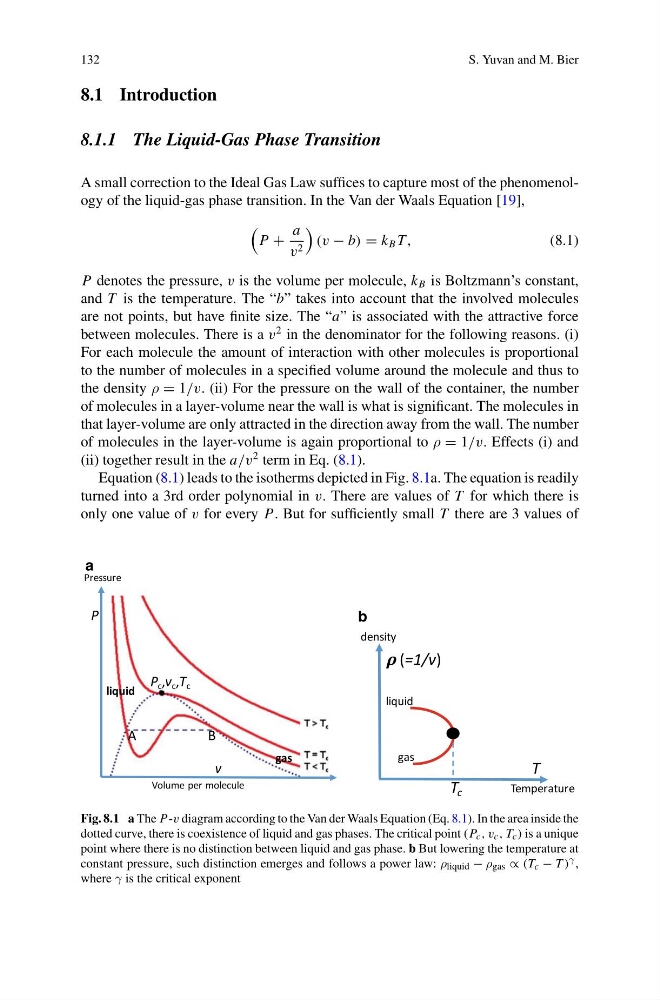
Equation (8.1) leads to the isotherms depicted in Fig. 8.1a. The equation is readily
turned into a 3rd order polynomial in v. There are values of T for which there is
only one value of v for every P. But for sufficiently small T there are 3 values of
a
b
Fig. 8.1 a The P-v diagram according to the Van der Waals Equation (Eq. 8.1). In the area inside the
dotted curve, there is coexistence of liquid and gas phases. The critical point (P c , v c , T c ) is a unique
point where there is no distinction between liquid and gas phase. b But lowering the temperature at
constant pressure, such distinction emerges and follows a power law: ρ liquid − ρ gas ∝ (T c − T )
γ ,
where γ is the critical exponent
S. Yuvan and M. Bier
8.1 Introduction
8.1.1 The Liquid-Gas Phase Transition
A small correction to the Ideal Gas Law suffices to capture most of the phenomenology of the liquid-gas phase transition. In the Van der Waals Equation [19],
P +
a
v 2
(v − b) = k B T,
(8.1)
P denotes the pressure, v is the volume per molecule, k B is Boltzmann’s constant,
and T is the temperature. The “b” takes into account that the involved molecules
are not points, but have finite size. The “a” is associated with the attractive force
between molecules. There is a v
2 in the denominator for the following reasons. (i)
For each molecule the amount of interaction with other molecules is proportional
to the number of molecules in a specified volume around the molecule and thus to
the density ρ = 1/v. (ii) For the pressure on the wall of the container, the number
of molecules in a layer-volume near the wall is what is significant. The molecules in
that layer-volume are only attracted in the direction away from the wall. The number
of molecules in the layer-volume is again proportional to ρ = 1/v. Effects (i) and
(ii) together result in the a/v
2 term in Eq. (8.1).
Equation (8.1) leads to the isotherms depicted in Fig. 8.1a. The equation is readily
turned into a 3rd order polynomial in v. There are values of T for which there is
only one value of v for every P. But for sufficiently small T there are 3 values of
a
b
Fig. 8.1 a The P-v diagram according to the Van der Waals Equation (Eq. 8.1). In the area inside the
dotted curve, there is coexistence of liquid and gas phases. The critical point (P c , v c , T c ) is a unique
point where there is no distinction between liquid and gas phase. b But lowering the temperature at
constant pressure, such distinction emerges and follows a power law: ρ liquid − ρ gas ∝ (T c − T )
γ ,
where γ is the critical exponent