

82
R. S. MacKay
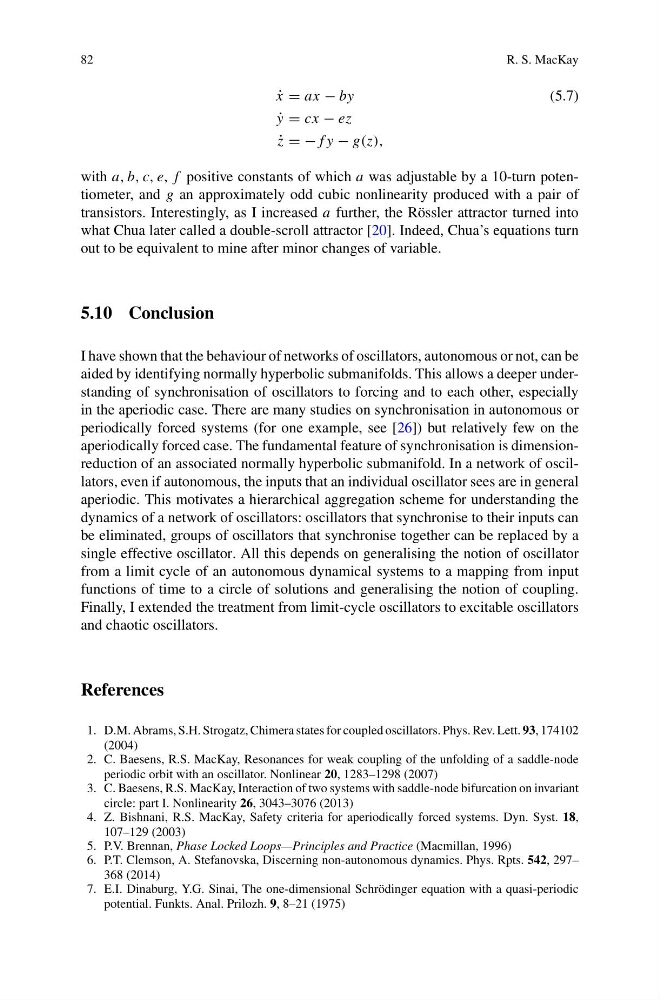
˙
x = ax − by
(5.7)
˙
y = cx − ez
˙
z = − f y − g(z),
with a, b, c, e, f positive constants of which a was adjustable by a 10-turn potentiometer, and g an approximately odd cubic nonlinearity produced with a pair of
transistors. Interestingly, as I increased a further, the Rössler attractor turned into
what Chua later called a double-scroll attractor [20]. Indeed, Chua’s equations turn
out to be equivalent to mine after minor changes of variable.
5.10 Conclusion
I have shown that the behaviour of networks of oscillators, autonomous or not, can be
aided by identifying normally hyperbolic submanifolds. This allows a deeper understanding of synchronisation of oscillators to forcing and to each other, especially
in the aperiodic case. There are many studies on synchronisation in autonomous or
periodically forced systems (for one example, see [26]) but relatively few on the
aperiodically forced case. The fundamental feature of synchronisation is dimensionreduction of an associated normally hyperbolic submanifold. In a network of oscillators, even if autonomous, the inputs that an individual oscillator sees are in general
aperiodic. This motivates a hierarchical aggregation scheme for understanding the
dynamics of a network of oscillators: oscillators that synchronise to their inputs can
be eliminated, groups of oscillators that synchronise together can be replaced by a
single effective oscillator. All this depends on generalising the notion of oscillator
from a limit cycle of an autonomous dynamical systems to a mapping from input
functions of time to a circle of solutions and generalising the notion of coupling.
Finally, I extended the treatment from limit-cycle oscillators to excitable oscillators
and chaotic oscillators.
References
1. D.M. Abrams, S.H. Strogatz, Chimera states for coupled oscillators. Phys. Rev. Lett. 93, 174102
(2004)
2. C. Baesens, R.S. MacKay, Resonances for weak coupling of the unfolding of a saddle-node
periodic orbit with an oscillator. Nonlinear 20, 1283–1298 (2007)
3. C. Baesens, R.S. MacKay, Interaction of two systems with saddle-node bifurcation on invariant
circle: part I. Nonlinearity 26, 3043–3076 (2013)
4. Z. Bishnani, R.S. MacKay, Safety criteria for aperiodically forced systems. Dyn. Syst. 18,
107–129 (2003)
5. P.V. Brennan, Phase Locked Loops—Principles and Practice (Macmillan, 1996)
6. P.T. Clemson, A. Stefanovska, Discerning non-autonomous dynamics. Phys. Rpts. 542, 297–
368 (2014)
7. E.I. Dinaburg, Y.G. Sinai, The one-dimensional Schrödinger equation with a quasi-periodic
potential. Funkts. Anal. Prilozh. 9, 8–21 (1975)
R. S. MacKay
˙
x = ax − by
(5.7)
˙
y = cx − ez
˙
z = − f y − g(z),
with a, b, c, e, f positive constants of which a was adjustable by a 10-turn potentiometer, and g an approximately odd cubic nonlinearity produced with a pair of
transistors. Interestingly, as I increased a further, the Rössler attractor turned into
what Chua later called a double-scroll attractor [20]. Indeed, Chua’s equations turn
out to be equivalent to mine after minor changes of variable.
5.10 Conclusion
I have shown that the behaviour of networks of oscillators, autonomous or not, can be
aided by identifying normally hyperbolic submanifolds. This allows a deeper understanding of synchronisation of oscillators to forcing and to each other, especially
in the aperiodic case. There are many studies on synchronisation in autonomous or
periodically forced systems (for one example, see [26]) but relatively few on the
aperiodically forced case. The fundamental feature of synchronisation is dimensionreduction of an associated normally hyperbolic submanifold. In a network of oscillators, even if autonomous, the inputs that an individual oscillator sees are in general
aperiodic. This motivates a hierarchical aggregation scheme for understanding the
dynamics of a network of oscillators: oscillators that synchronise to their inputs can
be eliminated, groups of oscillators that synchronise together can be replaced by a
single effective oscillator. All this depends on generalising the notion of oscillator
from a limit cycle of an autonomous dynamical systems to a mapping from input
functions of time to a circle of solutions and generalising the notion of coupling.
Finally, I extended the treatment from limit-cycle oscillators to excitable oscillators
and chaotic oscillators.
References
1. D.M. Abrams, S.H. Strogatz, Chimera states for coupled oscillators. Phys. Rev. Lett. 93, 174102
(2004)
2. C. Baesens, R.S. MacKay, Resonances for weak coupling of the unfolding of a saddle-node
periodic orbit with an oscillator. Nonlinear 20, 1283–1298 (2007)
3. C. Baesens, R.S. MacKay, Interaction of two systems with saddle-node bifurcation on invariant
circle: part I. Nonlinearity 26, 3043–3076 (2013)
4. Z. Bishnani, R.S. MacKay, Safety criteria for aperiodically forced systems. Dyn. Syst. 18,
107–129 (2003)
5. P.V. Brennan, Phase Locked Loops—Principles and Practice (Macmillan, 1996)
6. P.T. Clemson, A. Stefanovska, Discerning non-autonomous dynamics. Phys. Rpts. 542, 297–
368 (2014)
7. E.I. Dinaburg, Y.G. Sinai, The one-dimensional Schrödinger equation with a quasi-periodic
potential. Funkts. Anal. Prilozh. 9, 8–21 (1975)