

favouring the production of resources (e.g. by increasing forest hard mast species)
(Martin et al. 2012). Because these actions involve spending money, a rationale
based on using GIS, models and simulations to identify the distribution of trade-offs
over space and time becomes a powerful tool for managers. These models may also
incorporate the shifting balance of the trade-offs between services provided at the
landscape level, such as food supply and shelter for vertebrates, over the course of
seasons and life stages (May et al. 2010).
In general, the reduction of exposure in protected areas is a more common
practice than the reduction of sensitivity. One major reason for this is the fact that it
is easier and more operative to regulate on a territorial basis, for instance by
controlling access, than to intervene in ecosystems and populations, where accurate
knowledge of their functioning is often lacking. This strategy is particularly
appropriate in high mountain areas due to their low accessibility for humans, which
makes it possible to effectively control use by visitors and locals. Another example
of exposure reduction is the control of exotic species by minimising their presence
through limitations on their introduction and reinforcement of their eradication.
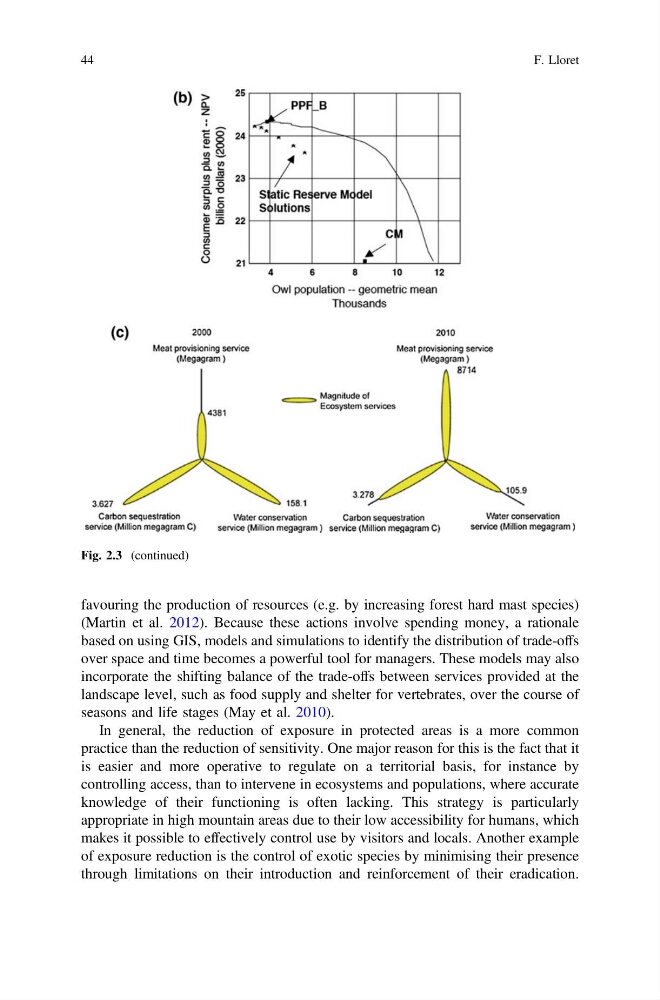
Fig. 2.3 (continued)
44
F. Lloret
(Martin et al. 2012). Because these actions involve spending money, a rationale
based on using GIS, models and simulations to identify the distribution of trade-offs
over space and time becomes a powerful tool for managers. These models may also
incorporate the shifting balance of the trade-offs between services provided at the
landscape level, such as food supply and shelter for vertebrates, over the course of
seasons and life stages (May et al. 2010).
In general, the reduction of exposure in protected areas is a more common
practice than the reduction of sensitivity. One major reason for this is the fact that it
is easier and more operative to regulate on a territorial basis, for instance by
controlling access, than to intervene in ecosystems and populations, where accurate
knowledge of their functioning is often lacking. This strategy is particularly
appropriate in high mountain areas due to their low accessibility for humans, which
makes it possible to effectively control use by visitors and locals. Another example
of exposure reduction is the control of exotic species by minimising their presence
through limitations on their introduction and reinforcement of their eradication.
Fig. 2.3 (continued)
44
F. Lloret