

2.4 Conservation Management of Exposure
and Sensitivity in High Mountains
According to the application of trade-off principles to conservation management,
resources allocated to a reduction in the exposure of conserved systems would often
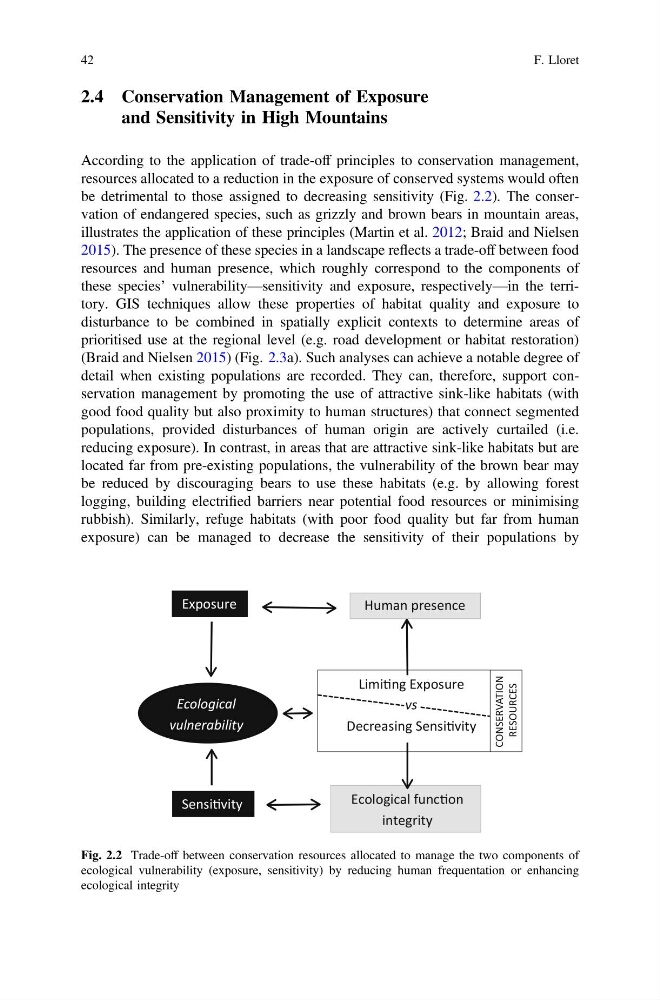
be detrimental to those assigned to decreasing sensitivity (Fig. 2.2). The conservation of endangered species, such as grizzly and brown bears in mountain areas,
illustrates the application of these principles (Martin et al. 2012; Braid and Nielsen
2015). The presence of these species in a landscape reflects a trade-off between food
resources and human presence, which roughly correspond to the components of
these species’ vulnerability—sensitivity and exposure, respectively—in the territory. GIS techniques allow these properties of habitat quality and exposure to
disturbance to be combined in spatially explicit contexts to determine areas of
prioritised use at the regional level (e.g. road development or habitat restoration)
(Braid and Nielsen 2015) (Fig. 2.3a). Such analyses can achieve a notable degree of
detail when existing populations are recorded. They can, therefore, support conservation management by promoting the use of attractive sink-like habitats (with
good food quality but also proximity to human structures) that connect segmented
populations, provided disturbances of human origin are actively curtailed (i.e.
reducing exposure). In contrast, in areas that are attractive sink-like habitats but are
located far from pre-existing populations, the vulnerability of the brown bear may
be reduced by discouraging bears to use these habitats (e.g. by allowing forest
logging, building electrified barriers near potential food resources or minimising
rubbish). Similarly, refuge habitats (with poor food quality but far from human
exposure) can be managed to decrease the sensitivity of their populations by
Ecological
vulnerability
Exposure
SensiƟvity
Human presence
Ecological funcƟon
integrity
LimiƟng Exposure
vs
Decreasing SensiƟvity
CONSERVATION
RESOURCES
Fig. 2.2 Trade-off between conservation resources allocated to manage the two components of
ecological vulnerability (exposure, sensitivity) by reducing human frequentation or enhancing
ecological integrity
42
F. Lloret
and Sensitivity in High Mountains
According to the application of trade-off principles to conservation management,
resources allocated to a reduction in the exposure of conserved systems would often
be detrimental to those assigned to decreasing sensitivity (Fig. 2.2). The conservation of endangered species, such as grizzly and brown bears in mountain areas,
illustrates the application of these principles (Martin et al. 2012; Braid and Nielsen
2015). The presence of these species in a landscape reflects a trade-off between food
resources and human presence, which roughly correspond to the components of
these species’ vulnerability—sensitivity and exposure, respectively—in the territory. GIS techniques allow these properties of habitat quality and exposure to
disturbance to be combined in spatially explicit contexts to determine areas of
prioritised use at the regional level (e.g. road development or habitat restoration)
(Braid and Nielsen 2015) (Fig. 2.3a). Such analyses can achieve a notable degree of
detail when existing populations are recorded. They can, therefore, support conservation management by promoting the use of attractive sink-like habitats (with
good food quality but also proximity to human structures) that connect segmented
populations, provided disturbances of human origin are actively curtailed (i.e.
reducing exposure). In contrast, in areas that are attractive sink-like habitats but are
located far from pre-existing populations, the vulnerability of the brown bear may
be reduced by discouraging bears to use these habitats (e.g. by allowing forest
logging, building electrified barriers near potential food resources or minimising
rubbish). Similarly, refuge habitats (with poor food quality but far from human
exposure) can be managed to decrease the sensitivity of their populations by
Ecological
vulnerability
Exposure
SensiƟvity
Human presence
Ecological funcƟon
integrity
LimiƟng Exposure
vs
Decreasing SensiƟvity
CONSERVATION
RESOURCES
Fig. 2.2 Trade-off between conservation resources allocated to manage the two components of
ecological vulnerability (exposure, sensitivity) by reducing human frequentation or enhancing
ecological integrity
42
F. Lloret