

2.1 Introduction
Conservation involves the allocation of limited resources to actions aimed at preserving the diversity of natural heritage and the properties and functions of
ecosystems, particularly if these actions are expected to provide outcomes beneficial
to significant portions of human society (i.e. ecosystem services).
The managed subjects (belonging to different organisation levels: species,
population, ecosystem) compete for the resources allocated to conservation.
Furthermore, conservation strategies may differ according to whether they focus on
minimising exposure to human-driven impact or on reducing the sensitivity of the
exposed biological system. These two strategies thus also compete for conservation
resources. This situation is made even more complex by the fact that conservation
goals compete, in their turn, with other objectives of human societies closely related
to economic well-being. Competition for shared resources between different functions, as exemplified by trade-offs, constitutes a basic principle of economics that is
shared by ecological systems. Here I use a framework based on the ecological
concept of trade-offs to analyse conservation issues relevant to high mountain
ecosystems.
2.2 Distinctive Features of Conservation in High
Mountain Ecosystems
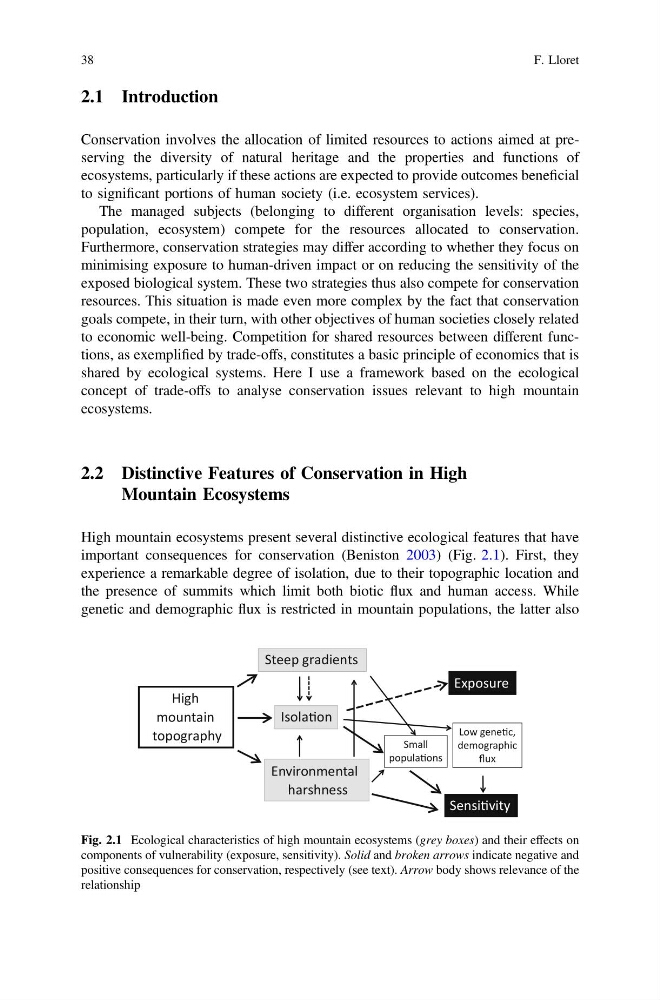
High mountain ecosystems present several distinctive ecological features that have
important consequences for conservation (Beniston 2003) (Fig. 2.1). First, they
experience a remarkable degree of isolation, due to their topographic location and
the presence of summits which limit both biotic flux and human access. While
genetic and demographic flux is restricted in mountain populations, the latter also
IsolaƟon
Environmental
harshness
Exposure
SensiƟvity
Low geneƟc,
demographic
flux
Small
populaƟons
Steep gradients
High
mountain
topography
Fig. 2.1 Ecological characteristics of high mountain ecosystems (grey boxes) and their effects on
components of vulnerability (exposure, sensitivity). Solid and broken arrows indicate negative and
positive consequences for conservation, respectively (see text). Arrow body shows relevance of the
relationship
38
F. Lloret
Conservation involves the allocation of limited resources to actions aimed at preserving the diversity of natural heritage and the properties and functions of
ecosystems, particularly if these actions are expected to provide outcomes beneficial
to significant portions of human society (i.e. ecosystem services).
The managed subjects (belonging to different organisation levels: species,
population, ecosystem) compete for the resources allocated to conservation.
Furthermore, conservation strategies may differ according to whether they focus on
minimising exposure to human-driven impact or on reducing the sensitivity of the
exposed biological system. These two strategies thus also compete for conservation
resources. This situation is made even more complex by the fact that conservation
goals compete, in their turn, with other objectives of human societies closely related
to economic well-being. Competition for shared resources between different functions, as exemplified by trade-offs, constitutes a basic principle of economics that is
shared by ecological systems. Here I use a framework based on the ecological
concept of trade-offs to analyse conservation issues relevant to high mountain
ecosystems.
2.2 Distinctive Features of Conservation in High
Mountain Ecosystems
High mountain ecosystems present several distinctive ecological features that have
important consequences for conservation (Beniston 2003) (Fig. 2.1). First, they
experience a remarkable degree of isolation, due to their topographic location and
the presence of summits which limit both biotic flux and human access. While
genetic and demographic flux is restricted in mountain populations, the latter also
IsolaƟon
Environmental
harshness
Exposure
SensiƟvity
Low geneƟc,
demographic
flux
Small
populaƟons
Steep gradients
High
mountain
topography
Fig. 2.1 Ecological characteristics of high mountain ecosystems (grey boxes) and their effects on
components of vulnerability (exposure, sensitivity). Solid and broken arrows indicate negative and
positive consequences for conservation, respectively (see text). Arrow body shows relevance of the
relationship
38
F. Lloret