

We analysed breeding parameters (during 1994–2011) and survival probabilities
(during 1987–2011) to determine if changes in the availability of food supply
and/or the effects of illegal poisoning are important anthropogenic mortality factors
affecting this population, and whether they can modify life-history traits in a
long-lived species. We tested the hypothesis that the reduction in the availability of
food resources in the ecosystem (as consequence of a sudden reduction of domestic
carcasses in the field from 2005 and the closure of several feeding stations) should
decrease survival probabilities, specially that of juveniles and subadults, which are
more dependent on this food resource than are older birds (Oro et al. 2008).
15.7.1 Influence of Health Policies on Demographic
Parameters
Between 1994 and 2011 we monitored 510 breeding attempts with a total of 298
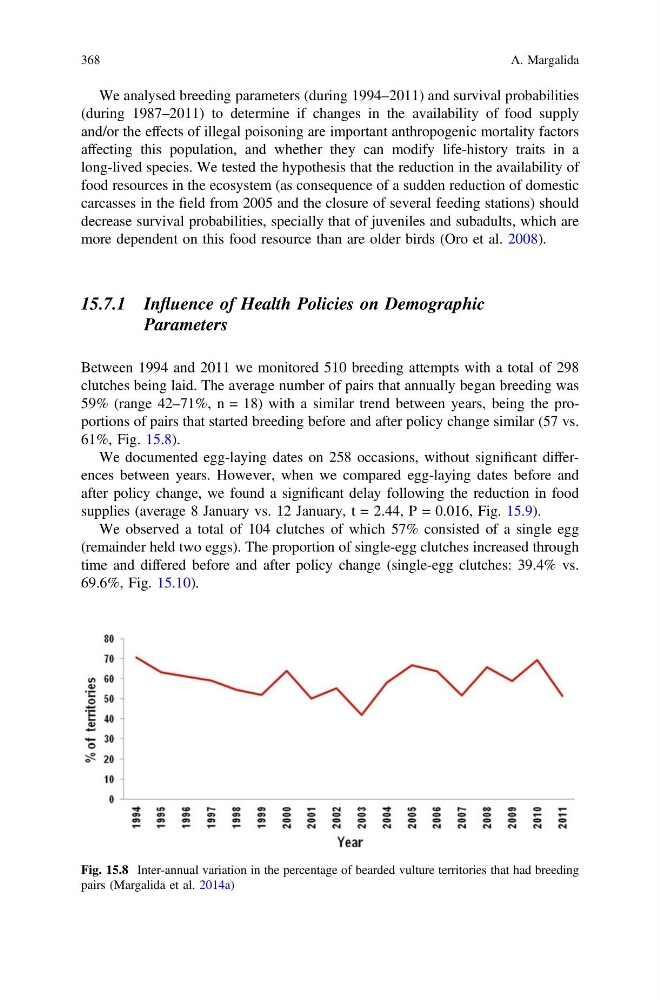
clutches being laid. The average number of pairs that annually began breeding was
59% (range 42–71%, n = 18) with a similar trend between years, being the proportions of pairs that started breeding before and after policy change similar (57 vs.
61%, Fig. 15.8).
We documented egg-laying dates on 258 occasions, without significant differences between years. However, when we compared egg-laying dates before and
after policy change, we found a significant delay following the reduction in food
supplies (average 8 January vs. 12 January, t = 2.44, P = 0.016, Fig. 15.9).
We observed a total of 104 clutches of which 57% consisted of a single egg
(remainder held two eggs). The proportion of single-egg clutches increased through
time and differed before and after policy change (single-egg clutches: 39.4% vs.
69.6%, Fig. 15.10).
Fig. 15.8 Inter-annual variation in the percentage of bearded vulture territories that had breeding
pairs (Margalida et al. 2014a)
368
A. Margalida
(during 1987–2011) to determine if changes in the availability of food supply
and/or the effects of illegal poisoning are important anthropogenic mortality factors
affecting this population, and whether they can modify life-history traits in a
long-lived species. We tested the hypothesis that the reduction in the availability of
food resources in the ecosystem (as consequence of a sudden reduction of domestic
carcasses in the field from 2005 and the closure of several feeding stations) should
decrease survival probabilities, specially that of juveniles and subadults, which are
more dependent on this food resource than are older birds (Oro et al. 2008).
15.7.1 Influence of Health Policies on Demographic
Parameters
Between 1994 and 2011 we monitored 510 breeding attempts with a total of 298
clutches being laid. The average number of pairs that annually began breeding was
59% (range 42–71%, n = 18) with a similar trend between years, being the proportions of pairs that started breeding before and after policy change similar (57 vs.
61%, Fig. 15.8).
We documented egg-laying dates on 258 occasions, without significant differences between years. However, when we compared egg-laying dates before and
after policy change, we found a significant delay following the reduction in food
supplies (average 8 January vs. 12 January, t = 2.44, P = 0.016, Fig. 15.9).
We observed a total of 104 clutches of which 57% consisted of a single egg
(remainder held two eggs). The proportion of single-egg clutches increased through
time and differed before and after policy change (single-egg clutches: 39.4% vs.
69.6%, Fig. 15.10).
Fig. 15.8 Inter-annual variation in the percentage of bearded vulture territories that had breeding
pairs (Margalida et al. 2014a)
368
A. Margalida