

food in areas where carcasses are poisoned or contaminated with veterinary drugs
(e.g. Gilbert et al. 2007), promoting the recolonization of abandoned areas (Mundy
et al. 1992) and aiding in reintroduction programmes (Chamberlain et al. 2005).
To our knowledge, the Spanish population of bearded vultures represents one of
the few cases for which both positive and negative outcomes of artificial feeding
sites have been carefully weighed using a population dynamics approach
(Fig. 15.7). Recent studies have shown that supplementary feeding can have several
adverse effects on this population such as territory compression and coexistence
between breeders and floaters (Carrete et al. 2006b; Margalida et al. 2008a), and
changes in the mating system reducing territory quality (because of intraspecific
interactions) and population productivity (Carrete et al. 2006a). Present results,
however, support their usefulness as temporal tools to maintain individuals while
more complex objectives such as the eradication of illegal poisoning from the field
are achieved. However, the maintenance of SFS should not distract managers from
prioritising the long-term viability of this and many other species by eradicating
illegal poison use. Taking into account that one of the main threats to this population is its restricted geographic range, SFS can be utilised as a very specific tool
for the recovery of the population in peripheral areas, to promote the colonisation of
suitable unoccupied areas outside the Pyrenees. Although beyond the scope of this
chapter and awaiting scientific support, this latter possibility should be considered a
potentially positive aspect of SFS on species conservation.
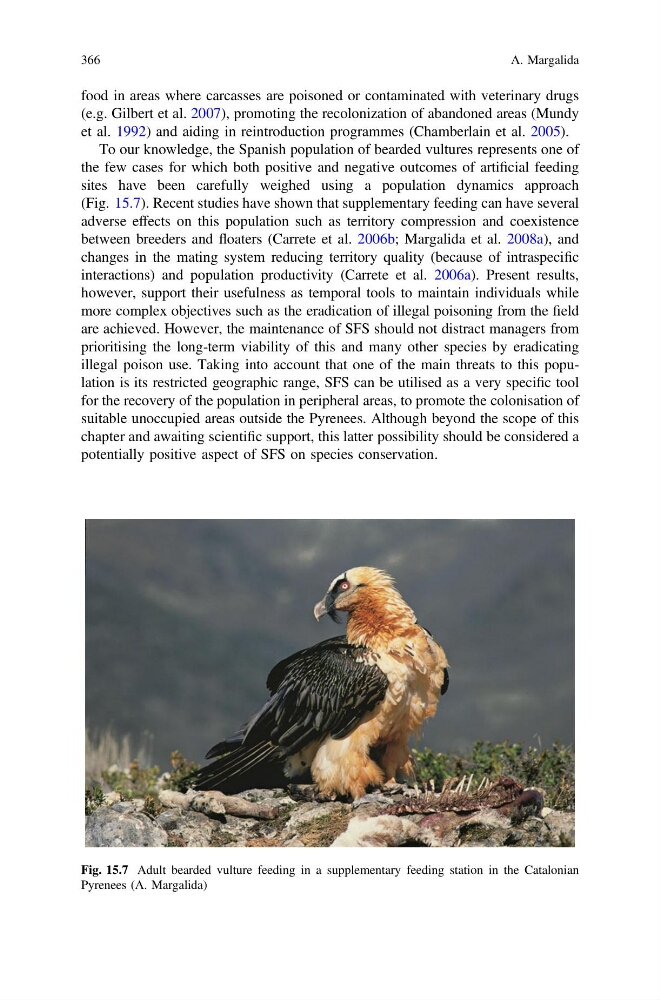
Fig. 15.7 Adult bearded vulture feeding in a supplementary feeding station in the Catalonian
Pyrenees (A. Margalida)
366
A. Margalida
(e.g. Gilbert et al. 2007), promoting the recolonization of abandoned areas (Mundy
et al. 1992) and aiding in reintroduction programmes (Chamberlain et al. 2005).
To our knowledge, the Spanish population of bearded vultures represents one of
the few cases for which both positive and negative outcomes of artificial feeding
sites have been carefully weighed using a population dynamics approach
(Fig. 15.7). Recent studies have shown that supplementary feeding can have several
adverse effects on this population such as territory compression and coexistence
between breeders and floaters (Carrete et al. 2006b; Margalida et al. 2008a), and
changes in the mating system reducing territory quality (because of intraspecific
interactions) and population productivity (Carrete et al. 2006a). Present results,
however, support their usefulness as temporal tools to maintain individuals while
more complex objectives such as the eradication of illegal poisoning from the field
are achieved. However, the maintenance of SFS should not distract managers from
prioritising the long-term viability of this and many other species by eradicating
illegal poison use. Taking into account that one of the main threats to this population is its restricted geographic range, SFS can be utilised as a very specific tool
for the recovery of the population in peripheral areas, to promote the colonisation of
suitable unoccupied areas outside the Pyrenees. Although beyond the scope of this
chapter and awaiting scientific support, this latter possibility should be considered a
potentially positive aspect of SFS on species conservation.
Fig. 15.7 Adult bearded vulture feeding in a supplementary feeding station in the Catalonian
Pyrenees (A. Margalida)
366
A. Margalida