

related to tourism (trampling, skiing, etc.) might become more severe if the alpine area
shrinks (Pickering et al. 2003; Rixen and Rolando 2013; Rixen et al. 2011).
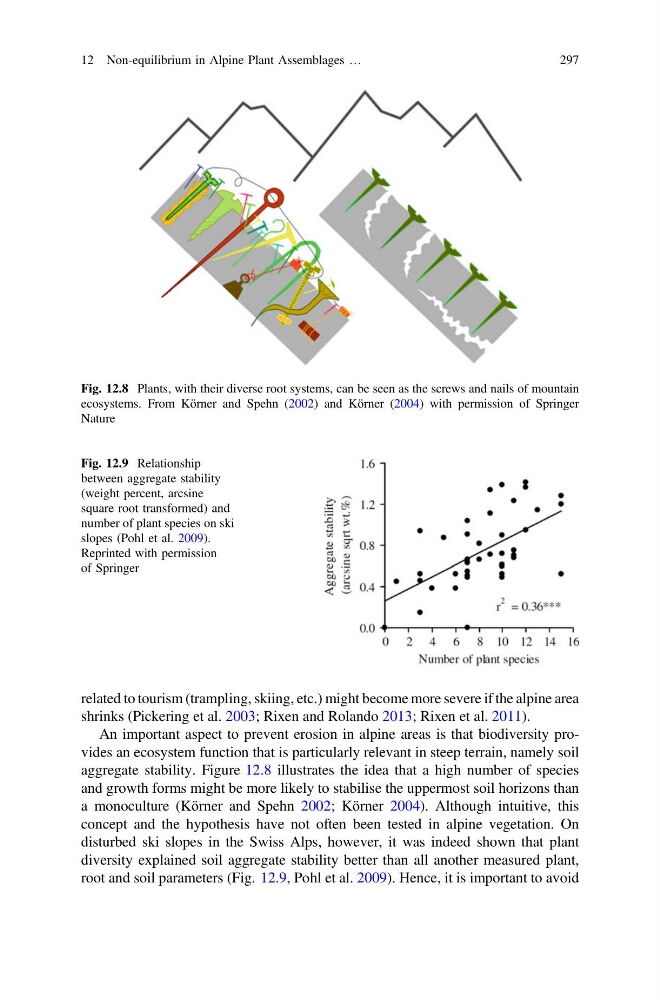
An important aspect to prevent erosion in alpine areas is that biodiversity provides an ecosystem function that is particularly relevant in steep terrain, namely soil
aggregate stability. Figure 12.8 illustrates the idea that a high number of species
and growth forms might be more likely to stabilise the uppermost soil horizons than
a monoculture (Körner and Spehn 2002; Körner 2004). Although intuitive, this
concept and the hypothesis have not often been tested in alpine vegetation. On
disturbed ski slopes in the Swiss Alps, however, it was indeed shown that plant
diversity explained soil aggregate stability better than all another measured plant,
root and soil parameters (Fig. 12.9, Pohl et al. 2009). Hence, it is important to avoid
Fig. 12.8 Plants, with their diverse root systems, can be seen as the screws and nails of mountain
ecosystems. From Körner and Spehn (2002) and Körner (2004) with permission of Springer
Nature
Fig. 12.9 Relationship
between aggregate stability
(weight percent, arcsine
square root transformed) and
number of plant species on ski
slopes (Pohl et al. 2009).
Reprinted with permission
of Springer
12 Non-equilibrium in Alpine Plant Assemblages …
297
shrinks (Pickering et al. 2003; Rixen and Rolando 2013; Rixen et al. 2011).
An important aspect to prevent erosion in alpine areas is that biodiversity provides an ecosystem function that is particularly relevant in steep terrain, namely soil
aggregate stability. Figure 12.8 illustrates the idea that a high number of species
and growth forms might be more likely to stabilise the uppermost soil horizons than
a monoculture (Körner and Spehn 2002; Körner 2004). Although intuitive, this
concept and the hypothesis have not often been tested in alpine vegetation. On
disturbed ski slopes in the Swiss Alps, however, it was indeed shown that plant
diversity explained soil aggregate stability better than all another measured plant,
root and soil parameters (Fig. 12.9, Pohl et al. 2009). Hence, it is important to avoid
Fig. 12.8 Plants, with their diverse root systems, can be seen as the screws and nails of mountain
ecosystems. From Körner and Spehn (2002) and Körner (2004) with permission of Springer
Nature
Fig. 12.9 Relationship
between aggregate stability
(weight percent, arcsine
square root transformed) and
number of plant species on ski
slopes (Pohl et al. 2009).
Reprinted with permission
of Springer
12 Non-equilibrium in Alpine Plant Assemblages …
297