

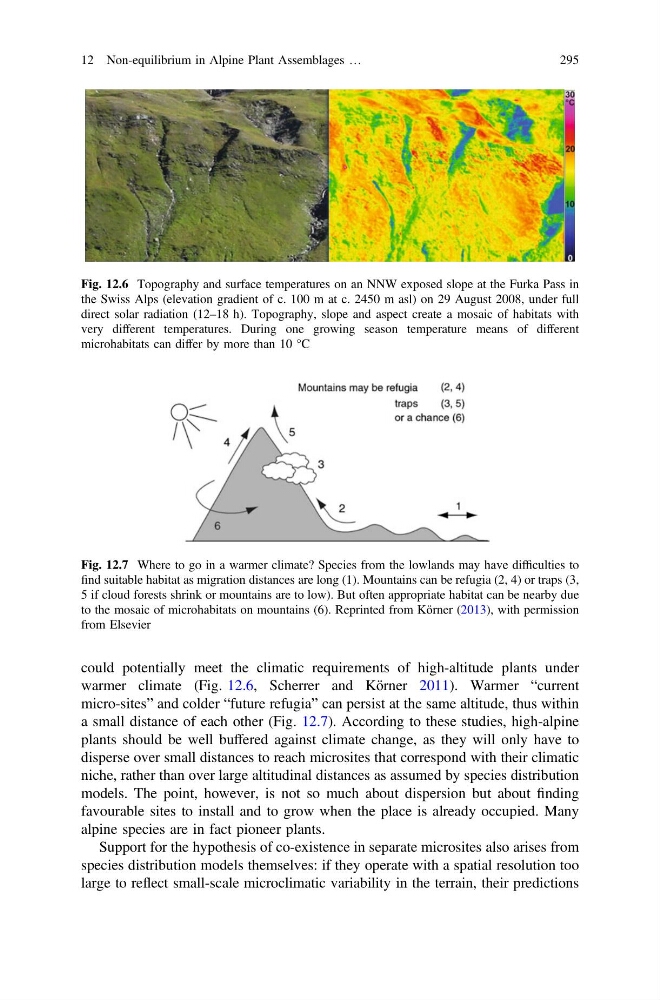
could potentially meet the climatic requirements of high-altitude plants under
warmer climate (Fig. 12.6, Scherrer and Körner 2011). Warmer “current
micro-sites” and colder “future refugia” can persist at the same altitude, thus within
a small distance of each other (Fig. 12.7). According to these studies, high-alpine
plants should be well buffered against climate change, as they will only have to
disperse over small distances to reach microsites that correspond with their climatic
niche, rather than over large altitudinal distances as assumed by species distribution
models. The point, however, is not so much about dispersion but about finding
favourable sites to install and to grow when the place is already occupied. Many
alpine species are in fact pioneer plants.
Support for the hypothesis of co-existence in separate microsites also arises from
species distribution models themselves: if they operate with a spatial resolution too
large to reflect small-scale microclimatic variability in the terrain, their predictions
Fig. 12.6 Topography and surface temperatures on an NNW exposed slope at the Furka Pass in
the Swiss Alps (elevation gradient of c. 100 m at c. 2450 m asl) on 29 August 2008, under full
direct solar radiation (12–18 h). Topography, slope and aspect create a mosaic of habitats with
very different temperatures. During one growing season temperature means of different
microhabitats can differ by more than 10 °C
Fig. 12.7 Where to go in a warmer climate? Species from the lowlands may have difficulties to
find suitable habitat as migration distances are long (1). Mountains can be refugia (2, 4) or traps (3,
5 if cloud forests shrink or mountains are to low). But often appropriate habitat can be nearby due
to the mosaic of microhabitats on mountains (6). Reprinted from Körner (2013), with permission
from Elsevier
12 Non-equilibrium in Alpine Plant Assemblages …
295
warmer climate (Fig. 12.6, Scherrer and Körner 2011). Warmer “current
micro-sites” and colder “future refugia” can persist at the same altitude, thus within
a small distance of each other (Fig. 12.7). According to these studies, high-alpine
plants should be well buffered against climate change, as they will only have to
disperse over small distances to reach microsites that correspond with their climatic
niche, rather than over large altitudinal distances as assumed by species distribution
models. The point, however, is not so much about dispersion but about finding
favourable sites to install and to grow when the place is already occupied. Many
alpine species are in fact pioneer plants.
Support for the hypothesis of co-existence in separate microsites also arises from
species distribution models themselves: if they operate with a spatial resolution too
large to reflect small-scale microclimatic variability in the terrain, their predictions
Fig. 12.6 Topography and surface temperatures on an NNW exposed slope at the Furka Pass in
the Swiss Alps (elevation gradient of c. 100 m at c. 2450 m asl) on 29 August 2008, under full
direct solar radiation (12–18 h). Topography, slope and aspect create a mosaic of habitats with
very different temperatures. During one growing season temperature means of different
microhabitats can differ by more than 10 °C
Fig. 12.7 Where to go in a warmer climate? Species from the lowlands may have difficulties to
find suitable habitat as migration distances are long (1). Mountains can be refugia (2, 4) or traps (3,
5 if cloud forests shrink or mountains are to low). But often appropriate habitat can be nearby due
to the mosaic of microhabitats on mountains (6). Reprinted from Körner (2013), with permission
from Elsevier
12 Non-equilibrium in Alpine Plant Assemblages …
295