

Although prevention is more expensive than paying compensation, it is better
than paying for the damage caused by bears because it prevents social conflict.
Keeping attacks and damage to a minimum is required to avoid social conflicts in
regards to the presence of brown bears. Moreover, the measures applied for protection against the brown bear also set a positive precedent for the current reintroduction of the wolf and the possible future reintroduction of the lynx. The flock
protection measures applied can be useful for brown bears, wolves, lynx and even
feral dogs. In Catalonia, the Decree 176 of 31 July 2007 and Order AAM/147 of 8
May 2014 provide legislation on the payment of compensation for damage caused
by protected species: the brown bear, wolf and vulture. The aim is to increase the
density of brown bears (i.e. the number of animals in the geographic area occupied)
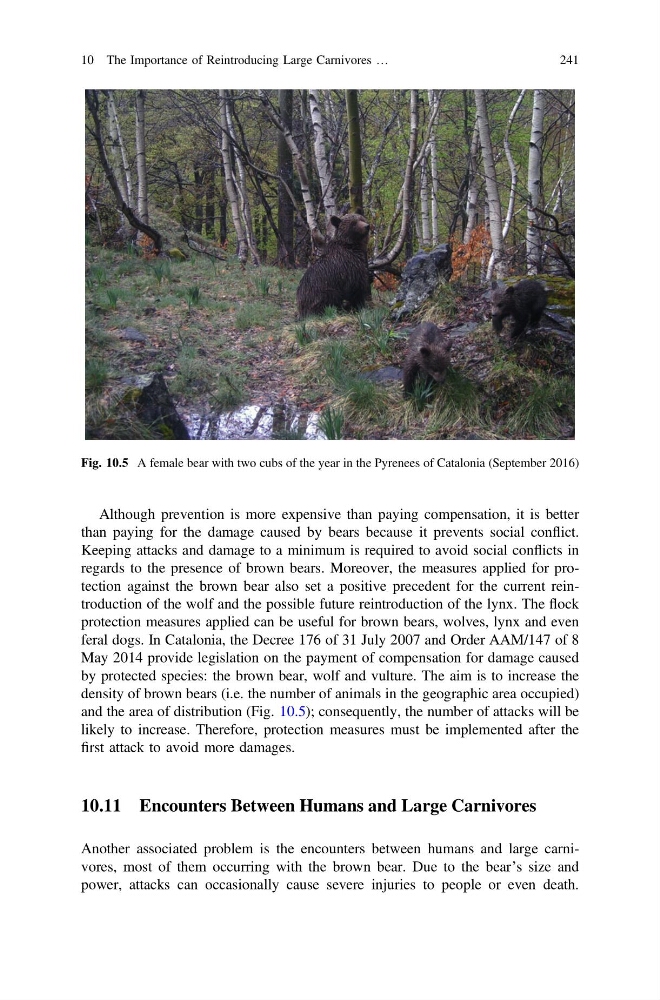
and the area of distribution (Fig. 10.5); consequently, the number of attacks will be
likely to increase. Therefore, protection measures must be implemented after the
first attack to avoid more damages.
10.11 Encounters Between Humans and Large Carnivores
Another associated problem is the encounters between humans and large carnivores, most of them occurring with the brown bear. Due to the bear’s size and
power, attacks can occasionally cause severe injuries to people or even death.
Fig. 10.5 A female bear with two cubs of the year in the Pyrenees of Catalonia (September 2016)
10 The Importance of Reintroducing Large Carnivores …
241
than paying for the damage caused by bears because it prevents social conflict.
Keeping attacks and damage to a minimum is required to avoid social conflicts in
regards to the presence of brown bears. Moreover, the measures applied for protection against the brown bear also set a positive precedent for the current reintroduction of the wolf and the possible future reintroduction of the lynx. The flock
protection measures applied can be useful for brown bears, wolves, lynx and even
feral dogs. In Catalonia, the Decree 176 of 31 July 2007 and Order AAM/147 of 8
May 2014 provide legislation on the payment of compensation for damage caused
by protected species: the brown bear, wolf and vulture. The aim is to increase the
density of brown bears (i.e. the number of animals in the geographic area occupied)
and the area of distribution (Fig. 10.5); consequently, the number of attacks will be
likely to increase. Therefore, protection measures must be implemented after the
first attack to avoid more damages.
10.11 Encounters Between Humans and Large Carnivores
Another associated problem is the encounters between humans and large carnivores, most of them occurring with the brown bear. Due to the bear’s size and
power, attacks can occasionally cause severe injuries to people or even death.
Fig. 10.5 A female bear with two cubs of the year in the Pyrenees of Catalonia (September 2016)
10 The Importance of Reintroducing Large Carnivores …
241