

The European lynx once lived in the Pyrenees (Beaufort 1965; Arribas 2004;
Rodríguez-Varela et al. 2015), but probably disappeared in the second half of
twentieth century (Ruiz-Olmo 2001). Today, there is no lynx in the Pyrenees, but a
European lynx release pilot project is planned in Catalonian in coming years
(Ruiz-Olmo et al. 2006; Magrama 2015a).
10.8 Problems Generated by the Presence of the Brown
Bear and Wolf in Catalonia and the Pyrenees
The brown bear and wolf created problems in the Pyrenees through their attacks on
livestock (sheep and goats) and beehives such as social and political conflict, fear
among the locals and tourists, and their competition with hunters. The objectives of
the Catalan government is: (1) to preserve large carnivore populations; (2) to
conserve mountain livestock (sheep, goats, cows and horses) since the maintenance
of the mosaic landscape (pastures and forests) has an important input in the
economy of the mountain communities and (3) to protect mountain beekeeping
activities (apiculture) because it is important for the economy of Catalan agricultural activity and because cross-pollination of mountain flora is essential for the
ecosystem.
10.9 Damage to Livestock and Beehives
Brown bears prey on beehives and livestock (sheep and goats). They can sometimes
chase away horses and cows and even wound them. Wolves prey on livestock
(sheep, cows and calves, foals and shepherd dogs) and lynx also prey on livestock,
mainly sheep. Between 1996 and 2015, 320 bear attacks in Catalonia caused 629
victims (369 dead sheep and goats and 249 damaged beehives) (Fig. 10.3). The
annual average was 16 attacks (SD = 6.44) and 31.45 victims (SD = 18.57). The
Catalonian government and other public administrations paid an annual average of
€5990 (SD = 3045.04) in compensation. This figure only includes compensation
for certified bear attacks, but not compensation for political or social reasons.
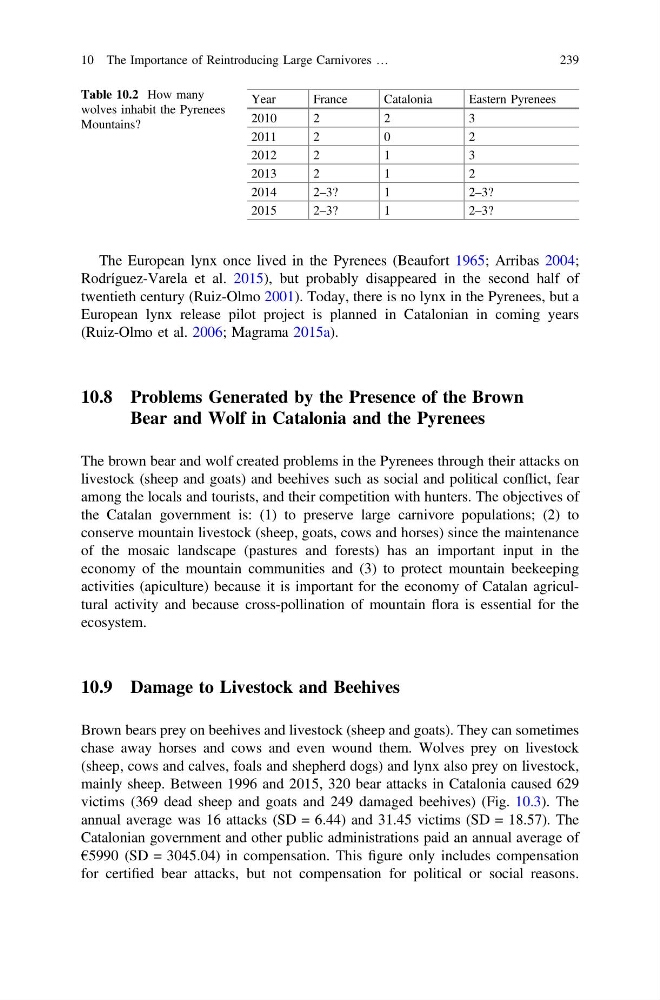
Table 10.2 How many
wolves inhabit the Pyrenees
Mountains?
Year
France
Catalonia
Eastern Pyrenees
2010
2
2
3
2011
2
0
2
2012
2
1
3
2013
2
1
2
2014
2–3?
1
2–3?
2015
2–3?
1
2–3?
10 The Importance of Reintroducing Large Carnivores …
239
Rodríguez-Varela et al. 2015), but probably disappeared in the second half of
twentieth century (Ruiz-Olmo 2001). Today, there is no lynx in the Pyrenees, but a
European lynx release pilot project is planned in Catalonian in coming years
(Ruiz-Olmo et al. 2006; Magrama 2015a).
10.8 Problems Generated by the Presence of the Brown
Bear and Wolf in Catalonia and the Pyrenees
The brown bear and wolf created problems in the Pyrenees through their attacks on
livestock (sheep and goats) and beehives such as social and political conflict, fear
among the locals and tourists, and their competition with hunters. The objectives of
the Catalan government is: (1) to preserve large carnivore populations; (2) to
conserve mountain livestock (sheep, goats, cows and horses) since the maintenance
of the mosaic landscape (pastures and forests) has an important input in the
economy of the mountain communities and (3) to protect mountain beekeeping
activities (apiculture) because it is important for the economy of Catalan agricultural activity and because cross-pollination of mountain flora is essential for the
ecosystem.
10.9 Damage to Livestock and Beehives
Brown bears prey on beehives and livestock (sheep and goats). They can sometimes
chase away horses and cows and even wound them. Wolves prey on livestock
(sheep, cows and calves, foals and shepherd dogs) and lynx also prey on livestock,
mainly sheep. Between 1996 and 2015, 320 bear attacks in Catalonia caused 629
victims (369 dead sheep and goats and 249 damaged beehives) (Fig. 10.3). The
annual average was 16 attacks (SD = 6.44) and 31.45 victims (SD = 18.57). The
Catalonian government and other public administrations paid an annual average of
€5990 (SD = 3045.04) in compensation. This figure only includes compensation
for certified bear attacks, but not compensation for political or social reasons.
Table 10.2 How many
wolves inhabit the Pyrenees
Mountains?
Year
France
Catalonia
Eastern Pyrenees
2010
2
2
3
2011
2
0
2
2012
2
1
3
2013
2
1
2
2014
2–3?
1
2–3?
2015
2–3?
1
2–3?
10 The Importance of Reintroducing Large Carnivores …
239