

resources and space with humans and continue to do so. Some can be dangerous to
humans and are considered fearsome. Human attitudes are an important component
of large carnivore management and conservation (Piédallu et al. 2016). Attitudes
towards large carnivores of humans co-inhabiting places with them are not always
of acceptance.
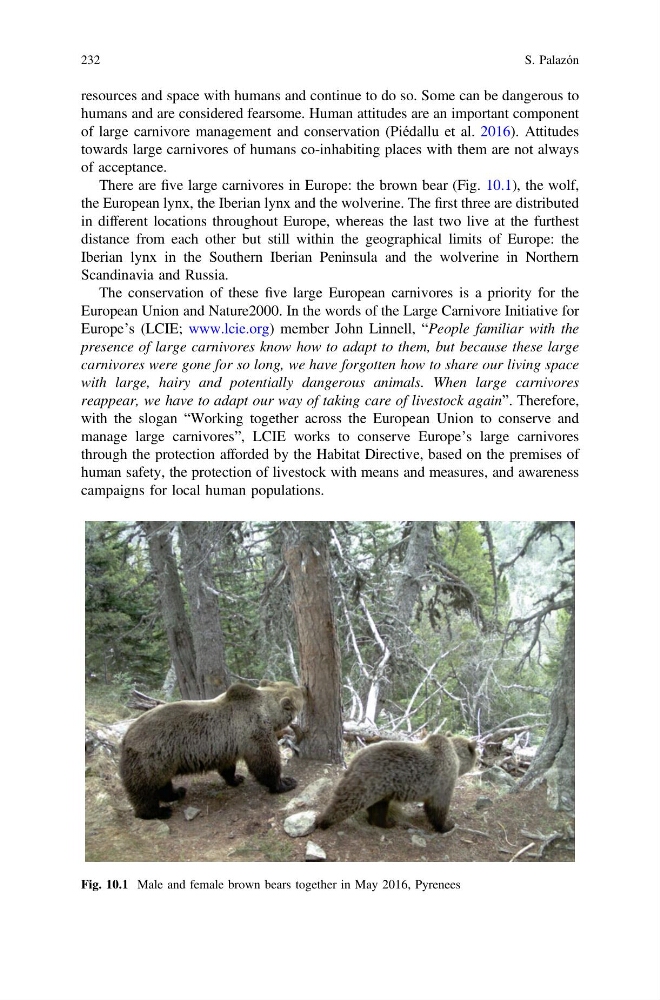
There are five large carnivores in Europe: the brown bear (Fig. 10.1), the wolf,
the European lynx, the Iberian lynx and the wolverine. The first three are distributed
in different locations throughout Europe, whereas the last two live at the furthest
distance from each other but still within the geographical limits of Europe: the
Iberian lynx in the Southern Iberian Peninsula and the wolverine in Northern
Scandinavia and Russia.
The conservation of these five large European carnivores is a priority for the
European Union and Nature2000. In the words of the Large Carnivore Initiative for
Europe’s (LCIE; www.lcie.org) member John Linnell, “People familiar with the
presence of large carnivores know how to adapt to them, but because these large
carnivores were gone for so long, we have forgotten how to share our living space
with large, hairy and potentially dangerous animals. When large carnivores
reappear, we have to adapt our way of taking care of livestock again”. Therefore,
with the slogan “Working together across the European Union to conserve and
manage large carnivores”, LCIE works to conserve Europe’s large carnivores
through the protection afforded by the Habitat Directive, based on the premises of
human safety, the protection of livestock with means and measures, and awareness
campaigns for local human populations.
Fig. 10.1 Male and female brown bears together in May 2016, Pyrenees
232
S. Palazón
humans and are considered fearsome. Human attitudes are an important component
of large carnivore management and conservation (Piédallu et al. 2016). Attitudes
towards large carnivores of humans co-inhabiting places with them are not always
of acceptance.
There are five large carnivores in Europe: the brown bear (Fig. 10.1), the wolf,
the European lynx, the Iberian lynx and the wolverine. The first three are distributed
in different locations throughout Europe, whereas the last two live at the furthest
distance from each other but still within the geographical limits of Europe: the
Iberian lynx in the Southern Iberian Peninsula and the wolverine in Northern
Scandinavia and Russia.
The conservation of these five large European carnivores is a priority for the
European Union and Nature2000. In the words of the Large Carnivore Initiative for
Europe’s (LCIE; www.lcie.org) member John Linnell, “People familiar with the
presence of large carnivores know how to adapt to them, but because these large
carnivores were gone for so long, we have forgotten how to share our living space
with large, hairy and potentially dangerous animals. When large carnivores
reappear, we have to adapt our way of taking care of livestock again”. Therefore,
with the slogan “Working together across the European Union to conserve and
manage large carnivores”, LCIE works to conserve Europe’s large carnivores
through the protection afforded by the Habitat Directive, based on the premises of
human safety, the protection of livestock with means and measures, and awareness
campaigns for local human populations.
Fig. 10.1 Male and female brown bears together in May 2016, Pyrenees
232
S. Palazón