

9.3.2 Climate
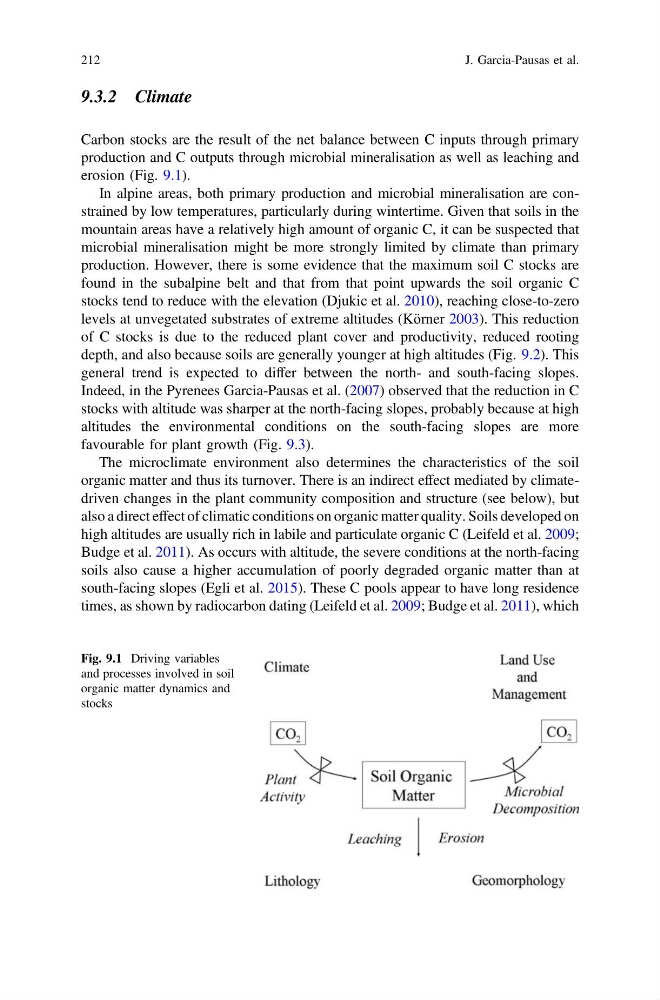
Carbon stocks are the result of the net balance between C inputs through primary
production and C outputs through microbial mineralisation as well as leaching and
erosion (Fig. 9.1).
In alpine areas, both primary production and microbial mineralisation are constrained by low temperatures, particularly during wintertime. Given that soils in the
mountain areas have a relatively high amount of organic C, it can be suspected that
microbial mineralisation might be more strongly limited by climate than primary
production. However, there is some evidence that the maximum soil C stocks are
found in the subalpine belt and that from that point upwards the soil organic C
stocks tend to reduce with the elevation (Djukic et al. 2010), reaching close-to-zero
levels at unvegetated substrates of extreme altitudes (Körner 2003). This reduction
of C stocks is due to the reduced plant cover and productivity, reduced rooting
depth, and also because soils are generally younger at high altitudes (Fig. 9.2). This
general trend is expected to differ between the north- and south-facing slopes.
Indeed, in the Pyrenees Garcia-Pausas et al. (2007) observed that the reduction in C
stocks with altitude was sharper at the north-facing slopes, probably because at high
altitudes the environmental conditions on the south-facing slopes are more
favourable for plant growth (Fig. 9.3).
The microclimate environment also determines the characteristics of the soil
organic matter and thus its turnover. There is an indirect effect mediated by climatedriven changes in the plant community composition and structure (see below), but
also a direct effect of climatic conditions on organic matter quality. Soils developed on
high altitudes are usually rich in labile and particulate organic C (Leifeld et al. 2009;
Budge et al. 2011). As occurs with altitude, the severe conditions at the north-facing
soils also cause a higher accumulation of poorly degraded organic matter than at
south-facing slopes (Egli et al. 2015). These C pools appear to have long residence
times, as shown by radiocarbon dating (Leifeld et al. 2009; Budge et al. 2011), which
Fig. 9.1 Driving variables
and processes involved in soil
organic matter dynamics and
stocks
212
J. Garcia-Pausas et al.
Carbon stocks are the result of the net balance between C inputs through primary
production and C outputs through microbial mineralisation as well as leaching and
erosion (Fig. 9.1).
In alpine areas, both primary production and microbial mineralisation are constrained by low temperatures, particularly during wintertime. Given that soils in the
mountain areas have a relatively high amount of organic C, it can be suspected that
microbial mineralisation might be more strongly limited by climate than primary
production. However, there is some evidence that the maximum soil C stocks are
found in the subalpine belt and that from that point upwards the soil organic C
stocks tend to reduce with the elevation (Djukic et al. 2010), reaching close-to-zero
levels at unvegetated substrates of extreme altitudes (Körner 2003). This reduction
of C stocks is due to the reduced plant cover and productivity, reduced rooting
depth, and also because soils are generally younger at high altitudes (Fig. 9.2). This
general trend is expected to differ between the north- and south-facing slopes.
Indeed, in the Pyrenees Garcia-Pausas et al. (2007) observed that the reduction in C
stocks with altitude was sharper at the north-facing slopes, probably because at high
altitudes the environmental conditions on the south-facing slopes are more
favourable for plant growth (Fig. 9.3).
The microclimate environment also determines the characteristics of the soil
organic matter and thus its turnover. There is an indirect effect mediated by climatedriven changes in the plant community composition and structure (see below), but
also a direct effect of climatic conditions on organic matter quality. Soils developed on
high altitudes are usually rich in labile and particulate organic C (Leifeld et al. 2009;
Budge et al. 2011). As occurs with altitude, the severe conditions at the north-facing
soils also cause a higher accumulation of poorly degraded organic matter than at
south-facing slopes (Egli et al. 2015). These C pools appear to have long residence
times, as shown by radiocarbon dating (Leifeld et al. 2009; Budge et al. 2011), which
Fig. 9.1 Driving variables
and processes involved in soil
organic matter dynamics and
stocks
212
J. Garcia-Pausas et al.