

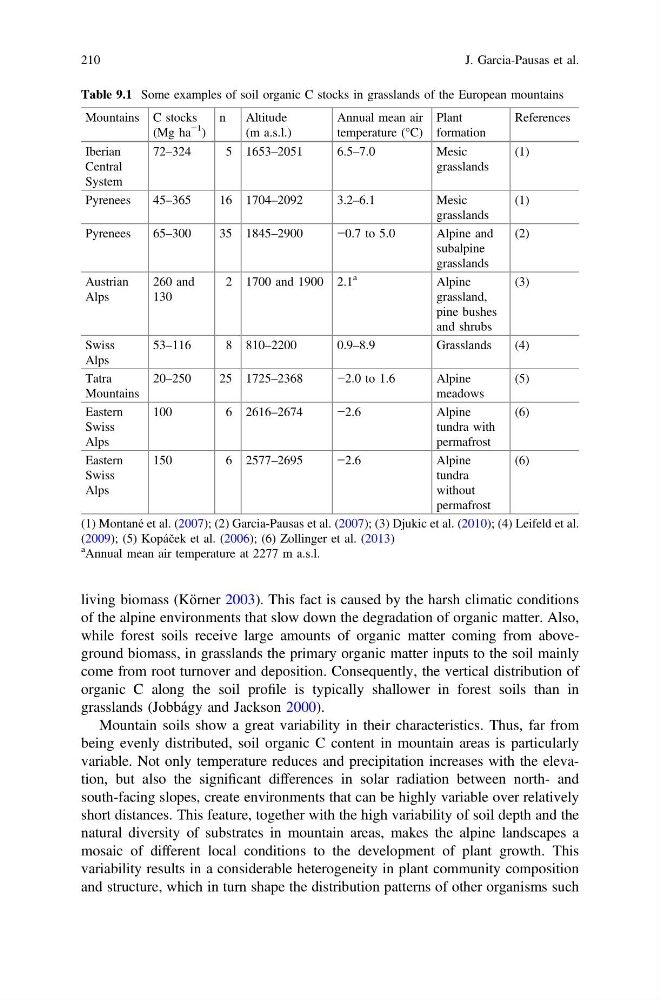
Table 9.1 Some examples of soil organic C stocks in grasslands of the European mountains
Mountains C stocks
(Mg ha
−1
)
n
Altitude
(m a.s.l.)
Annual mean air
temperature (°C)
Plant
formation
References
Iberian
Central
System
72–324
5 1653–2051
6.5–7.0
Mesic
grasslands
(1)
Pyrenees
45–365
16 1704–2092
3.2–6.1
Mesic
grasslands
(1)
Pyrenees
65–300
35 1845–2900
−0.7 to 5.0
Alpine and
subalpine
grasslands
(2)
Austrian
Alps
260 and
130
2 1700 and 1900 2.1
a
Alpine
grassland,
pine bushes
and shrubs
(3)
Swiss
Alps
53–116
8 810–2200
0.9–8.9
Grasslands
(4)
Tatra
Mountains
20–250
25 1725–2368
−2.0 to 1.6
Alpine
meadows
(5)
Eastern
Swiss
Alps
100
6 2616–2674
−2.6
Alpine
tundra with
permafrost
(6)
Eastern
Swiss
Alps
150
6 2577–2695
−2.6
Alpine
tundra
without
permafrost
(6)
(1) Montané et al. (2007); (2) Garcia-Pausas et al. (2007); (3) Djukic et al. (2010); (4) Leifeld et al.
(2009); (5) Kopáček et al. (2006); (6) Zollinger et al. (2013)
a Annual mean air temperature at 2277 m a.s.l.
living biomass (Körner 2003). This fact is caused by the harsh climatic conditions
of the alpine environments that slow down the degradation of organic matter. Also,
while forest soils receive large amounts of organic matter coming from aboveground biomass, in grasslands the primary organic matter inputs to the soil mainly
come from root turnover and deposition. Consequently, the vertical distribution of
organic C along the soil profile is typically shallower in forest soils than in
grasslands (Jobbágy and Jackson 2000).
Mountain soils show a great variability in their characteristics. Thus, far from
being evenly distributed, soil organic C content in mountain areas is particularly
variable. Not only temperature reduces and precipitation increases with the elevation, but also the significant differences in solar radiation between north- and
south-facing slopes, create environments that can be highly variable over relatively
short distances. This feature, together with the high variability of soil depth and the
natural diversity of substrates in mountain areas, makes the alpine landscapes a
mosaic of different local conditions to the development of plant growth. This
variability results in a considerable heterogeneity in plant community composition
and structure, which in turn shape the distribution patterns of other organisms such
210
J. Garcia-Pausas et al.
Mountains C stocks
(Mg ha
−1
)
n
Altitude
(m a.s.l.)
Annual mean air
temperature (°C)
Plant
formation
References
Iberian
Central
System
72–324
5 1653–2051
6.5–7.0
Mesic
grasslands
(1)
Pyrenees
45–365
16 1704–2092
3.2–6.1
Mesic
grasslands
(1)
Pyrenees
65–300
35 1845–2900
−0.7 to 5.0
Alpine and
subalpine
grasslands
(2)
Austrian
Alps
260 and
130
2 1700 and 1900 2.1
a
Alpine
grassland,
pine bushes
and shrubs
(3)
Swiss
Alps
53–116
8 810–2200
0.9–8.9
Grasslands
(4)
Tatra
Mountains
20–250
25 1725–2368
−2.0 to 1.6
Alpine
meadows
(5)
Eastern
Swiss
Alps
100
6 2616–2674
−2.6
Alpine
tundra with
permafrost
(6)
Eastern
Swiss
Alps
150
6 2577–2695
−2.6
Alpine
tundra
without
permafrost
(6)
(1) Montané et al. (2007); (2) Garcia-Pausas et al. (2007); (3) Djukic et al. (2010); (4) Leifeld et al.
(2009); (5) Kopáček et al. (2006); (6) Zollinger et al. (2013)
a Annual mean air temperature at 2277 m a.s.l.
living biomass (Körner 2003). This fact is caused by the harsh climatic conditions
of the alpine environments that slow down the degradation of organic matter. Also,
while forest soils receive large amounts of organic matter coming from aboveground biomass, in grasslands the primary organic matter inputs to the soil mainly
come from root turnover and deposition. Consequently, the vertical distribution of
organic C along the soil profile is typically shallower in forest soils than in
grasslands (Jobbágy and Jackson 2000).
Mountain soils show a great variability in their characteristics. Thus, far from
being evenly distributed, soil organic C content in mountain areas is particularly
variable. Not only temperature reduces and precipitation increases with the elevation, but also the significant differences in solar radiation between north- and
south-facing slopes, create environments that can be highly variable over relatively
short distances. This feature, together with the high variability of soil depth and the
natural diversity of substrates in mountain areas, makes the alpine landscapes a
mosaic of different local conditions to the development of plant growth. This
variability results in a considerable heterogeneity in plant community composition
and structure, which in turn shape the distribution patterns of other organisms such
210
J. Garcia-Pausas et al.